Showing posts with label Mesopotamia. Show all posts

Mesopotamia History Co-op - Writing Assignments

Although this year the kids are writing about any topic they choose, last year they completed many writing assignments in conjunction with our Mesopotamia/Persia studies.


Mesopotamia
- Write about the differences between Viking, Celtic, Scythian and Persian houses.
- Write about clothing in ancient Mesopotamia. How was it made? What did they wear?
- Create a timeline for Mesopotamia detailing the six most important events. Illustrate your timeline.

Sumarians
- How did Sumerian inventions change the way people lived?
- What job would you like to have had in Sumer? Why?

Marsh Arabs
- Why can't people live on the Marshes in southern Iraq when there is no water?


Cyrus the Great
- What do you think are the five most important human rights every person should have? Why?
- Pretend you are interviewing Cyrus the Great. Write down at least five questions and his answers.

Darius
- Write about Darius' Canal in Egypt. Why was it significant? How did they build it?
- Pretend you are entering Persepolis for the first time. Describe in detail what you see.
- How were the Spartans different from the Persians?
- The Royal Road - Why was it important? How was it like the Pony Express? How is it like our modern highway system?
- Create a timeline detailing the events of the Battle of Marathon.


Xerxes
- Write about how Celtic Art is different from Persian Art.
- Write about how Celtic society is different from Persian society.
- Write about the most interesting Persian King.


Mesopotamia Unit Study Resources

Here are the books and videos we enjoyed in conjunction with our Mesopotamia/Persia Unit Study.


Mesopotamia

Mesopotamia From Nomads to Farmers is a 14 minute kids cartoon that provides a nice overview of the time period.
Ancient Mesopotamia - Short Summary Video

Sumarians

Gilgamesh the King (The Gilgamesh Trilogy) tells the story of the most famous Sumerian legend. In the Last Quest of Gilgamesh, as Gilgamesh searches for immortality he has several adventures. Many of them remind me of the adventures Odysseus had in the Odyssey. 

There is a cartoon version of The Epic of Gilgamesh on youtube that is also nice for kids.
Lost Civilisations relates many events of the bible to the Sumarians and Babylonians.
Sumer, The first Civilization
Rules for the Game of Ur - The game of Ur was one of the oldest games ever discovered, and it is fun to play today.

Marsh Arabs

Natural World Special Miracle in the Marshes of Iraq is a video which tells the story of the modern draining and rebuilding of the Marsh lands in Iraq. It's interesting because the people live today in much the same ways as they di 3000 years ago.
Mudhif - Short Reed House Video

Babylon

Babylon was a powerful empire at two different times during Mesopotamian history. The first time Hammurabi was a great leader who wrote down the laws of the land.
Law Code Stele of Hammurabi

Hittites

The Lords of Hattusa describes the capital city of the Hittites and how their civilizations was rediscovered.

Assyrians

The Assyrians Masters of War - This 30 minute video is a good one for adults.


Hanging Gardens of Babylon

During the second Babylonian empire Nebachadnezzer freed the Jews and built the hanging gardens. This was the time period the great Ishtar gate was built.
The Babylon Mystery (Nebachadnezzer) is a one hour video which tells the story of Babylon.
Hanging Gardens of Babylon - video on the watering of the Hanging Gardens
Gift for a Queen - Short video on the hanging gardens of Babylon.
Ishtar Gate and Processional Way - Short video on the Ishtar Gate

Persia

The Engineering an Empire series of videos from the History Channel is a fun introduction to historical cultures of the past. We watched them when studying Ancient Greece and revisited the series for our study of Persia.
Engineering an Empire, Alexander the Great - The Persian Empire ended with the invasion of Alexander the Great. This video describes the numerous engineering feats Alexander conquered while conquering the east.
Persepolis was one of the capital cities of the Persian Empire. The city was a collection of palaces and one of the riches places in the world. We found two wonderful videos on Persepolis.
Persepolis
Persepolis - Lost Worlds

The king's treasured diamond which casts colors throughout the room is stolen in The Legend of the Persian Carpet by Tomie de Paola. The king is very sad and leaves the kingdom. The workers and apprentices figure out a way to get the king to come back. This delightful picture book is good for elementary age kids.

Shadow Spinner provides readers a glimpse into life in a Harem of the Persian kings. My eleven year old and I enjoyed reading this book together.

We checked out several Arabian Nights books. My eleven year old who is a very strong reader highly recommends Tales from the Arabian Nights by James Riordan. This was by far her favorite. She read it from cover to cover.


Xerses - Persia Unit Study - Weaving for Kids

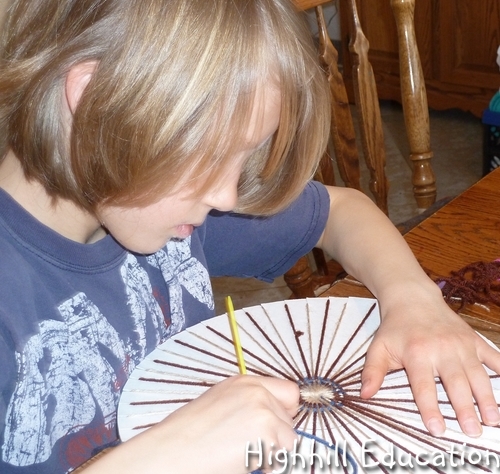
Week 4: We wove Persian carpets.

Xerxes was the last great Persian king. His soldiers crossed from Asia into Europe across the Hellespont (Turkey) on a bridge of boats. When a storm broke up the first bridge, he had his soldiers whip the water to punish it. Unfortunately for Xerxes, his immortal soldiers, which were though invincible, were defeated by the Greeks. The brave 300 is one of the most famous Spartan stories from history.

After learning a bit about Xerxes, we read a legend about Persian carpets. In The Legend of the Persian Carpet the king is very sad after his prized diamond is stolen. He misses the beautiful rainbow patterns created when light was reflected through the diamond. Carpets were very important to the ancient Persians and are still very important today.

For our weaving project we managed to use five different style looms with six children. 

Here are two great videos for weaving on a simple cardboard loom.
Basic Weaving
Simple Patterns and Designs

The circular loom was created in a similar manner. There is a small hole in the center of the cardboard circle.

This wooden, store-bought loom is similar to the Harrisville Designs Pegloom.

This loom was created from a shoe box lid by adding slits in the top of the cardboard. It functions just as well as the wooden loom.

The Harrisville Designs Style A Easyweaver is a little more advanced. This loom can be used to create items such as scarves and table runners.

The completed weavings were used as doll blankets, wall hangings, and coin purses.

If you haven't signed up to follow Highhill Education by email now would be a great time. Ancient Rome is coming next. Look for the sign-up bar on the right-hand side of the blog.


This post is linked to: 

* I did not receive any compensation for this recommendation. I'm just a homeschooling mom who has found many products that I like. If you're interested in the products I recommend on this blog I want to make it easy for you to find them. 
** I am an Amazon associate and receive a small portion of the sales on orders made after clicking in from this site, which I promptly spend on homeschooling books and supplies for my children.

Persia Unit Study - Darius - Persepolis

Week 2: We made a three dimensional model of the Hall of One Hundred Columns.

Persepolis was a palace city built for the kings of Persia. Located in modern day Iran, the sight contained several different castles. One of the castles was known as the Hall of 100 Columns and functioned as a greeting hall for the King to greet his Satraps (governors). They came from all over the empire bearing gifts. We watched this video on Persepolis.


Then the kids worked together to create this model of the Hall of 100 Columns using Google Sketch-Up. They learned about the standards library, patterning features and adding material painted surfaces during the process. The columns were actually constructed from black marble and had bulls at the tops.

They found these columns in the standards library and used them instead. They also found the throne in the standards library.

After inserting one column, they copied it ten times to create a row and then copied all ten, ten more times to create 100. The floor was covered with a large carpet, so they painted their floor to look like a carpet too.

To see more of our history activities please visit our history page.


This post is linked to:
Show and Tell
Show and Share
Relentlessly Fun
Hip Homeschool Hop
Montessori Monday
Living and Learning at Home

Cyrus the Great, Zoroaster, Sacred Fire Jars

Persia Unit Study - Week 1 - We made sacred fire jars.

Cyrus the Great united the Persians and Medians and became the first great king of Persia. He was an incredibly just ruler and was known to the Greeks as Cyrus the Law-Giver. He freed the Jews in Babylon and declared human rights for all people. The human rights were even written down on a cylindrical rock which now resides at the British Museum in London.

The Engineering an Empire series is wonderful and they have an episode on Persia. The Royal Road discussed in the video still exists today.

During the time of Cyrus the Great many people practiced the religion of Zarathustra. The religion has a lot in common with modern Hinduism. The people were taught to think good thoughts, do good deeds and use kind words. Since they held fire sacred and purified themselves in the smoke of the sacred fire we made sacred fire lanterns for our craft.

 The kids began by painting the inside of a glass jar.

Then the jars were decorated with glitter glue. 


That's it! I love simple projects.

Tunjur! Tunjur! Tunjur!: A Palestinian Tale is a story that comes from the Persian Empire. A woman who really wants a child ends up with a pot which does some stealing. The story is resolved when the pot is filled with something quite undesirable. 

To see our projects from this area of the world before the Persian Empire, please visit our History Page.


Hanging Gardens of Babylon - Pulleys

Week 9: We created a pulley system like one that may have been used to water the Hanging Gardens of Babylon.

There are three different types of simple machines.
  • Lever
  • Inclined Plane, Screw, Wedge
  • Wheel and Axel, Pulley

Last week we studied The Hanging Gardens of Babylon, and created an Archimedes screw which may have been used to water the gardens. Another possible way the gardens may have been watered is through the use of a pulley system. This week we created our own pulley system.

The goal was to use the pulleys and materials on the left to lift light-weight balls from the base of the stairs to the blue Ishtar Gate.

One problem became evident right from the start. How would the portion of the string with the cup attached pass through the pulley?

The kids solution was to use a building toy with wheels instead of the provided pulleys.

Several designs were explored and tested before arriving at the final design.

Another issue was getting the pulleys to stay in place. The kids used tape. My husband would have used tape too. It worked.


Finally the found a solution that worked. This project took the majority of the afternoon to complete and was a lesson in engineering as well as working together. When it was finished they were so proud and I was very happy it worked out.

To see our other history activities please visit our history page.


This post is linked to:
Hip Homeschool Hop
The Chicken Chick
Monday Kid Corner
Miscellany Monday 
TGIF Linky
Kitchen Fun with My 3 Sons

Hanging Gardens of Babylon - Archimedes Screw

Week 8: We made an Archimedes Screw.

The Hanging Gardens of Babylon were one of the seven wonders of the ancient world. Built during the second Babylonian Empire, the legend says that the gardens were a gift from Nebuchadnezzar II to his wife.


There are several mysteries about this ancient wonder, but one has to do with water. One theory says that the gardens were watered using Archimedes Screws several hundred years before Archimedes, the Greek inventor of the Archimedes screw lived.

There are three different types of simple machines.
  • Lever
  • Inclined Plane, Screw, Wedge
  • Wheel and Axle, Pulley
An Archimedes screw is a simple machine used to lift material from a low point to a high point by increasing the distance thereby lessening the steepness.

This Archimedes screw is located at the Playmobil Fun Park in Germany. Kids can spend hours moving material around in this play pit.


Our Archimedes screw was much smaller. We followed the instructions in the Walk Beside Me blog to create our Archimedes screws.
We began by cutting a hole and the end off an empty water bottle.

Then we cut six circles out of stiff paper to fit inside the water bottle.

A slot was cut in the circles and they we put onto a skewer.


Next they were taped together to form a spiral.

The spiral was stretched out and taped to the skewer to be held in place.

The screw was tested with cereal. It had to be modified several times before it worked. There were many issues.
The cereal got caught in the tape joints of the disks.
The disks were not spread out far enough.
Many disks were too small so the cereal fell back to the bottom before it could be raised to the top.

All the issues were fixed with tape and each screw successfully lifted at least one piece of cereal.
We used 1 liter bottles. I think it would have worked better with bigger bottles. This was a more challenging project than I anticipated, but very rewarding. About two and a half hours were spent reworking the screws to get them to work. This proved to be a true lesson in engineering, science, history, and patience.

To see our other history activities please visit our history page.


Related Posts Plugin for WordPress, Blogger...