Showing posts with label Math. Show all posts

How to Select a Homeschooling Math Curriculum

Math Curriculum

Beginning with counting and progressing towards solving complicated equations, mathematics is a unique subject in that each year it builds upon previous knowledge much more than in any other subject. Complete math curriculum packages typically follow these progressions, but some circle back and review much more than others. Today there are textbook/workbook, online interactive and video based options available for all levels. In addition, there are story based math books that do an excellent job of teaching the application of math.

Most parents new to homeschooling believe they must follow a complete curriculum for every subject in order for their child to learn effectively. While a ready-made curriculum can certainly help achieve this goal, it can be expensive and not necessary. When studying math in particular, proficiency in addition, subtraction, multiplication and division, time, money and measurement is the bulk of the knowledge required to be learned in grades preK-5th. All of these skills can be mastered with a generic workbook and time spent playing with manipulatives, and games. There are a wide range of options available to help students visualize and memorize math concepts. These options can be extremely motivating. Homeschooling does not have to be expensive and regimented to be effective.

In this post I will discuss complete curriculum options along with a few games and manipulatives. If you are interested in teaching math through games and activities I will be writing more on that in the near future.


Children working at 6th to 8th grade levels typically begin studying more abstract math such as preAlgebra, algebra and geometry. It is extremely common for homeschooling parents to become nervous at the prospect of teaching these subjects. Some families opt for the parent most knowledgeable in math to take over the math instruction at this point. Where as other families find programs where the children can work independently. To many this is a video-based or on-line math curriculum but many children work just as good independently from books.


Math curriculum for students in grades 9th through 12th becomes more advanced. Many students identify what type of career their future will hold and begin studying practical, household or business math where as others continue with the college-prep route of advanced mathematical coursework. There are options and support for each of these paths.


Highhill Education Approach - My Favorite Math Curriculum


We used very little math curriculum in the elementary school years and instead opted to play games and do activities. We started out with Uno for number recognition, then progressed to War to learn greater-than/less than. From there I taught them to play Black Jack 21. This game is great for addition. We also played adding war and learned the game of Cribbage. Cribbage is great for addition and also for learning strategy. Once were ready for multiplication I couldn't find a game. That's when I created the card game Speed! It teaches skip-counting which flows directly into multiplication and division. We did many more artsy math activities as well as other hands-on math activities, but these were the primary games we played on a daily basis to learn elementary math skills.

Once the kids were older we selected two complete math curriculums and did both of them for each subject. Yes, we did both Math-U-See algebra and Life of Fred algebra. We did both for geometry, and algebra II. For pre-calculus and calculus we continued with Life of Fred but found a traditional public school textbook instead of Math-U-See as the curriculum stops at algebra II. Traditional math programs tend to focus on the procedure of math and touch on the application without creating a sufficient understanding. Life of Fred is the opposite. It focuses on the application while introducing the calculations, but it doesn't have very much repetition. For that reason, I found my children were able to cover the second math book at a rapid pace. It both refreshed and enhanced their skills. My oldest is currently studying engineering, so I think this method worked for us.

Complete Math Curriculum

  • Math Seeds - preK-3rd, online, game based
  • Math-U-See - secular, K-12, uses manipulatives, DVD based, and highly visual
  • Right-Start Math - K-geometry, abacus, games
  • Saxon Math - Traditional, Christian math program, PreK-12, textbook based
  • Singapore - secular, Traditional, K-12
  • Teaching Textbooks - on-line, video based, animated, 3-11
  • Math Mammoth - Workbook/Textbook, K-12
  • Life of Fred - Literary based, complete math curriculum, shows application behind math, PreK-College, I particularly liked the pre-algebra II with economics as it introduced some business math concepts.
  • Math for Business and Life by Webber - 6th-12th, one year
  • Murderous Maths - secular, 5th-8th, Literary based math, chapter books
  • Mr. D Math - PreAlgebra-PreCalculus, online video, teacher contact available
  • Thinkwell - on-line, video based, one-year subscription, PreAlgebra-Calculus

Math Manipulatives and Games - Great for Kinesthetic Learners


    A New Way to Use Your Speed! Cards

    The card game Speed! comes with eight decks of playing cards. Each deck is color coded and uniquely numbered to help kids memorize the multiplication tables. For example, the red Two-Speed deck contains the numbers 2, 4, 6, 8, 10, 12, 14, 16, 18 and 20. The blue Seven-Speed deck contains the numbers 7, 14, 21, 28, 35, 42, 49, 56, 63 and 70. The game was designed as a two-person racing game where the winner is the first person to get rid of all of his/her cards. (see video)

    However, since the game is comprised of decks of cards, many games that can be played with a standard deck of cards can also be played with Speed! cards. This adds a new twist to many card games. One simple game that works very will with Speed! cards is a game called "Garbage".  The video below shows the game playing played with a standard deck of cards.


    The photo below shows the desired finished layout if the game was being played with the Three-Speed deck of cards.


    What I like about the game Garbage is that it is a slower placed game that allows players more processing time. When playing this game and drawing a number 24 for example, players can say out loud "24 is 8 times 3", or "24 divided by 3 is 8". This helps kids to better link skip-counting to multiplication and division and provides a fun alternative game to play with the Speed! cards.

    How to Slow Down the Game of Speed!

    Speed! is a great game for learning to skip-count, which leads directly into learning multiplication and helps kids to develop an excellent mathematical foundation. But, what do you do if the child gets intimidated by the "speed" of the game?


    While most kids love the game Speed! because if its intense pace, this can have the opposite effect on some children. (Click here to see a video of the game Speed! being played.) One thing that can be done is to institute turns into the standard Speed! game. This can be done in one of two ways. The simplest way is for each player to play one card and then let the other person have a turn to play one card passing only when the player does not have a playable card. The second way to institute turns into the game of Speed is to allow one player to play cards until he/she runs out of moves, and then let the other player play all cards until running out of moves. Taking turns will greatly slow the pace of the game allowing more processing time and calming the nerves of children who need it.

    Teaching Kids about Money

    What do you teach your kids about money? When my kids were younger we often talked about money. We taught them that every time they earned or received money it should be separated into four containers labeled save, spend, donate and invest. We talked about the differences between loans and credit cards, how much we earn, monthly expenses, interest rates, etc... but I had never seen a comprehensive program for teaching kids about finances UNTIL.


    all homeschool financial education kids curriculum

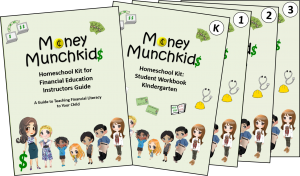
    I found Money Munchkids at a recent homeschooling convention. The program is for kids in grades K-3rd. My kids are a bit old for it, but I was impressed with the product which is a series of workbooks that cover many aspects of money. If you're looking for a summer activity, or a program to teach kids about money check it out.

    Here are links to a few other activities regarding money:

    Counting Money with Jelly Beans for Sale
    Entrepreneur Books for Kids
    Economics Books for Little Kids
    Place Value Activity using Money
    Selling Ice Cream for Money
    Teaching Kids About Money: Save, Spend and Invest

    With many sites on-line it is often difficult to determine who is making money from what and this bothers me. Therefore, I want to be perfectly clear and let you know that with this blog I don't make any money for recommending this product or most of the products I recommend. I do make an extremely small amount of money (about $10/month) if you click and place an order for something I recommend on amazon through this blog. The only exception is the card game Speed! that I developed and the book Johnny's Jelly Bean Tacos written by my husband. I hope you enjoy this recommendation and the others I have made as they have worked well for me and my family throughout our homeschooling adventure.

    One Way Homeschooling and High School can be used Together

    Last week I described how we are using a Montessori inspired approach to middle school and my son's progress in learning to program in Xcode. In addition to programming in Xcode, he is working on a math patterns book and taking two courses at our local high school.


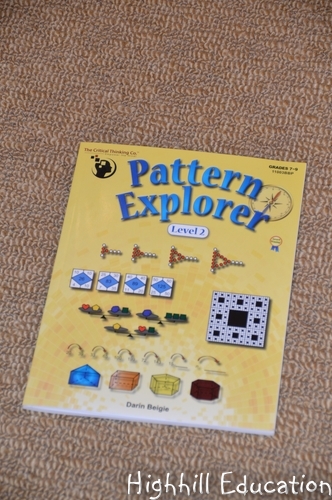
    At the end of the last school year we were studying a book together entitled Pattern Explorer. He liked this book enough to decide to complete it on his own. I really like the Pattern Explorer book because it teaches students to think about math in a non-traditional way. The book he is completing is perfect for kids who are at the pre-algebra and algebra level of math. It is a level 2 book, so there is also a level 1. For more information on this book click here.

    At the high school my son is taking an engineering class and band.  In Michigan homeschooled students are allowed to take any non-core classes. That means they may take anything that is not specifically required for graduation. Parents must provide transportation, but for us the school is close enough for him to walk. My older daughter has taken many art classes as well as AP biology, AP physics, AP composition and a dentistry class at the tech center.

    So far he is really excited to go to the public school for a portion of the day and I'm happy this opportunity exists. He will get to see some of his friends from scouts and see what public school is all about. Taking two morning classes will require him to wake up with an alarm clock on a very regular basis with no slack for sleeping in. Although we have had a regular schedule for school, the school system will be much more rigid and structured. It will be good for him to see this system. He will get to learn from people new to him and he will be expected to meet their expectations. Overall, I hope he has some fun, learns new skills and finishes knowing that he is smart and capable.

    Although it is still too soon to tell, the first few weeks were good. I'm optimistic that the two hours he spends in public school each day will be beneficial.

    Montessori in Middle Homeschool - Xcode

    Last week I mentioned we are implementing a Montessori inspired approach to middle school. After giving the kids a long list of research topics mixed with hands-on activities and small projects to choose from, my son exclaimed that he wanted to learn to program in Xcode, an Apple programming tool used to create Apps. Well that wasn't on the list, but an acceptable topic none-the-less.

    After completing three days of school he unfortunately hadn't gotten too far with Xcode, but had been very persistent and learned a lot. His main issue was getting access to Xcode which was a real challenge since he has a Windows computer. In what must be an effort to increase sales of hardware, Apple makes it quite difficult to run Xcode on a non-Apple machine.


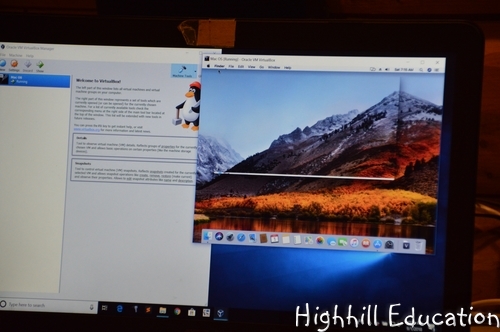
    He actually did get Xcode running but it runs slow on his Windows machine. To get it going, he figured out how to create a virtual Apple desktop on his PC. This was quite a process which involved lots of trial and error, and an unwanted bit-coin mining virus. In the end, Xcode will run on the virtual desktop, but runs too slow to be an effective solution. Next he investigated remote logging-into my husband's Apple machine to see if he could run Xcode that way. Well it tuned out that the best way to access Xcode was directly through an Apple computer. Now he is in the research and tutorial phase of learning Xcode. I can't wait to see where this leads him.

    Most Montessori programs are designed for pre-school through elementary. What I like about the Montessori philosophy is that students are motivated by selecting their own activities. However, un-like an unschooling approach where the student has complete control over what they study, I like the way the Montessori approach sets-up the classroom and effectively gives students acceptable choices. I see our approach to education as Montessori inspired because the choices are given by the adult but selected by the student. It tends to be quite hands-on and often involves learning life skills. Since middle and high school students are capable of reading, a list of acceptable topics and activities for this age works well. Also, unlike the elementary years where students are learning the basics and have necessary manipulatives readily available, for this age, resources are gathered and research completed based on what the student selects to pursue.

    So far this approach to education is accomplishing a few of my educational goals for the year including teaching the kids to persevere, making them more independent learners and getting them excited about school. They have been motivated to read and research because they have selected what they want to study. Both my husband and I assist them and try to offer suggestions when we see them getting stuck or progress slowing.

    Although this project has taken the majority of his time, he has a few other smaller projects he is working on. I will explain more next week.

    Pattern Explorer Review

    Pattern Explorer is one workbook, from The Critical Thinking Company While their other workbooks were equally engaging, I felt this one was the most appropriate level for my kids. Their workbooks are unique because they are designed to teach kids how to think. This one really works! I would recommend it as well as trying others.

    Pattern Explorer comes in Levels 1 and 2. The Level 2 book pictured here is geared towards students studying pre-algebra or algebra. Each page contains several picture problems such as the one shown below. The top problem on the left shows a series of figures containing solid and transparent circles. The student is asked how many shaded and total circles appear in later stages of the series.

    This may seem like quite a difficult question, but the table below the figures assists the students in finding the answer by helping to recognize patterns. Once the table is completed it becomes much easier to see how the number of circles in later figures is determined.


    The page on the right above shows a different type of problem in the book. The balance problem works a little like solving a algebraic problem in which you can divide both sides by the same number, or subtract the same number from both sides. For example, the top problem asks how many diamonds will balance a pentagon. One pentagon sits on the top left scale balancing four triangles. Two triangles balance three diamonds on the other scale. To solve the problem, students must figure out how the different shapes relate to each other. Students can arrive at the same answer thinking about the problem in different ways.

    In addition to these two types of problems, the book contains sequence problems, function problems and number problems all designed to teach kids to think. As a child I was always good at math, and now I have kids who are good at math. These books are excellent for kids excelling in math, but would also be good for those struggling as they approach problems in a pictorial way that appeals to the brain in a different way.

    Speed! - New Font

    Skip-counting is a key ingredient in teaching upper level elementary math concepts. Once kids have a good handle on the numbers 1-100 and can count backwards from 20 to 0 they are ready to learn skip-counting. This usually happens between the ages of 4 and 8 years old and around the same time as kids are learning addition. Numerous math skills are based on skip-counting such as multiplication, division, adding and reducing fractions. With a good understanding of skip-counting, children are able to progress much more rapidly through these upper elementary math concepts.


    Songs, the card game Speed! and hands-on practice work well together to cement the fundamentals of skip-counting. When playing Speed! kids learn to skip-count beginning on any number. For example, if they are skip-counting by 3's, they may begin at 18 and progress to 21. They also learn to skip-count backwards. The rhythm and rhyme of song helps engage memory and the colored decks of cards in the game Speed! help kids create a visual association with numbers.

     The card game Speed! has just been given a facelift. The exterior of the container was lightened from a dark blue to a light blue and the numbers on the cards are now a more common font which is easier to rapidly read. The original version is shown above on the left, and the updated version is on the right.


    If you haven't purchased this game yet, now's the time. After all, it's fun and a great way to keep kids learning over the summer! Kids play because they want to win, not to learn to skip-count. The beauty of the game is that in order to win, they have to have the skip-counting numbers memorized and they do so enthusiastically. The big secret, is that the numbers are all the answers to the times tables. After playing Speed!, kids can quickly apply what they've learned to multiplication, division, factoring, and fractions. How can you beat an educational game kids actually want to play.

    How to Teach Math Without a Curriculum

    Math is everywhere; games, art, and life and it's possible to teach kids lots of math with little to no curriculum. What's more, it's easy to do. However, as skills increase beyond addition, subtraction, multiplication, division, fractions and geometry curriculum makes teaching math much easier.

    All three of my children learned fundamental math skills through play. Kids learning math this way don't fall behind, or miss steps. On the contrary, they build a solid foundation of skills that enables them to understand higher level math much easier. Many concepts can be taught and absorbed rapidly enabling them to fly through more advanced math curriculum. Because my children were playing, they were motivated to learn. At age 15, my oldest daughter passed the calculus CLEP exam and at age 10 my youngest daughter tested at a 9th grade math level.

    Learning math still takes time. The difference here is the way math is being learned. Note that each of these skills should be mastered before moving onto higher level math and it is necessary to master some skills before beginning others. For example, kids should be able to recognize their numbers and count before moving onto any of the other games or activities. However, there are many skills which can be learned at the same time. For example, when kids are busy playing Black Jack 21 to learn to add, they can play Cribbage which reinforces adding skills and introduces strategy and skip-counting. Speed! teaches skip-counting of numbers one through nine. Kids can begin playing the game learning to count by 2's and 5's while mastering their addition facts.

    If you want to teach math this way, here is a list of progressively more difficult activities to try and master. This list covers the core skills of elementary math. We covered this list, added in other activities to introduce time, money, shapes and patterns, and also added a workbook or two each year so the kids could see math as written symbolically. Only the core activities are listed, supporting activities such as weaving potholders, drawing symmetric monsters, and additional games which involve a variety of math skills can be found on my Math Page. It is typical to move through the list of games and activities with some overlap concentrating on one game, but mixing in other games and activities for fun.


    Number Recognition

    UNO is one of the best games to begin with when introducing kids to math.

    Counting

    Chutes and Ladders is a classic game that kids enjoy playing. I like it because it helps with number recognition and they count from 1-100.

    Writing Numbers

    Make a homemade calendar. Doing this activity with each of my children, they were able to practice writing their numbers, learned about months, and again counted numbers from 1-31.

    Number Value

    War is the single best way to teach greater than less than. After flipping a card from a standard deck, the person who flipped the card with the greatest value gets to keep both cards. The game ends when one person holds all the cards.

    Adding

    Black Jack 21 is a gambling game played with a standard deck of cards. We didn't play Black Jack to gamble. We played it to learn to add. The dealer gives each player one card face down and one card face up. After peeking at their secret card, kids decide whether or not they would like an additional card to bring the sum of their numbers as close to 21 as possible. They can ask for as many additional cards as they would like receiving and deciding one-at-a-time. If they go over 21, they loose. If they stay under 21, the dealer gets a chance to get a higher total than the child. This game teaches prediction, statistics, strategy and most important - ADDING.

    Similar to War, players win a game of Adding War by getting all the cards. The only difference is that two cards are flipped over instead of one and the player with the greater sum of cards gets all four cards.


    Skip-Counting

    Speed! teaches skip-counting by 2's through 9's. Mastering this fundamental skill makes learning multiplication, division, factoring and fractions much easier.

    Cribbage is a much more complicated game than Black Jack or War, where players try to get points by getting numbers in a row, pairs and cards that total 15. It reinforces skip-counting by 2's and is wonderful for practice with addition. Since the game is more complicated, I would recommend playing after kids have a good handle of the above games, so around age 8 and up.

    Fractions

    Every homeschool mom knows that cooking is fraction application. We incorporated food into history and geography as well. Here are some fun dishes to make with kids.

    Geometry

    Geometry can be introduced by creating art with a compass and a straight edge. The geometric designs, shapes in circles found on my Math Page can be completed with kids around age 8 after they can draw a circle with a compass. The activities increase in difficulty when exploring math art with mandalas. The mandala activities are great for kids around age 10 or when they have completed the shapes in circles activities.

    Please see my Math Page for additional activities to learn and practice math skills without a curriculum.

    Speed! Skip-Counting to Multiplication

    This video explains how the card game Speed! works to help kids boost their math skills.

    From skip-counting to multiplication, division and fractions, this game is excellent for kids ages 4-12, or anyone learning addition through multiplication.


    Speed! is a fast-paced card game that helps kids learn how to multiply. What it does is teaches skip-counting which is a fundamental skill that leads right into multiplication. Continuing to build on math skills, Speed! helps kids with division, factoring, reducing fractions, and the many math skills that build upon skip-counting. I want to show you how this works.

    The game contains eight decks of cards, 2-9’s. Each deck is color coded and based on a different number. For example, the three—speed deck contains the numbers 3, 6, 9, 12, 15, all the way up to 30. So playing 3-speed, kids learn to count by 3’s. Each deck is played the same way, only the numbers change. After kids master one deck, such as 3’s, they can move onto another deck, counting by 4’s or any number 2-9. Throughout this video, I will give examples referring to the 3-speed deck, but please keep in mind that the same principles apply to all decks. There is a video showing the game being played and I highly recommend viewing it if you haven’t yet.

    A unique aspect of this game is that in order to win, kids not only need to know how to count higher by 3’s beginning with 3, but they need to be able to count higher by three starting with any multiple. That means they may start on 18 and count to 21, then 24.  They also need to be able to count backwards by 3’s starting on any multiple of three. In other words, they may start on 15, and count to 12, then 9. Kids play to win, not to memorize, but regardless of their reason, they are learning a critical skill.

    After kids have played 3-Speed for a week or a month, or however long it takes them to get really fast they have memorized the answers to the 3 multiplication tables, but don’t necessarily understand the link between skip-counting and multiplication.

    At this point, it’s a good idea to lay the cards out in order like this, and explain this is 3x1, 3x2, 3x3, 3x4, 3x5, all the way up to 30. Then after asking the child “what’s 3x6?”, they can point and say 18. “What is 3x8?” Well it’s 24.

    Now the kids will begin to understand the link between skip-counting and multiplication, and it’s a good time to go back to playing the game. After all, the game is the drill work of multiplication and it’s the fun part. Kids are playing to win, and not to learn, but they are learning and that’s why it works.

    Some kids will understand immediately and not need any flash card work to make the transition into multiplication. Others will still need some time with flash cards, but since they are already familiar with the answers to the multiplication tables, the time spent with flash cards should be greatly reduced. Sticking with one deck and mastering the corresponding set of multiplication tables before moving on to another deck will result in a greater reduction of time spent with flash cards since there are less numbers in their head from which to select an answer.

    Learning division works the same way. Again, with the cards laid out in order, if the child is asked “what’s 24 divided by 3?”, they can count, 1,2,3,… it’s 8. What’s 12 divided by 3, It’s 4.

    It’s best to begin with the 2’s or the 5’s because they are easiest, and concentrate on one deck of cards until it is mastered. Concentrating on one deck of cards reduces the number of options for answers and helps kids to create number associations.

    In addition to building recognition within number families, kids that play a lot of Speed begin to  recognize patterns between the decks. When playing 3-Speed, they might say, well wait a minute, a lot of these numbers are in 6-Speed!, Six-Speed has a 6, 12, 18, 24, and 30. Those numbers are in both 3 and 6 Speed…. and wow! A bunch of these numbers are in 9-speed too. Nine-Speed has a 9, 18, 27. It’s unconsciously making number associations between different decks that can really help kids to boost their math skills.

    Now when they get into higher level math such as reducing fractions, they might have to reduce the fraction 6/21. So then they think, wait a minute, both of those numbers were in 3-speed. There is a relationship between those numbers, and the common number is 3. The fraction 6/21 can be reduced to 1,2…..7ths.

    When my own kids were around the age of 7 or 8, we played Speed! every day for about 4-6 months straight. It was our math curriculum. Each day, I would lay the cards out in order and quiz them orally on multiplication for about 1 minute. Then we would play Speed! for about 15 minutes concentrating on one deck until it was mastered. This emphasis on skip-counting and number association allowed all three of my very different children to fly through many math concepts.

    I recommend this game for kids ages 4 through 12 or for anyone learning addition up through multiplication. As soon as kids have an attention span, a desire to play games, and can count they are ready. The 2’s and 5’s are easiest, so they are the best decks to start with. When kids are learning addition, they are ready to begin counting by 2’s.

    We used this game as our primary method for teaching multiplication. Other families have used Speed! on family game night, to improve or review multiplication, to gain a good number sense, or as a fun way to work on math over the summer. Since there are 8 decks of cards in the set, 16 kids can play at one time making the game a great option for co-ops and schools.

    Remember, kids play because it’s fun and they want to win. Not because they want to boost their math skills, not to learn multiplication, but they do. So have fun with it. Thanks for watching.

    Area of a Triangle: Hands-on Math

    We did a simple hands-on activity to prove the area of any triangle is 1/2 the area of a rectangle.


    This activity came from the Murderous Maths book Savage Shapes. (Great series, bad title.) In the UK math is maths. This British series discusses pre-algebra level math concepts in story format. The books feel more like comic books than text books. They are quirky and entertaining, yet educational. I highly recommend you check them out.

    To begin this activity sketch three parallel lines. Then measure four draw marks the same distance on the center line to serve as the base for the shapes. Perhaps 1.5 inches. Next draw two perpendiculars extending from the first base to create a rectangle. Connect the base lines for the second base to a point in the center of the base above the line (and below the line) to create two isosceles triangles. The third base should be connected to a point above one endpoint to create a right triangle. The final base should be connected to a point outside the base to create an obtuse triangle.

    Cut out the shapes. 2 rectangles, 6 triangles. (Only 1 rectangle is needed)

    Place each pair of triangles on top of the rectangle to fully cover the area. This shows that the area of one triangle is equal to the area of 1/2 of the rectangle.

    Note: It will be necessary to cut some of the triangles in order for them to fit onto the rectangle.


    Math with Mandalas: Perpendicular Bisector

    We learned about bisecting angles and perpendicular bisectors through creating Mandalas.

    Creating Mandalas with children is a fun way to teach math concepts that doesn't feel like work. Kids can learn about degrees, angles, bisecting, radius, diameter, circumference, perpendicular, parallel among other geometry concepts.

    To begin, all that's needed is a good quality compass, paper and a straight edge (like a ruler). There is an endless possibility of mandalas that can be created. We have a book of simple geometric mandalas and find it very educational to try to recreate them. Interestingly enough, there usually ends up being more than one way each mandala can be created. In other words, sometimes steps can proceed in different orders, or alternative steps can be used which arrive at the same result. After walking kids step-by-step through the creation of several mandalas, I like to give them a challenge mandala and see if they can create one on their own.

    Each mandala created requires some construction lines which end up being erased in the final version. Therefore, it's best to draw them lightly. Here are the steps we used to create the above mandala.

    1. Draw a horizontal line on your paper with a straight edge. The line should be approximately the diameter of the outside circle. Set the compass radius to slightly greater than on half of the line. Place the pointer on the end of the line and create an arc above the line. Create another arc below the line. Repeat placing the compass point on the other end of the line.

    2. Create a perpendicular bisector by using a straight edge to connect the two crossing arc points.

    3. Set the compass radius to the desired radius for the center circle. Draw the center circle placing the compass point on the point where the two lines cross.

    4. Bisect the perpendicular angles. Place the compass point on one point where the circle and straight line cross. Create an arc just outside the center circle. Repeat the process placing the compass point on the adjacent point where the circle and other straight line cross. The two small arcs should cross.

    5. Bisect the angle connecting the center point of the circle and the crossing arc point with a straight edge.

    6. Repeat the process to bisect the other 90 degree angle.

    7. Find the center point for one of the eight surrounding circles. Referring back to the first picture, you can see that the center is difficult to locate, but a tangent point on the edge of each of the eight surrounding circles lies on the point where the 45 degree angle line and center circle cross. Therefore, set the compass radius to the same radius as the center circle. Place the compass point on the point where the 45 degree line and center circle cross. Create an arc to mark the center of the circle crossing the vertical line.

    8. Create one of the eight surrounding circles. Place the compass point on the point where the vertical line and arc meet. Draw the circle.

    9. Repeat the process creating three more circles.

    10.  Using the same method, repeat the process to create the four arcs which are not quite complete circles.


    11. Draw the outer circle. Open the compass so the radius is set for the size of the outer circle measuring the point with the sketched geometry.

    12. Erase all construction and undesired lines.

    13. Use a sharpie or black marker to define the desired lines.

    14. Color the mandala any way you choose.


    Triominos for Family Fun

    The kids love playing Triominos.

    This game is a spin on the traditional game of dominoes which involves math and strategy. Players try to be the first to play all of their tiles by matching two or three numbers on the tile to existing numbers on the board. Each time a tile is played the player receives points equal to the numbers on the tile. Bonus points are awarded for a few special circumstances such as when all three numbers are matched to place a tile. Play continues in this fashion until 400 points are scored and a winner is determined.

    After completing several games, players begin to develop strategy and notice that the numbers always increase in a clockwise fashion. With this knowledge, players understand which plays can allow or prevent players the ability to complete a hexagon. The more the game is played, the more strategy becomes understood. 


    We enjoy this game as its fun and builds thinking skills.

    Gaming and Critical Thinking

    Playing games is one of the best ways to develop critical thinking skills.

    Last week I wrote about attending our first gaming convention. If you've never heard of or been to a gaming convention, I highly recommend it.

    At the convention, I was busy playing my skip-counting card game Speed! in the vendor room while my husband and son tried out a variety of new games. Because a gaming convention is filled with people who like to play games, through demonstrating my game, I had the opportunity to see how playing games has enhanced the logic and critical thinking skills of the participants.

    Most people have a hobby. For some, their hobby is a musical instrument, for others it's sewing, woodworking, politics, reading, running or camping. There are an unlimited number of hobbies, but I had never thought of playing games as a hobby until I attended a gaming convention.

    Hobbies are interesting, because they are a pleasurable pastime for the participant. People tend to fill their free time exploring their hobby as much as possible, and over time become unofficial experts in their field as they continue to increase their knowledge.


    Speed! is a relatively easy game to learn, but I was stunned by how much quicker veteran gamers learned to play. Most picked up on all the rules after only about 2 minutes of instruction and were onto strategizing how to win. At one time during the convention a five year old boy and his seven year old sister walked up to my table. They only played one round of Speed!, but before the round was done they were racing at top speed while predicting two to three moves ahead. I could see the five year old boy thinking 'if I play my 9, then my sister will play her 12, but if I play my 3 instead, then she won't have a card to play. Picking up on strategy during the first round of play was unbelievable, but it happened over and over throughout the weekend.


    The question was why did the gamers pick it up so fast? Well the obvious answer was that they play games often. By continuously strategizing in different circumstances they have learned to recognize patterns at a rapid rate. In addition, they don't just follow the rules, but predict possible outcomes of various acceptable moves and select their best option. Based on the information available, they try to think several moves ahead when planning their moves.


    My husband and son witnessed this same skill while playing games with other gamers. At the conference many game tables were set-up with a person available to teach others the game. Attendees could show up at scheduled times to try out new games. My husband and son tried games with others three times at the convention and lost every time. They said that the other gamers were strategizing at the very beginning of the game while it took them half way through the game to understand the rules. The game hobbiests were just that much quicker.

    The skills being developed by playing games; critical thinking, logic, and decision making not to mention math, are applicable in many aspects of life from most careers, jobs and daily routines. There are many games on the market, so start thinking about games like books. Try one and see how it goes. If you like it teach friends and play again. Then try a new game. There are so many to choose from. Have fun!

    Please visit Highhill Education again next week as I will begin writing about some of the games my husband and son played.

    For more great educational activities check out these blog hops

    Home Game Library

    Do you collect and play games?

    Many homeschoolers naturally collect books. They visit the library, thrift stores, book stores and somehow end up with an endless supply of books. Well now is a great time to start a new collection. Games!


    The paradigm for how I view games has just gone through a transformation. In the 80's, when I grew up we all had the same games. Many of us have memories of playing Monopoly, Clue, Candy Land, Chutes and Ladders, Sorry and Life. Today, there are as many games to choose from as books. Ok, well maybe not quite as many, but the number is rapidly increasing.

    Have you recently visited a unique Toy and Game store and wondered why you have only heard of a few of the games? I have, and have felt very overwhelmed by the variety of choices. Fortunately, many stores now offer the opportunity to try out the games during their game days, but an even better way to try out a variety of new games is to attend a gaming conference.

    Over the weekend, we (my husband, son and I) attended our first gaming conference to promote my skip-counting card game Speed! While there I was stunned to find there are gaming conferences all over the state giving gamers the opportunity to participate in conferences many weekends of the year.

    It turns out there are five primary interests of gamers; board and card games, role playing games, minitures, collectables, and comics. Many of the gamers have interests in more than one area, but others stick to a focus. Because my game and interests fall into the board and card game category, that is the area we explored.


    At gaming conferences, attendees have the chance to try out a variety of games. Very reasonably priced tickets can be purchased for one day or the entire weekend. The tickets grant access to the convention's library of games as well as game tables set up with a "game master" that instructs first-time players in the rules of a game. In addition, game designers attend the conventions with their prototype games seeking advice for tweaks before production.

    It didn't take long for my husband and son to decide I would be taking care of our "Speed!" table, while they would roam the conference exploring as many new games as possible. Since this was our first experience at a gaming convention, they decided that their favorite table was actually a promotion table. There were over 30 unopened games on the table. Anyone attending the convention could play those games. If they played an entire game from start to finish, they could put their name into a raffle for that game. Well the boys ended up playing five games from the table and winning two of the games they played. The $70 win value, more than covered the $30/person ticket price for the entire weekend. They were all smiles.


    Before attending the conference I knew there was a bigger variety of games available than when I was a child, but had no idea of the extent. I was blown away by the choices and a little overwhelmed at first. But approaching a new game like a new book was key. You will not read everything in the library in one day and you won't play all the games either. That's the fun of it. Playing or reading something new and then sharing your experience with friends discussing a book at a book club, or playing a game during game night.

    If you have an opportunity to attend a gaming convention, I highly recommend the experience.

    Check out these great blog hops for more educational activity ideas.

    Is Life of Fred Enough?

    When I first saw the Life of Fred books in 2011, I bought the entire set. It was an excellent decision and I haven't looked back. Since then, Z-Twist books has come out with a chemistry book as well as language arts books which I also recommend.

    Life of Fred is a complete math curriculum written in story format. It not only teaches math concepts, but teaches the application of math thereby making math interesting. Since learning with Life of Fred is very different from traditional methods of learning mathematics, many considering purchasing Life of Fred books ask "How do kids learn from Life of Fred" and "Is Life of Fred Enough?"


    Learning with Life of Fred is different. The author of Life of Fred expects his students to think. Traditional math curriculum tend to give an example and then expect the student to repeat the steps in the example with different numbers. Opposite to this approach, Life of Fred books will explain the concept and how it is used in real life through a fictional story. Often an example of how it is applied is embedded in the text. At the end of each short chapter, the student will be asked to apply the same concept to a different real life situation. In addition, the student is typically asked a few questions based on math concepts and applications taught in prior chapters.

    Because the books are written in story format and teach application well, they do not make math monotonous. Instead of a page or pages of similar problems, Life of Fred asks only 2-10 questions depending on the material presented. When students are having difficulty with a procedural math concept such as long division, it is sometimes necessary to take a short break from the books and focus on the concept.

    There are many people who follow various math curriculum and use the Life of Fred books to supplement math. That is a very good idea as those students are learning both math concepts and application and getting plenty of procedural practice. At my house, we take the opposite approach. We use Life of Fred as our backbone and add in extra practice only when it is needed. The extra practice usually comes in the form of a short lesson coupled with a hand written set of problems to focus on a difficult concept. My children had difficulty with rounding and long division among other concepts, so we took short breaks during those lessons.

    Sometimes our breaks from Life of Fred have come in the form of entire short workbooks. Since the jump between the Fractions book and Decimals and Percent book was a challenge for my son, I have chosen to have my daughter complete a School Zone 6th grade workbook before beginning the Decimals and Percent book.

    Life of Fred is a complete curriculum. However, as with any math curriculum, if a student moves on before mastering a concept, it can have a snowball effect. If a student is having difficulty with a concept, the chapter should be repeated, they should try additional problems, or the concept should be presented from a different angle before proceeding. To me, it doesn't make a difference which math curriculum is being followed. If a student doesn't understand, they are not ready to proceed.

    We are Life of Fred fans and have been from the beginning. Because the books teach critical thinking and teach the application behind the procedural steps of math, Life of Fred students come away with a clear understanding of math and an ability to solve difficult problems of any type on their own.

    Check out these great blog hops for more educational activity ideas. 
    Related Posts Plugin for WordPress, Blogger...