Showing posts with label Writing. Show all posts

How to Select a Homeschooling Language Arts Curriculum

Language arts covers a wide variety of topics including learning to read, learning to write, spelling, grammar, vocabulary, poetry, literature, and composition. When purchasing a complete curriculum these topics are usually covered in a progressive grade level fashion. When purchasing a subject specific curriculum these topics may either be grouped together in a grade-level package or sold as individual pieces which you can put together to create an even more tailored curriculum.

Most parents new to homeschooling believe they must follow a complete curriculum for every subject in order for their child to learn effectively. While a ready-made curriculum can certainly help achieve this goal, it can be expensive and not necessary. Libraries are full of books, the internet full of content, the television full of streaming services, outdoors is full of nature and the basements and closets of many homes are filled with arts and craft supplies and toys and games which can be put together to form an even more tailored effective curriculum. Just know that there are many options and homeschooling doesn't have to be regimented and expensive to be effective.

Most language arts curriculum have separate resources for studying grammar, spelling and writing. In all levels and facets of language arts development it tends to be beneficial for the student to separate writing lessons from spelling and grammar. In other words, children tend to be more enthusiastic about writing interesting content when free writing is encouraged. If spelling and grammar are corrected too often during the context of writing lessons, children will gravitate towards writing with simpler sentences and less-interesting words. For this reason most companies offer separate resources for grammar, spelling and writing.


Age and skill level should be a major factor when selecting a language arts curriculum and each skill level should contain several different consistent activities to be a complete language arts curriculum. In children preK to 2nd grade, the curriculum should incorporate learning to read, learning to write and listening to someone read. In the traditional approach to education the curriculum may consist of workbooks for developing writing skills, simple phonics books and pre-selected stories; where as in a Montessori approach the curriculum could look very different consisting of letter and phonics manipulatives, paper letters to trace and non-fiction books to read with the child. There is a wide variety of language arts curriculum available.

For children in grades 3rd-5th the language arts curriculum should focus on transitioning from  beginning reading skills to proficient reading abilities. Most complete language arts curriculum for this age will come with books to be read by the child and read to the child as well as lessons involving spelling, grammar, poetry and writing.

Children working at 6th to 8th grade levels should begin using their language arts skills to gain knowledge and continue to develop their love of reading. They should be actively researching while  developing their writing skills and building their vocabulary. Depending on the student's knowledge from previous studies, the language arts curriculum may include more study in grammar and spelling.

Language arts curriculum for students in grades 9th through 12th tends to become more specialized. Some programs will spend an entire year focusing on literature alone followed by a year of composition studies. Other programs will continue to combine the topics into a comprehensive form of study. Programs may include studies in vocabulary building which may or may not include the study of Latin. Some programs, especially those aligned with a classical approach to education introduce the arts of logic and rhetoric for writing and analyzing written works.

It is surprising how much variety exists in language arts curriculum and the plethora of options available. Most homeschoolers tend to change language arts curriculum from year to year because each curriculum benefits the student in a different way. In addition, there are many language arts curriculum that are meant to be covered in one school year by a small range of grade levels.

I am no exception to this rule in that I have used a variety of language arts curriculum throughout the years. I tend to select curriculum that builds intrinsic motivation which inspires more than rewards kids to write. I like curriculum that offers a lot of room for the children to influence an assignment as opposed to very specific assignments. Over the years I have used the following language arts resources.

Highhill Education Approach - My Favorite Language Arts Curriculum

Learning Letters and Words - No curriculum - We learned these skills with plastic letters and play which I will write more about in a future post.

Leap Frog Videos (The Letter Factory, The Word Factory, The Complex Word Complex) were a huge hit with my kids for learning to read as these videos were the only television my kids were exposed to. Watching these videos along with some structured game-like play and phonics activities was all my kids needed to learn to read. The process took about a year of repetition of the videos and activities, so it wasn't instantaneous, but it was effective and motivating.

Five in a Row - This is a PreK-6 level program in which a high-quality children's literature book is selected each week and read once per day for five days in a row. After the daily reading an interesting activity associated with the book is completed.

Brave Writer - When we used Brave Writer it was more of a philosophy than a curriculum. As a professional writer, the creator of the Brave Writer curriculum explained how to inspire children to write and improve their writing skills. Now Brave Writer offers a variety of grade level books which teach using the Brave Writer philosophy. In addition, there are on-line Brave Writer classes.

Essentials in Writing - Not to be confused for the Institute for Excellence in Writing which is listed below and hugely popular with homeschoolers, we used the Essentials in Writing Program for one year of our homeschooling journey. This program was by far the most structured language arts program we have used and incorporates daily lessons which cover grammar and writing. The company also has programs for literature, but we did not use them.

Logic of English - This is the single best book for explaining why the spelling of English words is so inconsistent. There is an easy-to-read chapter book which explains all of the rules as well as an entire curriculum developed for many grade levels. Amazon Link

Word Roots - As we have never used many workbooks in our family this one was an effective way to build vocabulary. There are five books for grades 3-12 designed for building vocabulary. Amazon Link: Beginning Level, Level 1, Level 2, Level 3, Level 4.

Royal Fireworks Press - I found this curriculum in 2018 and love it. There are seven levels designed to span K-12. Each level takes roughly one year to complete so there is plenty of time to try out other language arts curriculum on off years. Each level contains a series of books in topics of poetry, grammar, writing and language building. We have studied poetry as suggested with so many homeschooling philosophies but never understood it so well. I just love the way grammar, writing and the origin of words is broken down and explained in a way that makes sense.

Did you notice that Reading was barely mentioned on the above list? That's because free reading is a daily requirement. In addition, reading has been greatly developed through the study of history, science and geography studies.

Language Arts Curriculum


My top picks may not be a good fit for your family. Don't worry. There are many options. Here are even more language arts curriculum options that come well recommended from other homeschoolers who have used them. Most companies who sell full curriculum packages also sell their curriculum in subject specific pieces so be sure to check out the full curriculum providers whose methods align with your homeschooling style.

Complete and Semi-Complete Language Arts Curriculum

Learning to Read

  • All About Reading - secular, preK-2nd grade, books, manipulatives, activities
  • Bob Books - secular, preK-2nd grade, small books with progressively more difficult words
  • Explode the Code - secular, K-4th grade, on-line and workbooks, phonics based
  • McGuffy Readers - Christian, preK-2nd, beginning reading books
  • Reading Eggs -secular, preK-2nd, online, game-style, phonics, grammar, spelling, reading
  • Leap Frog Videos - secular, preK-2nd grade, videos

Learning to Write

Spelling

  • All About Spelling - secular, preK-6th, books, manipulatives, activities
  • Logic of English (listed under full language arts curriculum above)  
  •  Spelling Power - secular, Traditional Approach, Complete spelling curriculum, PreK-12

Grammar

Vocabulary

Writing/Composition

Reading/Literature


Life of Fred English and Grammar

Did you know there are Life of Fred English books?


The creator of Life of Fred is a retired high school math teacher who entertains students while doing an excellent job teaching the application of math. Unlike a typical math textbook, the books require little "kill and drill" problem work.

In the language art series, five year old math professor Fred, travels to Australia and ends up teaching language arts. In the same way the math books teach application of concepts, the language arts series aims to teach the application of grammar.

I worked through the series of four books over a period of about six months with my fifth and eighth grader who have a good background in creative writing and some knowledge of the parts of speech. We found the books entertaining and a good overview of English and grammar.

Because language arts does not naturally build upon itself like math, we found it difficult to retain all of the concepts presented in the books. Therefore, I would recommend working through these books as a review or as a tangent to other language arts lessons. They are worth while, but I would not rely on them as the sole method for learning literature and grammar concepts.

Essentials in Writing - Our Writing Curriculum for 2017 and 2018

With a 5th grader and 8th grader learning at home, this is the first year we have followed a structured writing curriculum.


As I've stated in the past, I believe reading, writing and math are fundamental skills required for any education. Although we haven't followed a structured writing curriculum, we have worked on writing. The Brave Writer philosophy has had lots of influence on our past writing, and we have always placed value on working on writing 3 to 4 times per week.

So why now? This year my 11th grader is thriving in an AP Composition class at our local high school. Obviously, the lack of a writing curriculum hasn't had too much of an impact. Well, the main reason is that I finally found a curriculum I wanted to follow.

The Essentials in Writing program is very much in-line with our family's approach to writing. It covers grammar, but doesn't over emphasize it. Instead, it places a large focus on making writing interesting. There are many lessons on incorporating action verbs, descriptive adjectives, adverbs, simile, metaphor, personification, and onomatopoeia. The lessons begin by identifying literary elements and then teach incorporation through the use of writing short paragraphs.

In addition, I was drawn to the program because it was simple to implement. The book comes with video professor lessons which are between 2 to 10 minutes in length per lesson. We usually watch the lessons, and then work on the assignments in the book. Our family chooses to work on writing four days per week, one hour per day for a total of four hours per week. Most days we cover one lesson, but often cover one-and-a-half, to two lessons. I believe we are on-track to complete the book over the school year.

As with most curriculum, this one is far from perfect. I have found mistakes and a few questions that could have been worded better. Overall, I feel Essentials in Writing has been a good addition to our school day this year. It has kept our writing sessions short and focused, and made them a lot easier for me to implement. I'm still undecided as to whether or not we will follow the curriculum next year and at what level, but this year it has taught the kids a lot and we will continue to finish the book.

As a side note, this is not the writing program IEW, or Institute for Excellence in Writing, which is very popular but a different writing program.

Writing an Oxymoron - Honest Politician

My daughter wrote a sentence with an oxymoron - honest politician.

Since art is a favorite subject for my 9 year old, I have been working to deeply incorporate it into her curriculum. This year she is using the book Teaching English Through Art for writing two days per week. The other days we work together to write and edit stories, descriptive works and other forms of writing. The book has been a big hit!

This week her assignment was to write a sentence containing an oxymoron. (An oxymoron is two words put together that don't normally go together.) The book gave several examples to choose from. With the presidential election only days away honest politician seemed like a natural choice for her.

Her sentence reads "Honest politicians are very rare. Hillary Clinton is not honest."


The other night at dinner, she added, "I hope Hillary doesn't win because I think I want to be the first female president. Or maybe I want to be a clothes designer."

Whoever wins, I hope will preserve Constitutional Freedoms.

Happy Election Day!

Constitution Study for High Schoolers

The Five Thousand Year Leap should be the government book for high school children.


When I was in high school I remember learning about the three branches of government, ages required to hold various offices, the Constitution and two main parties. Overall, the course was very basic. 

Politics today are so wrapped up in party specific agendas and special interest projects. Often decisions of politicians make little to no sense at all. The book The Five Thousand explains why the Founding Fathers wrote the Constitution they way they did. Despite coming from a variety of backgrounds; (differing religious beliefs, professions, income level, etc) they were all well read and agreed on most issues. The majority of their discussions focused on the best ways to implement their goals. They didn't focus on party specific issues, rather, they spent their time writing a document which would work in a variety of different circumstances.

One of their primary goals was to create a government which operated between the two extremes of tyranny (ruler's law) and anarchy (no law). In other words, they wanted the people to rule. The book steps through 28 principles of which the Founding Fathers based their ideas. Beginning with the principles of Natural Law, and virtuous and moral people, this book explains the reasoning of the Founding Fathers in a way that makes a lot of sense still today.

While reading this book my 13 year old daughter completed a number of writing assignments which corresponded with the chapters. Here are some of her essay questions.


Tyranny and Anarchy
1. North Korea is a country currently ruled by tyranny. Somalia has anarchy. Research both countries and write an imaginary tale of your life as a child in each country.


Natural Law
2. You know the difference between right and wrong and therefore instinctively understand natural law. Create a table listing examples of acts both in accordance with and contrary to natural law.

Natural Law vs Political Law
3. Describe at least two past or current American laws which are not in agreement with natural law. Why were the laws passed? What happened?

Irredentism - Land Taken by Force
4. If you were a world leader, describe your irredentism policy.

Price Caps and Price Controls
5. Do you believe price caps/controls are positive or negative policies? Explain using examples.

Immigration
6. Immigration is a current hot topic in politics. How would you deal with immigration?

Booms and Busts in Economics
7. Briefly describe the cycle of economics.

8. What is inflation?

Government Subsidies
9. Should businesses be subsidized? Why/why not? Give examples.


Check out these great blog hops for more educational activity ideas.


Apples to Apples - Grammar, Games and Fun

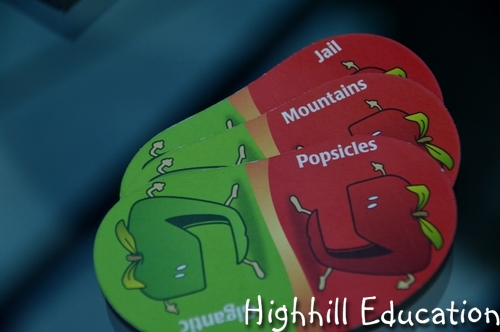
What do you think is the coldest? Jail, Mountains or Popsicles?


In the game Apples to Apples, players select a card from their hand which they believe goes best with the selected adjective. The judge (a rotating position) selects the best match. The winner is the first person to have five of their cards selected by the judge. 


 Apples to Apples Party Box - The Game of Crazy Combinations (Family Edition)

Crazy combinations make this game fun. Mushy clowns, colorful throw up, and fragile spaghetti may be selected as best matches. There are several versions of this game. After becoming hooked with a novelty Jelly Belly version we purchased a version with lots more cards. The kids love this game and I like it too. It's fun, but the kids are reading (a little), learning about nouns and adjectives, and beginning to select different cards based on who is judging. After all, my daughter is much more likely to select a card that says dance or fairy and my son is more likely to select iPad. Sometimes playing to the judge really works.

Fantasy Writing Activity for Kids - Setting

We learned about settings of fantasy stories and wrote our own fantasy setting.

One of the best ways to acquire great writing skills is to study great writing. It may sound counter intuitive, but great writing is not only found in written form. Movies are wonderful sources for writing inspiration and a fun treat for kids when studying writing.

The goal of this lesson was to make the children aware of how authors describe settings in the fantasy genre. Since the mind can wander in a million different directions, the fantasy genre is the perfect one for this lesson.

Monsters, Inc.

In the popular movie Monsters, Inc, the Monsters live in their own unique world. The movie gives many wonderful visual descriptions of the monster world which is both different and similar to our own. In Monster world, there is a business which makes power called Monsters, Inc. Unlike power plants on Earth, power in Monster world is generated by getting kids to scream. Like factories on Earth, there is a boss and workers with a variety of different jobs. Some monsters handle paperwork, others work on the electronics and machinery and others are professional scarers. After watching the movie, the kids listed a number of items which described the setting of the movie.

Patchwork Girl of Oz

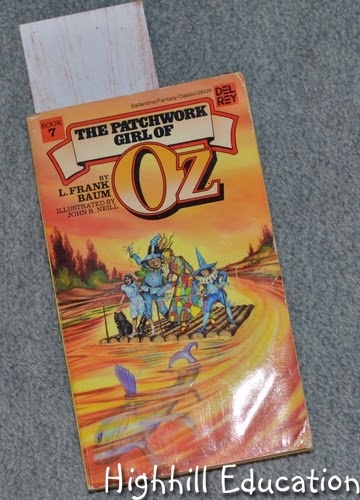
In addition to discussing the setting of Monsters, Inc, we discussed the setting of the Hopper's and Horner's lands in the book The Patchwork Girl of Oz. L. Frank Baum, the author of the Wizard of Oz and eighteen sequels, was a master at describing characters and settings. Each of his books are filled with descriptions of different lands his characters visit on their adventurous journeys.


The Hoppers are creatures with one leg who live in houses which are fancy on the outside and plain inside. The marble exteriors are decorated with elaborate carvings. They hop everywhere they go and they are afraid of the Horners. The Horners, are creatures with one horn in the middle of their forheads and tri-colored hair. They are not scared of the Hoppers as long as the fence is locked. They like jokes, have two legs, round bodies and live in houses which are fancy on the inside and plain on the outside. The kids had no trouble listing items which described both the Hoppers and the Horners.

Hedgehog Land

When my children have free time and aren't running around outside, they love to play with their stuffed hedgehogs. They have given each of their hedgehogs personalities, and created many fantasy lands where they live. Vanilla is the queen of all of the hedgehogs. She has her own land where she rules like a tyrant. Among other things, she visits the supermarket in her very own diamond studded golden tank.


J.J. Peter is an inventor who lives in Vanilla's land. He spends all of his time in his room inventing. He doesn't like to socialize much but does tolerate Vanilla most of the time.


Inside Vanilla Land, Vanilla has her own palace. It is quite extravagent and filled with servants and high-tech inventions from J.J. Peter.


Since the kids play with each other in their fantasy world the writing was already done. The challenge of this assignment was getting the descriptions down on paper. When kids play, they are often writing. It can be amazing to watch.


* I did not receive any compensation for this recommendation. I'm just a homeschooling mom who has found many products that I like. If you're interested in the products I recommend on this blog I want to make it easy for you to find them. 
** I am an Amazon associate and receive a small portion of the sales on orders made after clicking in from this site, which I promptly spend on homeschooling books and supplies for my children.

Illustrating Idioms

We illustrated a few idioms.

Saved by the Bell, Tie the Knot, and When Pigs Fly are a few phrases that will completely baffle my children. We are very literal in my house, but I have a friend who loves to speak poetically and idioms are a regular part of her vocabulary.

Like poetry, idioms are phrases in which the meaning is quite different from its appearance. It can be entertaining to guess at the meaning of idioms. Having a good understanding of idioms demonstrates a command of language often only obtainable by native speakers.

To increase our knowledge of idioms, we browsed IdiomSite.com and then choose an idiom to illustrate. Here's the results.

Put the Pedal to the Metal (Go really fast!)

Kick the Bucket (to die)

 On the Fence (working on making a decision and not convinced either option is superior)


 Learning idioms is both entertaining and a fun way to work on language skills.


Check out these great blogs full of educational activity ideas.

* I did not receive any compensation for this recommendation. I'm just a homeschooling mom who has found many products that I like. If you're interested in the products I recommend on this blog I want to make it easy for you to find them. 
** I am an Amazon associate and receive a small portion of the sales on orders made after clicking in from this site, which I promptly spend on homeschooling books and supplies for my children.

Implementation of Brave Writer

Brave Writer is a writing philosophy designed to inspire kids to share their ideas. My favorite Brave Writer product The Writer's Jungle teaches educators how to teach writing while keeping motivation high.

It's full of tips for reviewing written works and offering suggestions for improvement. In addition, the activity ideas increase vocabulary and creativity with words. Teaching writing becomes more fun after implementing the program.


The part I struggled with was how long to spend revising works. My son and I wrote a paper together, but it seemed to take way to long to complete. There were numerous issues with his writing such as organization, and complete sentences. To me it was important to address them all. My 13 year old daughter could easily freewrite stories that were many pages long. In fact, she wrote ten chapters. The volume of output from her was impressive, but tackling a ten chapter book for revision was a daunting task. We pushed through it, but it was too big for her level of writing.

Enter my friend April. I recommend Brave Writer to April, and she loved it. A few months after using it, she described her implementation of the philosophy. Well it was brilliant, so now I use her implementation too. Here's how it works.

Three week cycles are repeated and one new paper is completed each cycle.

Week 1
Monday - Freewrite on assigned topic (This will become the finished paper of the cycle.)
Tuesday - Writing activity
Wednesday - Writing activity
Thursday - Revision 1 to assigned paper
Friday - Freewrite Friday

Week 2
Monday - Revision 2 to assigned paper
Tuesday - Writing activity
Wednesday - Writing activity
Thursday - Clean rewrite of assigned paper
Friday - Freewrite Friday

Week 3
Monday - Editing work on assigned paper
Tuesday - Writing activity
Wednesday - Writing activity
Thursday - Finish/Publish assigned paper
Friday - Freewrite Friday

On Tuesdays and Wednesdays April usually studies grammar for writing activities. We sometimes study grammar, but also use the time for poetry tea times, copywork, dictation, and writing activities from the Writer's Jungle and from Brave Writer's Daily Writing Tips.

During each revision phase I select one aspect of the paper to improve. Introductory sentences that grab attention, organization of the paper, sentence structure, and adding details to vague descriptions are some areas which have received attention. I work with each child individually for revisions as each paper and child has unique needs. Although two revision cycles rarely make a paper shine, they do make it brighter. Repeating this cycle ensures some written works will make it all the way through the revision phase. Each time a paper receives revision attention, future freewrites seem to improve.

Limiting the days spent on the cycle's paper to two per week works well so as not to overwhelm the children. They have time to digest what they have written and are ready to visit the paper when revision time comes.

Of all the weekly writing activities, both my children and April's like freewrite Fridays the best. Both of us are just happy the kids are writing and enjoying it.


* I did not receive any compensation for this recommendation. I'm just a homeschooling mom who has found many products that I like. If you're interested in the products I recommend on this blog I want to make it easy for you to find them. 
** I am an Amazon associate and receive a small portion of the sales on orders made after clicking in from this site, which I promptly spend on homeschooling books and supplies for my children.

Writing Prompt - If My Food Could Talk

If your food could talk what would it say?

When this salad dressing spoke to me in the store I had to try it. Not only that, it made me think about what other foods may say.

We turned talking food into a short writing activity by first taking out several different food items from the pantry. Next about 20 minutes was spent writing what different foods might say. From the lists, favorites were selected and illustrated.

Mashed Pumpkin

Peanut Butter

Granola Bars

Apples

Does your food speak to you????????????
Check out these great blogs full of educational activity ideas.  


Using a Typewriter to Inspire Kids to Write

My daughter decided to type and illustrate a story.

To me, the most important part of writing education is to develop a love or at least a desire to write. Changing the medium from a pencil, to a pen, to crayons, markers, or paint, from lined paper, to blank paper, to colored paper, to the computer word processing program, to the drawing program on the computer, to a postcard.......... can help to keep writing motivation strong. So when my daughter wanted to drag out the typewriter my son purchased a few years ago at a flea market and type her story, my husband helped her right away.

She had fun pushing the keys, but in the process wrote three different stories.

This was completely my seven year old's idea and a perfect example of a successful unschooling activity.


Presidential Campaign Slogans

We created Presidential Campaign Slogans and posters to go with them.

Slogans are used to advertise a variety of products and they also work for presidential candidate advertising, or campaigning, as we like to call it. The web site History.com contains a list of ten winning past presidential campaign slogans. PresidentsUSA contains a list of past campaign slogans. Can you guess who was the Not Just Peanuts president? How about Good Money Never Made Times Hard? The best slogans contain literary elements such as rhyme, alliteration and rhythm making them a perfect subject for a writing activity.


Fifteen minutes were spent brainstorming slogans, and then favorites were made into posters. Here are a few slogans we came up with.

You'll Have Lots of Fun When We Go Back to the Constitution
Down With Crazy Laws!
FDR was a Pig, He Made the Government too BIG
I will make thee free you see. Now it's time to elect me.
B your Boss! Choose what U think is good.
I already see you like me.
I'm Independent and I know It
What's your idea?
Think, Think, Think

And here are the posters.


Be sure to check out our Language Arts Page for more writing activity ideas.


Check out these great blogs full of educational activity ideas.

Slogan Writing Activity for Kids - Apples

We wrote slogans for apples.

Creating slogans is one technique companies use to sell their products and there are many memorable slogans such as "Milk, it does a body good!" My children don't watch very much television, in fact our television hasn't worked for over two years and we don't miss it. So their knowledge of slogans was a bit limited. Before writing our slogans we watched a few videos and they gained a better understanding.

I laughed heartily while viewing Top 10 Food Catchphrases as it brought back many childhood memories. My favorite was the Wendy's Where's the Beef? clip. Although this type of advertising would probably not go over well today due to its lack of political correctness, it sure was funny.


 Top 10 Food Catchphrases

Even funnier was the short video containing made-up slogans that truly represented products.

If Company Slogans Were Honest

Although my kids didn't understand all of the humor, the videos did serve to explain what a slogan is. After watching, I gave each of the kids an apple and had them write slogans for apples.


Here's what we came up with:

7 Year Old Daughter
Apples crunch in the mouth.

11 Year Old Son
Fast, Easy, Healthy, Good!
Red Sugar
Our Tree, Your Money

14 Year Old Daughter
Yum! Yum! Yummy!
Don't Be Grumpy, Be Happy with Apples
Got Any Apples Bro?

My Slogans
Eat It Before the Worm
Twist the Stem
How Will You Get Yours Down?


And here's a final thought - An Apple A Day Keeps the Doctor Away


Check out these great blogs full of educational activity ideas.

Riddle Writing

We read, solved and wrote a few riddles as suggested in my daily writing tip email from Brave Writer.

The website Your Dictionary explains different types of riddles and contains several examples. Daily Brain Teaser is a blog which contains many different types of thinking puzzles including riddles.

Here's an example; Three eyes have I, all in a row; when the red one opens, all freeze.” The answer is traffic light.

After reading through several riddles we attempted to create our own. First we thought of an object and then wrote 2-5 sentences describing the object.


Here's what we came up with.

7 Year Old Daughter
I do not see you in the day. I see you in the night. 
Answer - Bat

I am prickly in the sun. 
Answer - Cactus


13 Year Old Daughter
I am way up north or south. I can be pink or purple but am primarily green. I normally come at night. I'm created by the Earth's magnetic field.
Answer - Northern Lights

I am leg extensions. I was invented in medieval times.
Answer - Stilts

My Riddle

Even though I'm dead and gone I'm still worth a lot. In fact, I travel all around the world each and every day. 
Answer - Benjamin Franklin $100 dollar bill


Science Fair - Helping Kids Prepare

We participated in the science fair and it was a grand learning experience.

Science fairs are about so much more than just science. Forming a plan, perseverance, writing, revising, editing, presenting and creativity are all important elements. Committing to participate in a science fair is a huge undertaking, but the knowledge gained by going through the process is unmatched. Following through with the entire project can easily count for reading, researching, writing, presentation, math and science.

In our house we do lots of science. The majority of our Cell, Human Body, Astronomy, and Earth Science projects were demonstration based science. Most science fair projects, however, are discovery based. This means that they follow the scientific method by first asking a question, and follow through with an experiment to answer the question.

My son has a passion for science. It's his favorite hobby. He's constantly growing plants from seed, engineering devices, and exploring. When he engages in these activities, he naturally follows the scientific method whether he realizes it or not.

1. Ask a question
2. Form a hypothesis
3. Research
4. Plan an experiment to answer question
5. Analyze data
6. Communicate results


A normal science project may take an afternoon to a few days to complete, but a science fair project can take weeks. One big difference is the way the results are communicated. Discussing results with family and friends is not the same as writing out the entire project for others to read. The latter just takes more time.


Here are some tips for working through a science fair project.

Select a Topic
Selecting a science fair topic is by far the most difficult part. Library books, the internet and the child's natural interests help a lot. It's important to let the child lead the way by helping him/her find an interesting topic. Ask the child what he wonders about. Maybe the child is interested in how things grow. Maybe they want to learn about magnets. Perhaps they are interested in how electricity works. A topic is different than a question. My son was interested in erosion and my daughter interested in crystals. They knew they wanted to explore their respective topics, but exploring one aspect of the topic required much discussion.


Question
Once they decide on a topic the child should write down a specific question to answer through scientific test. When we began work on the science fair project my daughter's question was not terribly clear. She wanted to know what kinds of crystals are the easiest to grow? I asked her what kinds you could grow and how she would determine ease of growth. She could name a few and thought about creating a table with the number of steps required to grow them, but then decided she wanted to know what kinds of grown crystals were the prettiest? I asked how she would determine which were the prettiest. Then she asked what is the best ratio of Borax to water to grow the best crystals?, before asking, Do different ratios of Borax to water affect the quantity of crystals grown?

All of her questions required a similar experiment, but writing down a question to answer provided direction for the experiment.


Here are some other science fair questions that could be explored.
Does adding salt to water affect the temperature at which it freezes?
Does the ratio of water to rice affect cooking time?
What liquid preserves apples the best? water, corn syrup, vinegar
Does color affect the length of time a candle burns?
Does temperature affect how high tennis balls bounce?
Does heart rate change with exercise?
What is the best type of soil for plant growth?
How does smell affect taste?
What metals rust with salt water?
Does the surface area of water affect rate of evaporation?
Does hot water cool quicker than coffee?
How does the temperature of a cake change when its put into the oven?

Scientific Method
The child should be familiar with the steps in the scientific method. Take time to look at examples of science fair projects others have done. Be sure to read all the material on the display boards. The internet is an excellent resource.

Hypothesis
A hypothesis is just a guess. Be sure to have the child write down the hypothesis before beginning research and experimentation. Kids (and adults) like to change their mind as they learn more. An incorrect hypothesis does not mean a project is a failure. It's fun to see what happens after committing to a guess.

Research
Be sure the kids have a good understanding of the problem. After doing research ask the child to write down what they know about their topic. My son really surprised me stating that "erosion is a problem because it sometimes happens right under houses." His writing was unique and displayed a good understanding of why he was performing his test.

Test Plan
Writing a test plan is very important and a step that's often completed after the experiment. Working for an engineering company, before being an educator, we were required to write test plans before any tests. They provided focus, communicated ideas to other team members and served as vehicles to get funding. This step is just as critical in a science fair project. Writing the plan down in advance forces kids to think through the entire process. It ensures the experiment will answer the question, provides direction during the experiment, and gives parents a heads-up if any supplies are required. Kids should plan their own experiment, but be given planning assistance if they ask for help, or if their plan has problems.


Experiment
It's best to let the kids conduct their own experiments. One way to do this is to occupy yourself with an activity nearby, while the child performs the experiment. Don't interfere unless help is requested. If the child had a good plan before beginning, they likely can get pretty far with the experiment on their own and will feel very accomplished by doing so.

Analyze Data
Participating in a science fair project is a great opportunity to practice math application. Means, averages and medians can be calculated to help the results make sense. Tables and graphs often work well to display science fair project results. Suggest the child create such figures and provide assistance if required.

Form a Conclusion
Was the hypothesis right or wrong? Why? What factors could have changed the results? Air temperature? Wind? Answering these questions should provide a good start for writing a conclusion.


Write-Up Results
Let the child write-up their results and help them to organize it in categories. Allow two to three weeks to complete the writing portion as it will need to go from the rough draft phase all the way through the publishing phase of the writing process.


Create Science Fair Display Board
Show the child examples of science fair displays so they can see how each step in the scientific method is represented. Ask them which ones they like the best and why. Bold titles, large font (16 pt or greater), photos, and boarders to highlight the text make for pleasing displays. This step can easily take an entire afternoon of work. Artsy kids may spend three days decorating their boards, so be sure to provide plenty of time for this step.


Presentation
Whether or not the science fair has judges, there are likely to be kids and adults with questions about projects. Just mentioning it in advance helps many kids prepare.


Final Thoughts
Participating in a science fair is a huge assignment and a learning opportunity that shouldn't be missed. Forget about spelling, grammar, writing and history lessons for a few weeks while you prepare. Clear your calendar and don't schedule too many activities. Praise the kids participating and have fun!


A Fun Alphabetizing Activity for Kids

We alphabetized our postcards.

Exchanging postcards is an activity packed with learning. Kids can improve writing skills, learn geography, math (buying stamps and making change), and how the postal system works. We've been exchanging postcards on and off for a while now and the kids have built up quite a collection. A while back we participated in an organized 50 state postcard exchange. We have done informal exchanges through Postcardkids and PostCrossing and have purchased many postcards during our European travel adventures.

In organizing the cards my daughter received a geography lesson and an alphabetizing lesson. She had no idea she was receiving the lessons, she was just busy organizing.

The postcards were stuck to loose leaf papers with photo corners in a notebook. The notebook contained tabs for each of the continents as well as a separate tab for the United States. The first sheet behind each tab was a blank outline map. Behind the map was a sheet for each state or country in alphabetical order.

To put cards in my daughter had to find the correct page. Since the book was in alphabetical order she quickly learned how to alphabetize. In addition, as each of the postcards was placed in the notebook the country or state where the postcard originated was colored.


Here's the Missouri page.


Published Authors Write Rough Drafts Too

We explored the rough draft of a published author.


Writing is often fun for kids until it's time to take a rough draft to the next step. After all, they read lots of books and they all look great. The kids never get the opportunity to see the rough drafts from published authors.

Unfortunately Dr. Seuss died before he had the chance to complete the story which was eventually published under the title Hooray for Diffendoofer Day! Fortunately for us, not only was the story celebrating alternative teachers completed, but the published version contains Dr. Seuss's rough draft.


The story from Dr. Seuss was in fact in a very rough form. It contained sketches and verses and ideas for characters, but it lacked a plot. It was in more of a concept form than a rough draft. The book explains how Dr. Seuss' sketches were transformed into the published story.

This rare opportunity to see a Dr. Seuss rough draft was an eye opening experience for my children. Before this, I think they thought authors just wrote down a finished version.

Check out these Blog Hops for activity ideas from others.

Related Posts Plugin for WordPress, Blogger...