Showing posts with label Reading. Show all posts

How to Select a Homeschooling Language Arts Curriculum

Language arts covers a wide variety of topics including learning to read, learning to write, spelling, grammar, vocabulary, poetry, literature, and composition. When purchasing a complete curriculum these topics are usually covered in a progressive grade level fashion. When purchasing a subject specific curriculum these topics may either be grouped together in a grade-level package or sold as individual pieces which you can put together to create an even more tailored curriculum.

Most parents new to homeschooling believe they must follow a complete curriculum for every subject in order for their child to learn effectively. While a ready-made curriculum can certainly help achieve this goal, it can be expensive and not necessary. Libraries are full of books, the internet full of content, the television full of streaming services, outdoors is full of nature and the basements and closets of many homes are filled with arts and craft supplies and toys and games which can be put together to form an even more tailored effective curriculum. Just know that there are many options and homeschooling doesn't have to be regimented and expensive to be effective.

Most language arts curriculum have separate resources for studying grammar, spelling and writing. In all levels and facets of language arts development it tends to be beneficial for the student to separate writing lessons from spelling and grammar. In other words, children tend to be more enthusiastic about writing interesting content when free writing is encouraged. If spelling and grammar are corrected too often during the context of writing lessons, children will gravitate towards writing with simpler sentences and less-interesting words. For this reason most companies offer separate resources for grammar, spelling and writing.


Age and skill level should be a major factor when selecting a language arts curriculum and each skill level should contain several different consistent activities to be a complete language arts curriculum. In children preK to 2nd grade, the curriculum should incorporate learning to read, learning to write and listening to someone read. In the traditional approach to education the curriculum may consist of workbooks for developing writing skills, simple phonics books and pre-selected stories; where as in a Montessori approach the curriculum could look very different consisting of letter and phonics manipulatives, paper letters to trace and non-fiction books to read with the child. There is a wide variety of language arts curriculum available.

For children in grades 3rd-5th the language arts curriculum should focus on transitioning from  beginning reading skills to proficient reading abilities. Most complete language arts curriculum for this age will come with books to be read by the child and read to the child as well as lessons involving spelling, grammar, poetry and writing.

Children working at 6th to 8th grade levels should begin using their language arts skills to gain knowledge and continue to develop their love of reading. They should be actively researching while  developing their writing skills and building their vocabulary. Depending on the student's knowledge from previous studies, the language arts curriculum may include more study in grammar and spelling.

Language arts curriculum for students in grades 9th through 12th tends to become more specialized. Some programs will spend an entire year focusing on literature alone followed by a year of composition studies. Other programs will continue to combine the topics into a comprehensive form of study. Programs may include studies in vocabulary building which may or may not include the study of Latin. Some programs, especially those aligned with a classical approach to education introduce the arts of logic and rhetoric for writing and analyzing written works.

It is surprising how much variety exists in language arts curriculum and the plethora of options available. Most homeschoolers tend to change language arts curriculum from year to year because each curriculum benefits the student in a different way. In addition, there are many language arts curriculum that are meant to be covered in one school year by a small range of grade levels.

I am no exception to this rule in that I have used a variety of language arts curriculum throughout the years. I tend to select curriculum that builds intrinsic motivation which inspires more than rewards kids to write. I like curriculum that offers a lot of room for the children to influence an assignment as opposed to very specific assignments. Over the years I have used the following language arts resources.

Highhill Education Approach - My Favorite Language Arts Curriculum

Learning Letters and Words - No curriculum - We learned these skills with plastic letters and play which I will write more about in a future post.

Leap Frog Videos (The Letter Factory, The Word Factory, The Complex Word Complex) were a huge hit with my kids for learning to read as these videos were the only television my kids were exposed to. Watching these videos along with some structured game-like play and phonics activities was all my kids needed to learn to read. The process took about a year of repetition of the videos and activities, so it wasn't instantaneous, but it was effective and motivating.

Five in a Row - This is a PreK-6 level program in which a high-quality children's literature book is selected each week and read once per day for five days in a row. After the daily reading an interesting activity associated with the book is completed.

Brave Writer - When we used Brave Writer it was more of a philosophy than a curriculum. As a professional writer, the creator of the Brave Writer curriculum explained how to inspire children to write and improve their writing skills. Now Brave Writer offers a variety of grade level books which teach using the Brave Writer philosophy. In addition, there are on-line Brave Writer classes.

Essentials in Writing - Not to be confused for the Institute for Excellence in Writing which is listed below and hugely popular with homeschoolers, we used the Essentials in Writing Program for one year of our homeschooling journey. This program was by far the most structured language arts program we have used and incorporates daily lessons which cover grammar and writing. The company also has programs for literature, but we did not use them.

Logic of English - This is the single best book for explaining why the spelling of English words is so inconsistent. There is an easy-to-read chapter book which explains all of the rules as well as an entire curriculum developed for many grade levels. Amazon Link

Word Roots - As we have never used many workbooks in our family this one was an effective way to build vocabulary. There are five books for grades 3-12 designed for building vocabulary. Amazon Link: Beginning Level, Level 1, Level 2, Level 3, Level 4.

Royal Fireworks Press - I found this curriculum in 2018 and love it. There are seven levels designed to span K-12. Each level takes roughly one year to complete so there is plenty of time to try out other language arts curriculum on off years. Each level contains a series of books in topics of poetry, grammar, writing and language building. We have studied poetry as suggested with so many homeschooling philosophies but never understood it so well. I just love the way grammar, writing and the origin of words is broken down and explained in a way that makes sense.

Did you notice that Reading was barely mentioned on the above list? That's because free reading is a daily requirement. In addition, reading has been greatly developed through the study of history, science and geography studies.

Language Arts Curriculum


My top picks may not be a good fit for your family. Don't worry. There are many options. Here are even more language arts curriculum options that come well recommended from other homeschoolers who have used them. Most companies who sell full curriculum packages also sell their curriculum in subject specific pieces so be sure to check out the full curriculum providers whose methods align with your homeschooling style.

Complete and Semi-Complete Language Arts Curriculum

Learning to Read

  • All About Reading - secular, preK-2nd grade, books, manipulatives, activities
  • Bob Books - secular, preK-2nd grade, small books with progressively more difficult words
  • Explode the Code - secular, K-4th grade, on-line and workbooks, phonics based
  • McGuffy Readers - Christian, preK-2nd, beginning reading books
  • Reading Eggs -secular, preK-2nd, online, game-style, phonics, grammar, spelling, reading
  • Leap Frog Videos - secular, preK-2nd grade, videos

Learning to Write

Spelling

  • All About Spelling - secular, preK-6th, books, manipulatives, activities
  • Logic of English (listed under full language arts curriculum above)  
  •  Spelling Power - secular, Traditional Approach, Complete spelling curriculum, PreK-12

Grammar

Vocabulary

Writing/Composition

Reading/Literature


Favorite Librivox Stories for Kids

Librivox is a website that offers thousands of free audio stories. As a parent, Librivox can help to provide countless hours of entertainment at home or in the car. Kids can just listen or get a copy of the book and follow along while listening to a plethora of volunteers who have read stories.

The secret behind Librivox is the age of the books. They are all in the public domain and therefore have expired copyrights. In addition to being great for kids, it is filled with stories for adults and can even be helpful when learning a foreign language.


With so many stories available, finding a place to begin can be daunting. Here is a list of some stories the kids and I have thoroughly enjoyed.

Animal and Fantasy Stories for Young Children

So many stories are available for young children. Many of us have heard of Peter Rabbit and The Wizard of Oz, but there are stories that are probably unknown. Arthur Scott Baily wrote several short stories for young children based on adventures of animals. Just William is about a mischievous little boy just having adventures.

Arthur Scott Bailey
Tale of Daddy Longlegs
Tale of Miss Kitty Cat

Beatrix Potter
The Tale of Peter Rabbit
The Tale of Mrs. Tiggle-Winkle

L Frank Baum
Wizard of Oz
Tin Woodman of Oz
Glinda of Oz

Alice in Wonderland

Wind in the Willows

Just William

Historical Fiction Stories

There are so many ways to learn about history through Librivox. Today, the Story of the World books are increasingly popular, but there are many books in the public domain that rival Story of the World. Eva March Tappan, MB Synge and HE Marshall all wrote stories in a similar fashion. They are based off different periods of history and each chapter tells the story of a famous person or event in history.

GA Henty wrote historical fiction novels each centered on a period of history. Most novels seem to involve a strong hero role model who saves the day. My kids have loved these stories beginning around 6th grade.


Eva March Tappan
Heroes of the Middle Ages
Makers of Many Things

MB Synge
Book of Discovery
On the Shores of the Great Sea

Henrietta Elizabeth Marshall
Our Island Story
This Country of Ours

GA Henty
Beric the Britton
Wulf the Saxon

Fairy Tales

If you have sensitive or very young children, fairy tales definitely need to be listened to with discretion as so many of them have dark themes. That being said, many young children love fairy tales and Librivox is full of them. We have often listened to tales from different nations before beginning historical studies of the region.

Fairy Tales
Andrew Lang's color Fairy Books such as the Brown Fairy Book, The Crimson Fairy Book, The Green Fairy Book, etc.
Indian Fairy Tales
Celtic Fairy Tales
Andersen's Fairy Tales

Science Fiction

Between Jules Vern and Edgar Rice Burroughs, there is no shortage of science fiction on Librivox. We are currently listening to 20,000 Leagues Under the Sea and really enjoying it. The Tarzan Stories were fun, but better for kids in 7th grade and above.

Jules Verne
Around the World in 80 Days
20,000 Leagues Under the Sea

Edgar Rice Burroughs
Tarzan Stories

That's just a start. There are tons of possibilities for free listening, it would take a lifetime to listen to everything.

To listen in the car, we download the stories into iTunes by searching in iTunes for "Librivox + Story Title". Then we create a playlist that contains all the chapters for a particular book, plug our iPod into the jack in the car and listen for hours on long drives.

Looking for more activities to do with children? Be sure to check out the pages of this blog; Math, Language Arts, Science, History, Geography, Arts and Crafts and these other great Blog Hops.

Apples to Apples - Grammar, Games and Fun

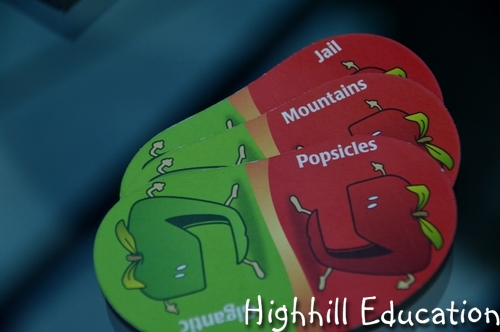
What do you think is the coldest? Jail, Mountains or Popsicles?


In the game Apples to Apples, players select a card from their hand which they believe goes best with the selected adjective. The judge (a rotating position) selects the best match. The winner is the first person to have five of their cards selected by the judge. 


 Apples to Apples Party Box - The Game of Crazy Combinations (Family Edition)

Crazy combinations make this game fun. Mushy clowns, colorful throw up, and fragile spaghetti may be selected as best matches. There are several versions of this game. After becoming hooked with a novelty Jelly Belly version we purchased a version with lots more cards. The kids love this game and I like it too. It's fun, but the kids are reading (a little), learning about nouns and adjectives, and beginning to select different cards based on who is judging. After all, my daughter is much more likely to select a card that says dance or fairy and my son is more likely to select iPad. Sometimes playing to the judge really works.

A Fun Alphabetizing Activity for Kids

We alphabetized our postcards.

Exchanging postcards is an activity packed with learning. Kids can improve writing skills, learn geography, math (buying stamps and making change), and how the postal system works. We've been exchanging postcards on and off for a while now and the kids have built up quite a collection. A while back we participated in an organized 50 state postcard exchange. We have done informal exchanges through Postcardkids and PostCrossing and have purchased many postcards during our European travel adventures.

In organizing the cards my daughter received a geography lesson and an alphabetizing lesson. She had no idea she was receiving the lessons, she was just busy organizing.

The postcards were stuck to loose leaf papers with photo corners in a notebook. The notebook contained tabs for each of the continents as well as a separate tab for the United States. The first sheet behind each tab was a blank outline map. Behind the map was a sheet for each state or country in alphabetical order.

To put cards in my daughter had to find the correct page. Since the book was in alphabetical order she quickly learned how to alphabetize. In addition, as each of the postcards was placed in the notebook the country or state where the postcard originated was colored.


Here's the Missouri page.


Interest Based Education - Reading

Until recently, my second grade daughter has shown very little interest in reading. Therefore, I consider reading our first major breakthrough using the interest based approach to education. Last year and previously, we read together and I required her to read to me. (After all, I feel reading is very important.) Unfortunately, despite the fact that she liked the books and even selected them herself, it was a constant struggle, since reading was required.


Enter Unschooling
One thing my seven year old is very interested in is Pippi Longstocking. In the past, I read her all four of the Pippi chapter books. Since then, she discovered Pippi cartoons on youtube. Although I personally don't have an issue with her watching the cartoons, I do have an issue with her spending all of her available time watching them. So I've been thinking about how to get her to change her focus.


Option 1 - Limit technology or Pippi time
Potential result: This will create a deeper desire for her to watch Pippi and more videos in the future. Plus, doing this is the opposite of encouraging interests.

Option 2 - Change her focus to a different educational video - In other words, encourage her to watch more videos (that are educational).
Liberty's Kids is a series of animated American History videos for kids. When episode one was turned on for me to enjoy, she quickly joined to watch the episode. I was hoping that she would turn on Liberty's Kids instead of Pippi on her own, but that didn't work. Perhaps she just needs a little more exposure to Liberty's Kids, or a series which she finds more interesting?

Option 3 - Offer to read the Pippi books again
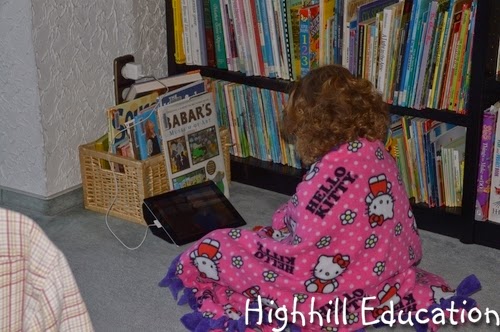
This is where we had the breakthrough. While she was watching Pippi, I pulled the chapter books off the shelf and set them down next to her. I offered to read them then walked away so she could finish her episode. Once the Pippi video was through, she came downstairs with her nose in one of the Pippi books and announced that she would be reading them on her own.


Although the books are way above her level I have no doubt she will be finishing them on her own.

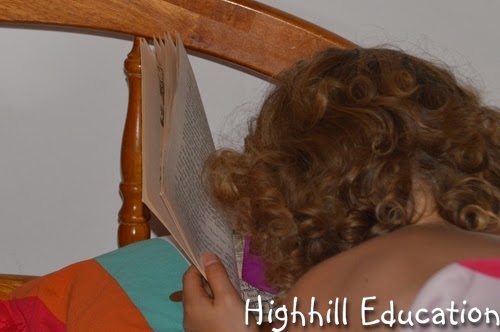
(Can you see the purple flashlight strapped to her head? She's reading Pippi in bed before going to sleep.)


She can read and is highly motivated to read the Pippi books. It just may take her a while to get through them all, but her reading skills should drastically improve.

Teaching Kids to Read

Learning to read is perhaps the most important skill children learn in school. Knowing how to read opens many doors and creates opportunity. Children can learn about anything which interests them. My Language Arts Page has links to ideas for some fun games to play in conjunction with learning to read.


Games are great for learning to read, but playing the games in a sequence that enables the child to build on existing knowledge is key. There are several steps in learning to read. Although it isn't necessary to thoroughly master each skill before moving on, sufficient knowledge of a skill set will enable the child to figure out missing information as they progress.

Many phonics curriculum methodically cover each step in this process, but they can be expensive and repetitive. All three of my children have learned to read by spending lots of time on each of the steps in the process, but without the pressure of a curriculum. Keeping children entertained and interested is more important than covering each minute detail. Practice through various activities will fill in gaps.

Teaching a child to read is so much fun. Playing games and spending time together are rewards enough to practice every day.


Here is the general process we follow to learn to read.

1. Learn letters
2. Learn letter sounds
3. Learn to read three letter short vowel words such as cat, big and hop
4. Begin reading very simple books. The School Zone books are my favorites because they are colorful, simple and entertaining.
The Fox on the Box (A School Zone Start to Read Book, Ages 4-7, Level 1)
Jog, Frog, Jog - level 1 (Start to Read! Library Edition Series)
The Gum on the Drum (Start to Read! Library Edition Series)
5. Continue to practice reading words with games, activities and manipulatives.
6. Introduce consonant blends such as br as in brat, and brim, cr as in crab, and sh as in fish and shop
7. Learn about the letters who like to go together at the ends of words; ll, ff, zz, ss and ck as in hill, off, and sack

Before Proceeding to Step 8 - kids should have a very good understanding of steps 1-7. Proceeding to Silent e too early can cause lots of confusion and frustration.

8. Learn how silent e makes the vowels say their name, for example tap changes into tape and bit changes to bite
9. Learn how when two vowels are together, the first one says its name; ai, ay, ue, ea, ei, ee, oa, and oe. For example - rain, blue, and each.
10. Continue reading simple phonics books and maybe try out some Dr. Seuss board books.
11. Learn how vowels combine with the letter r - ar, er, ir, or and ur - several sound alike and we must learn how to remember them over time and through reading.
12. Learn about silent b and silent k which do not make a sound.
13. While reading simple books discuss naughty words that don't follow the rules such as said and have.
14. Spend a day or two learning about the following unique sounds; ow, ou, igh, oo, y, aw, au, oi, oy, ew, eu, and eigh.
15. Practice reading two syllable words such as catfish and velvet.
16. Continue reading easy books such as Little Bear and Dr. Seuss. Read, Read, and Read.

Notes:
  • Steps 1 and 2 are often done in reverse order or simultaneously. For us one of our favorite resources to complete these steps are the Leap Frog Videos.

  • Many games on my Language Arts Page work well for steps 3-16.
  • We did not practice site words. Although it's not a bad idea most of them follow the above rules and can be learned through practice.

My favorite manipulatives for learning to read are letters. Big plastic letters, magnetic letters, letter tiles, homemade paper letters, or tiles which include blends and other common sounds all work equally well.

Here's an example of one of our learning to read sessions. We got out the letter tiles and introduced the ay tile and talked about its sounds. Next my daughter selected letters or letter combinations which would make words with ay. Her list includes; j, w, h, t, s, cl, pl and st.


When doing this activity, if she selects letters that are phonetically correct but not spelled the proper way in English such as toon instead of tune - I let it go. The point is to learn the rules of reading and the oo sounds the same as u with silent e. If she continues to spell tune, toon once she has mastered reading at a much higher level, we will talk about it then.

Since this is a learning to read post I thought it proper to link up some letter tiles. If you don't have letters already this is a great set, but if you do, just use what you have. After all, the English alphabet has only 26 letters and it doesn't matter if they are printed on paper, plastic or wood. Children can learn to read from them all.


This post is linked to: 
Sola Gratia 
True Aim Education

Lesson Planning - Reading

I'm having so much fun with this series and am enjoying reading the linked posts each week. To see the past subjects please visit our Resources Page.

Are your kids learning to read or enjoying good books? This is the first year I have had three capable readers.

Here are my top three Learning to Read resources.
Leap Frog Videos
Starfall
Active Phonics Game

After the kids learned their letters, sounds and a few basic words they read progressively more difficult books to me daily. Before long they were reading.

Last year we spent about an hour reading every day. Sometimes I read to the kids, sometimes they read to me, sometimes they read to each other and some days they did silent reading. 

    Here are some of the books I'm hoping to read with the kids this year.

    First Grade Daughter
    50 Famous Stories Retold by James Baldwin
    Just So Stories by Rudyard Kipling
    Paddle to the Sea by Hollings C Hollings
    Jataka Tales

    Fifth Grade Son
    The Jungle Book
    Rocks, Rivers and Earth
    Story of the World Volume 2 - Middle Ages
    Jataka Tales
    Pharaohs of Ancient Egypt

    Seventh Grade Daughter
    Indian Folk and Fairy Tales
    Kim
    Cat of Bubastes


    What books are you planning to read this year?
    • Link-up to your post URL
    • Include a link back to this page in your post – You can grab the button below
    Speed!
    This post is linked to:
    Read Explore Learn
    123 Homeschool 4 Me

    Metal Detecting - Cleaning Old Coins

    When kids are let alone to pursue their interests amazing things can happen. My husband brought my son on one metal detecting outing with co-workers and he was hooked. This new interest is already combining reading, history and science. He talks about it non-stop, read an entire adult book on metal detecting from cover-to-cover and has done plenty of internet research on great finds.

    I was so excited for him when he brought home this coin after his second outing. His next challenge was figuring out how to clean it. Coins are made out of a variety of different metals. Some cleaners and methods work well with certain types of coins, but can ruin others.

    So he did some more research on cleaning coins.

    First he tried a toothbrush, soap, water and hydrogen peroxide. The coin looked much better than when it came out of the ground.

    Next he tried glue.
    He covered the coin with glue and wrapped it in wax paper.


    When the glue dried he opened it and peeled off the glue.

    This process was repeated several times and the coin did look better.

    Then he tried to freeze it with a little water. Some of the gunk was supposed to come off when the ice was knocked off. It also worked to improve the coin.

    Some more experienced metal detectors took a look at the coin and said it probably wasn't very old and likely not a valuable coin. Maybe he will be luckier next time.


    This post is linked to: 
    Relentlessly Fun

    Writing to Read

    I have been participating in a blog hop at Cherrios & Lattes for children learning how to read and write. Although I wouldn't consider my daughter a reader yet, she can read or sound out most three letter words and a few more beyond that. One activity she really seems to enjoy, and does primarily on her own is copying sentences from books. She always picks her favorite book of the week and usually copies the first sentence or two. Then she asks me to read it. When I do she is so proud and satisfied with her work.

    Although she can't yet read she is learning so much with this activity. She is already familiar with the story and some of the words. Each time she copies a sentence she is figuring out a little more of this complex code. Awesome!

    Letters from Storybook Characters

    Have you ever received a letter from Rapunzel or Fancy Nancy? It's amazing! Kids love to receive letters from story book characters. I do this as a fun way to encourage reading and writing.


    This post is linked to:
    Sola Gratia
    Saturday Show and Tell
    Tuesday Tots 

    What's Gnu

    ThinkFun What's Gnu is fun game for learning to read and practicing spelling and vocabulary skills. It comes with sturdy cards, plastic letters and a letter dispenser. Players take a card and then try to fill in the missing letters with letters from the dispenser to make words.


    This post is linked to:
    Trivium Tuesdays
     * I did not receive any compensation for this recommendation. I'm just a homeschooling mom who has found many products that I like. If you're interested in the products I recommend on this blog I want to make it easy for you to find them.
    ** I am an Amazon associate and receive a small portion of the sales on orders made after clicking in from this site, which I promptly spend on homeschooling books and supplies for my children.

    Hide the Letters

    My kids love searching for Easter eggs and they also love searching for letters. Here is a fun hide-and-seek phonics activity.

    Hide three letters that form a word.


    Let the child find the letters and figure out the word.

    You could also put letters into the plastic eggs and hide the eggs.


    This post is linked to: 
    Rainy Day Mum

    Recommended Books for a 7 year Old

    A question I read on a lot of homeschool message boards is "Could you please recommend some books for my 7 year old to read." I rarely see this question asked for any other age. So I've been thinking about why that is. I believe it is because at the age of 7 many children are transitioning from picture books to chapter books. They're not quite ready for the challenging chapter books recommended in the higher grades, but ready for more than just short stories.

    Both my older children, daughter and son, have passed through this phase. Here is my list of books they were able to read on their own while transitioning from picture books to chapter books.


    There are many different books series which have been thoroughly enjoyed:

    Animal Stories by Thornton W. Burgess - The Ambleside On-line curriculum uses the Animal Book and Bird Book by Thornton W Burgess as part of the science curriculums around years 1-3. These Animal Stories such as The Adventures of Buster Bear, are quite a bit easier, educational and very entertaining.
    26 Fairmount Avenue Series by Tomie De Paola - This is a semi-autobiographical series of books and very good for the transition phase.
    The Littles by John Peterson
    Little House Chapter Books by Roger Lea MacBride (adapted) - This series is an extension of the Little House on the Praire books by Laura Ingles Wilder. The books follow her daughter Rose on her childhood adventures. I don't usually recommend adapted books, but these are good for children just beginning to read chapter books.
    Magic Tree House by Mary Pope Osborne - Although these are not my favorites, they do contain lots of historical and geographical information. The kids really like them.
    Magic School Bus by Joanna Cole - This series is another which is on my ok list. Again the kids really seem to like them and the stories contain lots of science information.

    In addition to the series books listed above, these books are great.
    Milly Molly Mandy by Joyce Lankester Brisley - The book contains several short stories which are particularly good for girls. They follow the oh so innocent adventures of a Little British Girl. I remember one of them about when she ran a store for the afternoon and another about her new bedroom.
    The Hundred Dresses by Eleanor Estes - This is another story particularly suited for girls.
    My Father's Dragon by Ruth Stiles Gannett - This is actually a series, but we have only read this book. 
    Abel's Island by William Steig - This is charming tale of adventure and survival as related by a newly wed mouse.
    The Big Wave by Pearl S Buck - Set in Japan this story deals with death and Tsunami.
    Tornado by Betsy Byars - This is the story of a dog who is lost to another family during a tornado.
    The Whipping Boy by Sid Fleishman - Set in the middle ages, the prince and his Whipping boy go on an adventure together.
    The Bears on Hemlock Mountain by Alice Dagliesh - A growing child must cross the wilderness to complete an errand.
    Viking Adventure by Clyde Robert Bulla - This book is an excellent example of a Living Book. Through story readers come away with an excellent understanding of life during Viking times.
    The Last Little Cat by Meindert De Jong - This is the story of how a little cat finds a home.
    Quake! Disaster in San Francisco, 1906 by Gail Langer Karwoski - This is the story of how a boy is seperated from his family during the earthquake, befriends another lost child, and eventually finds his family.


    Sign-up to follow Highhill Education by email below.
    Enter your email address:


    Delivered by FeedBurner


    This post is linked to: 
    No Time for Flash Cards
    Living and Learning at Home

    Bananagrams - Spelling and Reading

    I love playing games with my kids and fun-educational games are the best!

    Bananagrams - In this Scrabble-like game players race against each other to be the first to use all their letters in words. Words can be changed and letters can be traded. We have played individually and in teams. This fun-educational game is great for family game-night.

    My non-reader also enjoys playing this game. She will put letters together and we help her to sound them out. We often hand her a vowel to put in the middle and suggest a consonant or two for the beginning and end. It is fun for my older kids, but also helping my youngest learn to read.


    * I did not receive any compensation for this recommendation. I'm just a homeschooling mom who has found many products that I like. If you're interested in the products I recommend on this blog I want to make it easy for you to find them. 
    ** I am an Amazon associate and receive a small portion of the sales on orders made after clicking in from this site, which I promptly spend on homeschooling books and supplies for my children.

    Paperback Swap

    Paperback Swap is my favorite way to evolve a home library. Since we live in Germany our selection of books in English is somewhat limited. The library on the base tends to have books with recent copyrights, there is a thrift store that has a decent collection, and there is a book store on the base. Of course I also order books through Amazon.

    Paperbackswap is for trading books and membership is around $20 per year. After getting an account members type in the ISBN #'s of the books they are willing to send to someone else. It costs around $2.50 to mail a book. Each time a book is received, the member who sent the book receives one credit. One book costs one credit.

    The key to trading books this way is patience. It can take several months for books to be requested. In addition, popular books that are requested can have long waiting lists. If you are interesting in evolving your at home library this is a great way to do it.


    Check out these great blog hops.

    Spell Words from Magazine Cutouts - Phonics

    Here is a fun and free phonics activity to help little ones learn to read.

    Cut out photos of three-letter, short-vowel words such as pan, cup, bed, hat, dog, and cat from magazines. I did this step on my own before getting my daughter involved because I wanted to ensure that the words were all short vowel words.

    Get out the letters and try to spell the word.

    Staple several sheets of paper folded in half to make a book. Paste the magazine pictures into the book and try to remember how to spell the words. Then write the words below the pictures.


    This post is linked to:
    Show and Share Saturday

    ABC Book

    I love to make ABC books with my children to help them learn their letters and letter sounds. Stickers, magazine cutouts, hand drawn pictures, and photos can be used to decorate the pages.

    Fold seven sheets of printer paper in half and staple together to form a book.

    Label each page with one letter of the alphabet.

    Add stickers, cutouts from magazines, and/or drawings to the appropriate pages.

    Then read the book together and suggest they read their book to dad, grandma or another friend or family member.

    Check out these great blog hops.

     
    Related Posts Plugin for WordPress, Blogger...