Showing posts with label Government. Show all posts

Gerrymandering Explained to Kids

Here is a free and fun worksheet used to explain the concept of gerrymandering to kids.

Gerrymandering Worksheet

Gerrymandering is a way politicians draw voting district lines in a way that helps them retain power. With elections coming on November 6th some states have proposals on the ballot to reduce gerrymandering. Regardless of your stance on the issue, this presents a good opportunity to understand the issue.

 This video from CBC news explains the issue and how it works.


After watching the video I printed out the worksheets and told the kids each of the four groups of blue and red people represented a state. Each state would have five voting districts with five people in each district. I showed them two ways the district lines could be drawn and then asked them if they could draw the lines in a way that the blue guys won the election.


Just like the politicians, they had to draw oddly shaped groups. Once they were finished I declared them qualified to draw voting district lines for actual politicians.


Johnny's Jelly Bean Tacos - Book Release

My husband wrote a book and my daughters and I illustrated it! Johnny's Jelly Bean Tacos


I'm so excited to tell you about our second product from Highhill Educational Supplies, but first let me tell you about the author.


Jeff Norkoli is an informed citizen who has learned to gather information from a wide variety of news sources and thereby think for himself. Being aware of issues in the country is a passion of his, and living overseas in Europe for six years has given him a unique perspective. As a homeschooling father since 2007, he has learned to appreciate the value of a great story.

He holds degrees in both civil engineering and computer science. Throughout his career he has continuously been given tasks which include writing because his co-workers..... (didn’t want to do it)…. discovered his gift of word smithing. 

Long before becoming a homeschooling father, his own father shared with Jeff his talent for creativity with words often writing poems for birthdays and other special occasions. Jeff enjoyed listening to his father’s ballads and inherited his ability to naturally create them. His talent for writing coupled with his interest for educating children in an entertaining way inspired him to write this children’s book.


With sales down at his taco restaurant, Johnny Van Socken invents a new delicacy that becomes an instant success: jelly bean tacos! Unfortunately for Johnny, his success poses a threat to some of the local business owners. When the other business owners convince the local government to pass rules to control the sale of jelly bean tacos, Johnny stands up to protect his rights as a businessman, as well as the rights of his customers.

Johnny's Jelly Bean Tacos is written in verse and perfect for kids ages 4-10. The story introduces kids to the concept of government protectionism without ever mentioning the phrase. Like the card game Speed! which is truly a game, Johnny's Jelly Bean Tacos is truly an entertaining book. Although kids will come away with an understanding of protectionism, this is not a lesson in disguise. It is a great story!

The Tuttle Twins

The Tuttle Twins is a new series of books to help children learn about complex political and economic concepts.

There are currently five books in the series targeted at children ages 6-13. Each 50 page book focuses on a government policy or concept that has real life consequences for all citizens.

The Tuttle Twins and the Creature from Jekyll Island
The Tuttle Twins Learn about the Law
The Tuttle Twins and the Miraculous Pencil
The Tuttle Twins and the Food Truck Fiasco
The Tuttle Twins and the Road to Surfdom

For example, the Food Truck Fiasco explores protectionist laws designed to prevent competition when the owner of a restaurant convinces the city to pass laws that make it difficult for food truck vendors to continue to compete. Eminent Domain, Free Market, and concepts of liberty are among those introduced.

Because these books are targeted at young children, they are brief and the language is simple. The story line does a good job of introducing complex topics but doesn't go into a lot of detail, and does little to address opposing view points. Overall, they are a descent introduction especially if the parents encourage further discussion.

An unrelated follow on series that continues to explore similar complex topics is Richard Maybury Uncle Eric Books. The Uncle Eric books are better for children a little older. (Ages 12-18)

* I did not receive any compensation for this recommendation. I'm just a homeschooling mom who has found many products that I like. If you're interested in the products I recommend on this blog I want to make it easy for you to find them. 
 ** I am an Amazon associate and receive a small portion of the sales on orders made after clicking in from this site, which I promptly spend on homeschooling books and supplies for my children.

Government and Media

We are witnessing a major change in how government officials communicate with the public. First there were speeches given at railway stations, then there was radio, television, debates, and the internet. Now we are moving into social media.

Since the November 2016 Trump/Clinton election, Government and Media is a topic I keep thinking about. Regardless of which side you were on I believe we were all brainwashed by the media to believe that if the desired candidate lost, America would disintegrate. After all, the largest coverage given to Trump was talk about his harassment of women, and the greatest media coverage of Hillary was her unauthorized server.


The media is in a unique position to decide what is news and influence public opinion. Unfortunately, their selections of stories are usually based on increasing ratings. The book  Collins College Outlines: Introduction to American Government even had a term, new to me, for this type of reporting "Yellow Journalism". In general, Yellow Journalism gives the greatest attention to scandals, violence and disasters.

Yes, this type of sensationalism is entertaining, but it makes me personally feel like a stupid uninformed citizen. I haven't watched televised news very much for years. Each time I go back to news watching, it only last for a few days. I get frustrated by the limited background information offered, the vast amount of commercial interruptions and the stories of animals being rescued from trees. What is news these days?

I'm sure I'm not alone in these thoughts. Media is a powerful tool that changes the way people think. Although some people take extra time to do background research, the majority remain confused and uninformed despite watching the evening news regularly.


Seeing large amounts of people crying after the election was a sorry sight. As voters, most individuals felt the need to pick a side and were then swayed to believe disaster was ahead if their side lost. Depending on background, jobs, education and beliefs, life will be affected by leaders, but the effect should not be overwhelmingly terrible.

Media has influence, but we must not let media control our thinking. We must do independent research to be informed citizens. As Americans we should be proud to have a system that consists of three branches of government which were designed as an insurance policy so that no individual or group of individuals could grab a hold of our government and make radical change. No matter who is in charge, the system was designed so that the only work that "gets done" is agreed upon by a vast majority of citizens. The president is powerful, but even the president cannot easily do everything promised during campaigns.

Although our civil liberties have been slowly disappearing over time, we continue to enjoy more freedoms than most people on the planet. Because there are checks and balances, and because there are both democrats and republicans and libertarians and others, not much "gets done" in congress. For the most part, that is a good thing. When things "get done" that generally means new laws are passed that all citizens must obey. The only new regulations that should be made are those which are agreed upon by a huge majority. When one party controls everything, trouble starts. The balance is tipped and one party can do too much. In other words, we end up with wars, entitlements and policies desired by only a few that affect us all.

Donald Trump has used the media in a way different from any past president or candidate. Shortly after the election, I read an article entitled "If Donald Trump Tweets, is it News?" This concept was fascinating to me. By tweeting, Trump can bypass the media and communicate directly with the people. The media must be terrified of loosing influence. The world and government has gone through similar transitions several times in the past. First there was no major communication network, then newspapers, then radio, then television, then the internet and now social media. FDR took advantage of radio with his Fireside Chats. Kennedy took advantage of television participating in a debate with Nixon. We are going to witness a new first as Trump takes advantage of social media.


How exciting to be witnessing history!!!

For more great educational activities check out these blog hops

Preparing for the CLEP or AP Government Exam

I am reading the book Collins College Outlines: Introduction to American Government.


My daughter has passed several CLEP exams which grant college credit. Soon she will be taking the American Government CLEP exam.  This year has been a very different school year in that it is the first time I feel like I am teaching to the test.

Over the past six years my daughter has learned a lot about many history, art, government and economics topics through reading engaging books and hands-on activities. This year, she is documenting her knowledge by passing CLEP exams. In preparation for each for each exam she has spent approximately six weeks reviewing material and filling in gaps.

After she decides to take an exam she first takes a practice exam from the CLEP Study Guide. Next, we work together to identify any weak areas. Then she reviews previously read materials and we work to find new materials that help with the review.


In helping her find resources to study for the Government exam I came across the book Collins College Outlines: Introduction to American Government and I am really enjoying reading it. The book is part of a series that is marketed as helping students to prepare for AP exams. In general, AP exams and CLEP exams cover the same material, but the university decides which one, if any, or both, to accept. CLEP exams can be taken at any time of year, by anyone, but AP exams are only open to high school students. My daughter is in the unique position to be eligible for both exams.

Getting back to the book, since it is written for the general audience as a review for exam preparation it is mostly unbiased, a little dry, but very informative. It covers the creation of American government, federalism, mass media, interest groups, elections, congress, bureaucracy, civil liberties among other topics. My daughter and I are both familiar with many of the topics in the book but like they way it defines basic terms and explains the roles and interactions between groups. The book is meant for reviewing. It doesn't go too in depth into any topic, but gives enough information that can lead to further research by an interested reader.

Before reading this book we read the Uncle Eric Series by Richard J Maybury, The Five Thousand Year Leap, The Freedom Answer Book and others that can be found on the History Page. This book expands on that knowledge and we are drawing many connections between the book and current events.

I'm confident that after reading this book she will be prepared for yet another CLEP exam. Although this year has been a little less mind expanding than years past, it is really exciting to see how much she has learned by reading interesting books and hands-on activities. Homeschooling really does work!

For more great educational activities check out these blog hops.

Writing an Oxymoron - Honest Politician

My daughter wrote a sentence with an oxymoron - honest politician.

Since art is a favorite subject for my 9 year old, I have been working to deeply incorporate it into her curriculum. This year she is using the book Teaching English Through Art for writing two days per week. The other days we work together to write and edit stories, descriptive works and other forms of writing. The book has been a big hit!

This week her assignment was to write a sentence containing an oxymoron. (An oxymoron is two words put together that don't normally go together.) The book gave several examples to choose from. With the presidential election only days away honest politician seemed like a natural choice for her.

Her sentence reads "Honest politicians are very rare. Hillary Clinton is not honest."


The other night at dinner, she added, "I hope Hillary doesn't win because I think I want to be the first female president. Or maybe I want to be a clothes designer."

Whoever wins, I hope will preserve Constitutional Freedoms.

Happy Election Day!

Election Unit Study

We completed an Election Unit Study.

During the 2012 election year we spent some time studying the election.

Election Week Lesson Plan
Election Math
Election Books
President Song and Oval Office Craft
Contracts, Loans, Constitutional Freedoms

So when the authors at Silverdale Press contacted me asking me to review their Presidential Election Unit Study, I thought the timing was perfect for a more in-depth study.

The unit contains eight lessons beginning with the primaries and continuing through election day. Do you know the difference between the Primary and the General Election? What does it mean for a state to be winner take all? Which states are winner take all? The eight lessons in the unit explain each topic with a chapter followed by review questions, websites, and activity ideas. There are activities which draw on historical elections, as well as the current election.

The kids learned a lot when we added up the votes from each state and candidate from the primary elections. That way they could clearly see what was needed to win and why candidates would drop out at certain stages when it didn't look likely that they would be successful.Anothe r chapter we enjoyed concerned advertising campaigns and media. There were several references to television commercials of past elections which we were able to find on youtube.

Since the unit was recently written, the material couldn't have been more up-to-date. I found this unit very educational and for $30, with the election right around the corner, the timing is perfect.

Check out these great blog hops for more educational activity ideas.  

The Road to Serfdom


Serf is a medieval term which refers to a person who worked for a lord. Serfs were low status servants and held a position similar to that of a slave. The book The Road to Serfdom by F.A. Hayek was written for British citizens shortly after World War II as a warning to prevent them from becoming a socialist or communist nation.


One major issue in socialism is determining which policies to implement. Since each person is unique agreement on issues is not necessarily black and white. For example, most people may agree that the government should provide and maintain major highways, but should they be responsible for all roads? Who determines which roads are necessary? What about a road connecting two small country villages used by only a few people?

Perhaps government should assist the less fortunate such as children who are orphaned. But what about less fortunate drug abusers who self destruct and end up homeless? Some people may say yes where as other would say I'm not so sure.

Issues are not black and white, and once ruling powers begin making policy decisions, we as individuals loose the power to decide for ourselves. Therefore, an argument is made in the book that government should only implement policies for which a vast majority of the population is in agreement. Even so, each policy that is implemented leads to more potential areas for government to create policy. With more planning and policy, freedom becomes less predictable.

While living in Germany I learned of a local dance studio run by an American. Her studio was successful because she had identified a community need and her classes were well attended. Unfortunately, she was an American and not familiar enough with the rules (tax laws) where she was operating. More than once she received high tax bills (in the neighborhood of 10,000 Euros) she was not anticipating. One could argue that she should raise her prices and be more knowledgeable of her situation. Perhaps she felt that she was charging a significant price (likely compared to average American prices for similar services). After all her classes were full. Luckily, she was able to receive a donation and continue with her business.

I found this story incredibly interesting, because we also participated in dance while living in Germany, however, we attended classes within the German system. The class my daughter took cost only about 20 euros per year plus a few costume/shoe expenses which amounted to an additional 100 euros. So how could her classes be so cheap while the classes offered by the American were so expensive and her business was failing? My daughters lessons were not offered through a business. They were offered through a private club. The cost was the membership fee. It was a non-profit and the teachers were volunteers (which has its own set of issues).

So operating in the German system there was no monetary incentive for teaching dance. The teacher of the expensive lessons essentially made the same amount of money as the volunteer. Interesting? The point is that the more policy that is created, the less choice available to the citizens.

The book The Road to Serfdom explains how socialism and communism are implemented and why they gain popularity by drawing heavily on the examples of Russia and Germany. It is a college level text and not a simple book, but worth the time. After reading the Richard Maybury books and other easier books recommended in earlier posts I would recommend this book for gaining a deeper understanding of other forms of government.

Civil War - Big Government or Slavery?

To understand how American Government works today it's important to understand the past. Over the course of 150 years the federal government went from one of limited power to one that controls the states and regulates many aspects of our lives. Our freedoms have slowly been reduced especially during times of war when presidents present issues to the public to further their ulterior motives.


The Lincoln Administration was no exception. The Federal government gained an extraordinary amount of power through the front of the Civil War. In school we learned that Lincoln was a great president because he held the union together and stopped slavery. The book The Real Lincoln: A New Look at Abraham Lincoln, His Agenda, and an Unnecessary War presented a very different picture of the great president Abraham Lincoln.


Lincoln was a long time member of the Whig party and the Whig party wanted a strong central government. The party didn't have a strong stance on slavery. It did however, want to increase the power of influential businesses through special favors. Sound familiar? Lincoln set much of the framework for the way our government operates today. When Lincoln became president, he was a member of the Republican party. The Whig party had broken up, and although he was new a republican, he implemented the Whig party agenda. A central banking system was formed under the Lincoln administration and almost immediately, low interest rate loans were given to good friends.

Many big businesses were located in the north, and the south was the customer. Europeans produced goods which were competitive with the goods of the north. To force the southerners to purchase northern goods, the north wanted high import taxes placed on foreign goods. The south wanted the ability to choose which goods to purchase based on price and quality. The tax issue was one of the real reasons for the Civil War.

Another question I always had about Lincoln was "If he was so great, then why did people want to kill him?" That never made any sense to me. Well the book The Real Lincoln answered that question. In public speeches, Lincoln often contradicted himself by telling people what he thought they wanted to hear. He didn't really care about slavery. He cared about strong central government.

Once the war was far underway and the Union appeared to be loosing, Lincoln wrote the Emancipation Proclamation. Unfortunately, the document was responsible for freeing few if any slaves. It was written in a way that it didn't make much difference. In locations where the Union had control, they were not permitted to free slaves. The only slaves that could have been freed were those in locations where the Confederacy had control.

In addition, the public was outraged when Lincoln tried to turn the Civil War into a war over slavery. The southerners wanted slavery because it was a cheap source of labor. The north didn't have need for slavery, but also didn't sympathize with slaves or blacks. They saw blacks as workforce competitors. Racism was rampant. Once Lincoln attempted to change the purpose for the war soldiers deserted and riots began. Europeans hated the proclamation as well, and only saw it as an item which would create slave revolts.

Although approximately 2% of the population known as abolitionists wanted to end slavery, the rest of the country was fighting in the Civil War for economic reasons. If the South left the Union, the north would not be able to charge such high prices for imported goods. Lincoln was a Northerner. 

Reading this book offered a new perspective on history which makes sense. If you have questions on the history taught in the schools, I encourage you to read this book and then form your own opinion.


Check out these great blog hops for more educational activity ideas.

War is all about Money

The more I learn about wars in history, the more I see a repeated story.

I'm not a fan of children's story books that have a bully. The bullied child fights back and eventually the situation is resolved. In the end, the bullied child is happy. There are numerous books with this storyline and conflict. They only differ by the way the conflict is varied. Sometimes the bully steals lunch money, sometimes the bully pokes fun at clothing. Regardless, the story is the same. It's predictable.

Just like this storybook plot, war stories are repetitive. In each case, the leaders present an issue to the public that evokes lots of emotion. The more the public hears the emotional story, the more they support the war effort. However, in most cases, the public is completely unaware of the true motive behind the war. MONEY! In almost every case the story is the same. The true reason for war is money.


I'm not a history expert by any means. In fact, I didn't do that great in history class in either high school or college. However, for the past seven years I have been homeschooling my children. Each year we study history. For the past five years we have selected one cultural and time period of history and learned all about it. We have covered Mesopotamia, Greece, Rome, Persia, Celts, Vikings, China, Scythians, Middle Ages, Renaissance and now we're into American History. I'm amazed how frequently the war story repeats itself. Here are a few examples:

War - Public Support Gained of Issue - True reason

Roman Empire

The Romans fought many wars to expand their empire. The public supported the wars because they believed their enemies were barbarians and uncivilized people which they could teach and reform. However, the true reason for the wars was money. Each time the empire conquered new territory, slaves were taken. In ancient Rome slaves meant money.

Middle Ages (Crusades)

During the Middle Ages the Crusades were supposedly about religion, but in actuality they were all about money. The public felt they had a right to the holy land and that it was their duty to take the land from the non-believers. If they fought for the holy land they believed their sins would be forgiven and they would be rewarded in heaven. However, throughout the conquest, religious leaders with public support not only plundered wealthy cities, they also began services which resulted in huge economic gains. Groups of knights formed which became wealthy by offering protection to travelers. The knights enjoyed a tax exempt status which greatly contributed to their wealth. In addition, they offered travelers high-interest rate loans. This series of wars fought in the name of religion, was really about money.

Mexican-American War

In the early days of America President Polk hoped to achieve greater economic wealth by acquiring all of the land between the two oceans. However, Polk gained public support for the war by telling the people that Mexico fired on American soldiers on American soil. In actuality, the American soldiers who were fired upon were on land Mexico rightly believed belonged to them. Once again, public support was created for the war under the guise of righteousness when the true reason for the war was all about money.

Civil War

In recent weeks I've been reading about the Civil War. This most deadly of all past American Wars was fought in the name of slavery, when again the true motivation was money. The Lincoln administration wanted a big central government in which favors could be given to friends and big businessmen. Most of the favors were being received by people in the north. In the south, taxes were being raised on imports in order to force the people to purchase goods from the north. Because the south was opposed to these taxes, the north ended up closing ports in the south. This economic dispute lead to states in the south wanting to leave the union and ultimately war. The war fought in the name of slavery, was actually all about money.

Present

So now fast forward to present times. Why are we fighting in the middle east? I've heard women in those countries are treated poorly. I've heard we're scared those countries have weapons of mass destruction. Well I know they have oil. Oil represents money. I ask you........ do you think the war story has changed?

If you have any good books to recommend on this topic please leave me a comment.

Constitution Study for High Schoolers

The Five Thousand Year Leap should be the government book for high school children.


When I was in high school I remember learning about the three branches of government, ages required to hold various offices, the Constitution and two main parties. Overall, the course was very basic. 

Politics today are so wrapped up in party specific agendas and special interest projects. Often decisions of politicians make little to no sense at all. The book The Five Thousand explains why the Founding Fathers wrote the Constitution they way they did. Despite coming from a variety of backgrounds; (differing religious beliefs, professions, income level, etc) they were all well read and agreed on most issues. The majority of their discussions focused on the best ways to implement their goals. They didn't focus on party specific issues, rather, they spent their time writing a document which would work in a variety of different circumstances.

One of their primary goals was to create a government which operated between the two extremes of tyranny (ruler's law) and anarchy (no law). In other words, they wanted the people to rule. The book steps through 28 principles of which the Founding Fathers based their ideas. Beginning with the principles of Natural Law, and virtuous and moral people, this book explains the reasoning of the Founding Fathers in a way that makes a lot of sense still today.

While reading this book my 13 year old daughter completed a number of writing assignments which corresponded with the chapters. Here are some of her essay questions.


Tyranny and Anarchy
1. North Korea is a country currently ruled by tyranny. Somalia has anarchy. Research both countries and write an imaginary tale of your life as a child in each country.


Natural Law
2. You know the difference between right and wrong and therefore instinctively understand natural law. Create a table listing examples of acts both in accordance with and contrary to natural law.

Natural Law vs Political Law
3. Describe at least two past or current American laws which are not in agreement with natural law. Why were the laws passed? What happened?

Irredentism - Land Taken by Force
4. If you were a world leader, describe your irredentism policy.

Price Caps and Price Controls
5. Do you believe price caps/controls are positive or negative policies? Explain using examples.

Immigration
6. Immigration is a current hot topic in politics. How would you deal with immigration?

Booms and Busts in Economics
7. Briefly describe the cycle of economics.

8. What is inflation?

Government Subsidies
9. Should businesses be subsidized? Why/why not? Give examples.


Check out these great blog hops for more educational activity ideas.


Combining History, Government and Economics - Richard Maybury

The single best resource I have found which combines the subjects of history, economics and government are the Uncle Eric books written for children by Richard Maybury.


Uncle Eric Talks About Personal, Career, and Financial Security (An Uncle Eric Book)
Whatever Happened to Penny Candy? A Fast, Clear, and Fun Explanation of the Economics You Need For Success in Your Career, Business, and Investments (An Uncle Eric Book)
Whatever Happened to Justice? (An Uncle Eric Book)
Are You Liberal? Conservative? Or Confused? (An Uncle Eric Book)
Ancient Rome: How It Affects You Today (An Uncle Eric Book.)
Evaluating Books: What Would Thomas Jefferson Think About This? Guidelines for Selecting Books Consistent With the Principles of America's Founders (An Uncle Eric Book)
The Money Mystery: The Hidden Force Affecting Your Career, Business, and Investments (An Uncle Eric Book)
The Thousand Year War in the Mideast: How It Affects You Today (An Uncle Eric Book)
World War I: The Rest of the Story and How It Affects You Today, 1870 to 1935 (Uncle Eric Book)
World War II: The Rest of the Story and How It Affects You Today, 1930 to September 11, 2001 (Uncle Eric Book)

Reading this series teaches kids how to make decisions that will affect their lives in a positive way. I loved sections of Personal, Career and Financial Security which discussed the benefits of exposure to a variety of experiences such as, school plays and clubs, sports teams and work experience. Teens have the opportunities to learn different skills from all of these activities. Whether training a new employee, to working with another student to memorize lines, to speaking in front of a large audience, to learning to be responsible and show up on-time each day, kids will benefit.

The book Liberal? Conservative? or Confused? explained how different parties try to control different aspects of our lives which they believe will benefit society. What is a liberal and why is the term so confusing? This book explains.

Since I noticed many parallels between Ancient Rome and America a few years ago when we studied the Roman Empire, I was excited to read Ancient Rome: How It Affects You Today. There were three distinct eras of Roman history. There was the Roman Monarchy, The Roman Republic and then the Roman Empire. The book explains how the government changed during each era and how it effected the people. These changes are evident today in American history, but on a much accelerated basis.

Overall, I would highly recommend this series of books as part of a connected study of history, government and economics.


Check out these great blog hops for more educational activity ideas.

High School Government, Economics and History - A Combined Study

This year my high-school aged daughter studied government, economics and history.

Because there is so much correlation between the three subjects it's difficult not to study them together. Over the next several weeks, I will discuss the resources we used covering these subjects at the high school level.

Before beginning this in-depth government, economic, history study we spent a lot of time studying history. In fact, history has been covered in some form each year for at least six years. In addition, the basics of government were well understood before beginning this unit. This government course is not a course to learn about the three branches of government and how many representatives there are, but rather a course to understand how the government works and has operated throughout history. Different administrations have enacted policies which continue to affect us today. Many political decisions are based upon power and economics. To truly understand government and it's impact upon us, it is important to understand how we got to where we are. Hence, history, government and economics can and should be studied in conjunction.


There is no better place to start than the beginning of American Government as we know it today - The Constitution. The book Five Thousand Year Leap does just that. It explains the reasoning behind the Constitution in a set of principles used to define the Constitution such as Principle 7: The proper role of government is to protect equal rights, not provide equal things., Principle 1: The only reliable basis for sound government and just human relations is Natural Law, and Principle 27: The burden of debt is as destructive to freedom as subjugation by conquest. I highly recommend this book as a great place to study government once the basics are understood.


Please join me each week as we dig deeper into these three intertwined complicated subjects to shed light on them and make them easy enough so that a high school student can understand.

Check out these great blog hops for more educational activity ideas. 

Contracts, Loans, Constitutional Freedoms - An Activity for Children (ages 7-13)

We acted out the the court case Home Building & Loan Association v. Blaisdell (1934).

 Today a large percentage of the American population feels entitled to certain benefits. Many feel the government should provide for people. In the Freedom Answer Book by Judge Andrew P. Napolitano, he addresses many aspects of the constitution and how Government Laws and Policies have changed the United States Government and served to slowly move the United States in the direction of a country in which Government Policy tries to protect the people but actually creates greater damage.

In the court case Home Building & Loan Association v. Blaisdell, the court had to choose between two conflicting laws. The first was the Contract Clause of the Constitution and the second was a law passed by the State of Minnesota preventing lenders from foreclosing mortgages. The law was passed during the Great Depression and meant to slow down the effects of the depression while helping citizens get back on their feet. However, the law was in direct conflict with the Constitution.

The decision the courts ultimately made was to uphold the Minnesota law thereby protecting citizens from their own financial problems and ignoring the Contracts Clause of the Constitution. According to the book, it marked a turn away from the constitution and a turn toward the government protecting the common good. Here's a quote.

The Court was no longer concerned about keeping the markets open and free. It was no longer concerned with keeping the government small. It was no longer concerned with enforcing freely consented-to agreements. Its new priority was "the common good" and making sure the government would provide for it.


The court decided in favor of the Minnesota law, but I wanted to see how my kids would decide the case.

First the small hedgehog named Vegie 3, decided to purchase a house from the pink hedgehog named Snowflake.


They wrote out a bill of sale and both signed.

Next, Vegie 3 secured a loan from Hedgie, the banker.

Hedgie agreed to loan Vegie 3 $70,000 and Vegie 3 agreed to give Hedgie $1000 per month for 70 months and agreed to give Hedgie the house if she didn't pay. Hedgie did not charge interest.

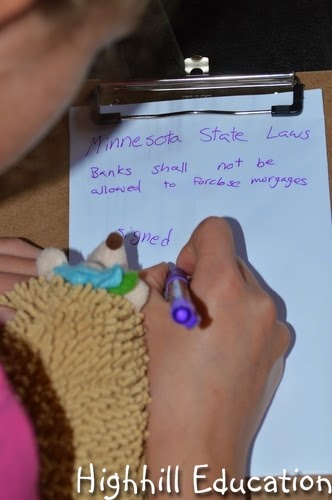
Next, the hedgehogs working in the government decided to pass a new law. Banks shall not be allowed to foreclose mortgages. They discussed how sometimes people (or hedgehogs) sometimes just need a little time to get back on their feet. When they are down-and-out taking their house can only make matters worse for them.

The government wrote and signed the law.

Then Vegie 3 went to work. She earned $2000 per month and happily gave Hedgie $1000 each month. The rest she sometimes saved and sometimes used to purchase food and go on vacation. Everything went fine until October came. Vegie 3 was told she was no longer needed at work. She tried desperately to find a job. She asked the bank if they were hiring, the government and even the courthouse, but nobody had any work for Vegie 3. After a few more months she ran out of money and was brought to court.

 
Hedgie wanted her money, but Vegie 3 couldn't pay. Therefore, Hedgie asked for the house. She brought her signed contract as evidence to present to the judges. Vegie 3 apologized for not paying, but said she couldn't and shouldn't have to because there was a law that said her house couldn't be taken away.

The judges heard the case and then went away for deliberation.

Obviously, this case was greatly simplified so that it could be understood by young children. Nonetheless, it presented an opportunity for discussion and consideration of significant issues.

The kids really had a difficult time deciding this case. They wanted to rule in favor of Hedgie, but provide a one year time period for Vegie 3 to find a new job. I instructed them that that was not an option. The case needed to be decided on the basis of which law took priority and was more important.

Their final verdict - Hedgie wins! Hedgie gets the house and will give Vegie 3 $10,000. The amount repaid on the loan. The reason - Vegie 3 did not pay. Hedgie loaned Vegie 3 money without interest, and the contract said she must pay the money back or she would loose the house. Hedgie is out a significant amount of money and needs her money back. Maybe Vegie 3 could find a job. She's smart. Unfortunately now she's jobless and houseless. Maybe she could find a rich husband, maybe she could sell her car to get some money, or maybe she could find a lower paying job like a food bagger at a grocery story. It's not really Hedgie's concern what Vegie 3 does. Hedgie feels bad, but doesn't deserve to loose the money she loaned.

I think in the end they decided the case on the basis of right and wrong. Regardless of whether a written law protects contracts or forbids the foreclosing of loans, they could see that the hedgehogs made a deal, one broke the deal, and the deal seemed reasonable.Therefore, it was fair that the remaining (yet undesirable) portion of the contract to be enacted.


Check out these great blogs full of educational activity ideas.
Related Posts Plugin for WordPress, Blogger...