Showing posts with label Geography. Show all posts

Firekeeper's Son

Set in Korea, The Firekeeper's Son is a fictional story based in history.


Long before telephone communication and the internet, the Koreans used signal fires to warn the king of a pending attack. In case of attack, enemies were most likely to arrive by sea. Therefore, the firekeeper living closest to the sea would light a fire every night to signal he did not see enemy soldiers. There were a series of firekeepers between the sea and the palace, and it was each firekeeper's job to light a fire after ensuring the fire in his line of sight was burning. If ever a fire was not lit, it was a sign of trouble.

Firekeepers tended to come from the same family. In The Firekeeper's Son, one night the fire didn't burn as usual. When the son went to investigate, he found the fire should have been lit and made sure the job was completed proving himself to be a qualified firekeeper.

This tale of courage not only teaches children about a small part of Korean history, but inspires. When kids hear tales of children taking responsibility it empowers them to do the same. I recommend this picture book for kids K-4th grade.

Game for Learning United States Geography

Last spring at a homeschooling convention I did a little bartering and I'm sure glad I did. The game Snapshots Across America is an engaging way for kids to learn about the United States and a few attractions in each one.

To win the game players must visit seven tourist attractions by driving their car, traveling by train, ocean liner, river boat, lake ship or airplane to destinations.

Other players can ruin a vacation by playing a weather card such as tornadoes in the midwest.

Each destination card has a representative photo and short description of the attraction. From Niagara Falls to Revolutionary War sites to volcanoes in Hawaii a player can travel all around the US.

This game was created by a homeschooling family to teach geography, and they did a great job. The cards are bright. The game sparks a travel interest. It's fun to see where else you can travel and there is even a little strategy involved in being the first player to visit seven destinations.

If you are planning a vacation, this game may even give you some new ideas. We have been playing about once per week in conjunction with reading about US history. This game is a wonderful supplement to any geography curriculum and would make a nice gift.


Geography Game

This is a very straight forward way to study countries of the world. All of the kids enjoyed playing the game when they were about six years old.

Materials:
Internet and printer or Blank outline country map
Crayons or colored pencils
Letter dice
Object counters such as dried beans


Set up
  • The first step is to decide on a continent to study and then print out a Blank Outline Map.
  • Next color each country a different color.
  • When you are ready to play, each player chooses two dice.
  • Then decide on a winning number. This is the number of beans a play must collect to win the game. 30 would be a good place to start.
Play
  •  The first player rolls the two letter dice and then finds all the countries that begin with the letters rolled. A bean is placed on each country.
  • When the player is finished placing beans, other players have a chance to place beans on any missed countries.
  • The player removes and keeps the beans and play proceeds to the next player. 
  • When a player collects 30 beans, or then number agreed upon at the start, the game is over.


Making Falooda with Kids (Indian Food)

We made falooda - a delicious desert.


In between rushing children to gymnastics, boy scouts and piano lessons we learned about falooda while listening to National Public Radio (NPR). Falooda is a layered desert popular in India and neighboring countries. With many variations, the layers consist of ingredients such as vermicelli noodles, gelatin, tapioca, flan and sweet basil seeds. In addition, rose syrup, milk and vanilla ice cream are added to fill in the spaces.


Not knowing what sweet basil seeds were I did some research and found they go by two other names; Sabja seeds and tukmaria. Seeds of the ocimum basil plant, they are praised for health benefits such as relieving constipation and increasing skin health. I found them in the Asian store.


Falooda was easier to make than I anticipated, but I had to begin about 4 hours in advance as both the sweet basil seeds and gelatin require advanced preparation. Wanting to make falooda for five people, I put 5 tbsp in a large bowl with water to soak for about 4 hours. I was amazed by the growth of the seeds and learned that the 5 tbsp was enough for about 10 faloodas.

Next I prepared the gelatin by putting two packets into 1/2 cup of cold water and then adding 1 1/2 cups of boiling water. Once the gelatin was completely dissolved, it was placed into the refrigerator for 4 hours to set.


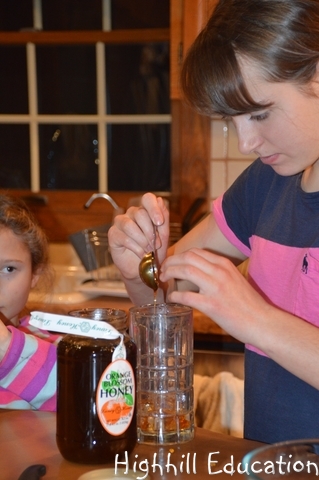
Once we were ready to put the faloodas together, we boiled vermicelli noodles and then began the layering. One half of the gelatin was placed into the bottom of four tall glasses. Next 1 tbsp of honey was added to each glass. I still don't know what exactly rose syrup is, so we used honey instead.


Next, three large spoonfulls of soaked sabja seeds were added to each glass followed by a fork full of cooked vermacelli noodles.


After the noodles were added the glass was filled with milk and then a scoop of vanilla ice cream was placed on top.

One of the comments I vividly remember from the radio interview on faloodas was that they demand attention to eat. That was incredibly true. Those vermacelli noodles were long and difficult, but fun to consume from a glass.

Once the glasses were empty, we were all full and happy.

For more great educational activities check out these blog hops

Alaska and Hawaii Books for Kids

Lesson 12: Alaska and Hawaii

This is the last lesson in our United States study. Earlier lessons can be found on the Geography Page.

America is a country filled with variation and uniqueness. Although differences can be seen between all the states, they are much easier to see on a regional basis. While learning more about the states, I wanted my daughter to gain an understanding of the overall geography of the United States and learn how the differences in climate effect the region. 

Studying all of the United States in a 12 week time frame is very short. Therefore, this study serves as a basic introduction. Before the US study, we learned about Native American. Because we studied Native Americans by concentrating on the region of the country where they were/are located, the two studies complimented each other in many ways.

For example, the plains Indians and the states of Iowa, Nebraska, and South Dakota occupy the same territory. With the same resources available, it was interesting to learn about both the pains Indians and the states of Iowa, Nebraska and South Dakota. Before colonization the Natives hunted buffalo, rode horse back and made clothes out of animal skins. Now the people of the plains are primarily farmers. So how did we go from then to now? The answers are not always happy, but hopefully I have raised some questions in my daughter's mind.

Next on our learning list is The Little House (9 Volumes Set) and a study of United States History. But first, a quick study of Alaska and Hawaii.

Alaska and Hawaii are probably our two most unique states. They are not part of the continental United States and therefore, much more remote than the others. Fortunately, there are lots of books available on these two states. Here are some that we read.

Hawaii

Luka's Quilt - When Luka doesn't appreciate the traditional quilt her grandmother makes their relationship suffers. Fortunately, they find a way to put aside their differences and both be happy.

The Island-below-the-Star - In 1947, Thor Heyerdahl of Norway journeyed across the Pacific Ocean on a raft in his Kon-Tiki: Across the Pacific in a Raft expedition. His exploration changed the way the world believed the Hawaiian Islands were populated. The book Island-Below the Star is a picture book that retells what the journey may have been like from the native perspective.


Alaska

Baby in a Basket - Pictured Above - This book tells and amazing, true-life story of a baby lost and then later found from a sleigh in Alaska.


Akiak: A Tale From the Iditarod - When a lead dog is taken out of the Iditarod, he isn't ready to be done racing, and finishes the race on his own. We loved this excited true stroy.

The Bravest Dog Ever: The True Story of Balto (Step-Into-Reading) is another exciting, but very different story about a lead sled dog in Alaska. Balto a true hero, is instrumental in getting medicine to sick children in Alaska during a snowstorm.


How Alaska Got Its Flag
Through a statewide competition, the big dipper ended up on the Alaska flag. This is an inspiring, non-fiction story.


The Great Alaska Pipeline is a very detailed book suitable for adults interested in the Alaska pipeline. It is interesting, but I would only recommend it for older children who are interested in engineering and big science projects.


A Child's Alaska is the perfect introduction to Alaska for young children as it highlights many Alaska uniquenesses such as the Northern Lights, sled dogs and the midnight sun.


Check out these great blog hops for more educational activity ideas.

Southwest and Pacific Coast States

Lesson 10: Southwest States
Arizona, New Mexico, Texas

The Grand Canyon, and the Petrified Forest are two national parks that make good topics for a southwest state study. Here are some picture books to introduce children to the southwestern states.

The Armadillo from Amarillo
Fish Fry
Armadillo Rodeo
Grandmother's Adobe Dollhouse


Lesson 11: Pacific Coast States
Washington, Oregon, California


Smoky Night
Tree in the Trail
Condor's Egg
Squirrel and John Muir
Quake!: Disaster in San Francisco, 1906


Check out these great blog hops for more educational activity ideas.

US States Unit Study: Heartland and Mountain States

Lesson 8: Heartland States
Minnesota, Iowa, Nebraska, North Dakota, South Dakota, Kansas, and Oklahoma.

With fields covered in grain, this is Little House Country. Small towns and farmland cover the center of the United States. For us, these are the states we drive through to reach skiing in the west, but I wanted my daughter to gain an appreciation for the heartland states; The Bread Basket of America.

We read the following books to learn about the Great Plains.

Climbing Kansas Mountains - In Kansas the grain elevators are the mountains.
Eve and Smithy: An Iowa Tale - Gardens, gifts and neighborly love are celebrated in this picture book.
The Huckabuck Family: and How They Raised Popcorn in Nebraska and Quit and Came Back - Can you grow popcorn? This is a funny tale of the Huckabuck family experience.

Lesson 9:  Mountain States
Colorado, Utah, Montana, Idaho, Nevada, and Wyoming.

Wild horses, and ranching have long histories in these states which are also popular destinations for outdoor enthusiasts. Some of the nations best known national parks lie in these states including Yellowstone, Moab, and Glacier.

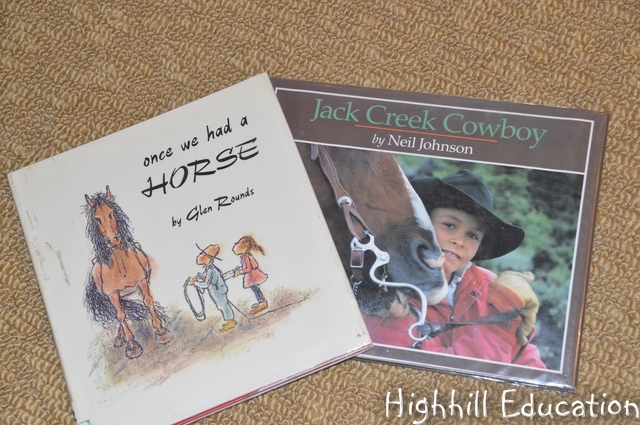
Learning about the mountain states we found three delightful books on cowboys. Jack Creek Cowboy gave a thorough picture of the life of a cowboy. It was quite a long picture book and good for children who are beginning to read chapter books to read on their own.

Once We Had a Horse was a simple story about two kids and their horse.


Tyler's New Boots tells the story of a boy going on a cattle drive. He doesn't want to get his new boots dirty.

A study of the mountain states wouldn't be complete without touching on Yellowstone National Park. The amazing land actually sits on top of a caldera volcano which is scary to think about. Here's an activity for kids to learn more about caldera volcanoes.- Yellowstone Caldera Volcano Activity


Once A Wolf: How Wildlife Biologists Fought to Bring Back the Gray Wolf is a great book for the animal loving child. Another book good for children beginning to read chapter books on their own, this book tells an amazing story of the history of wolves in Yellowstone. The video above goes well with the book.


Check out these great blog hops for more educational activity ideas.
Related Posts Plugin for WordPress, Blogger...