Showing posts with label Educational Games. Show all posts

A New Way to Use Your Speed! Cards

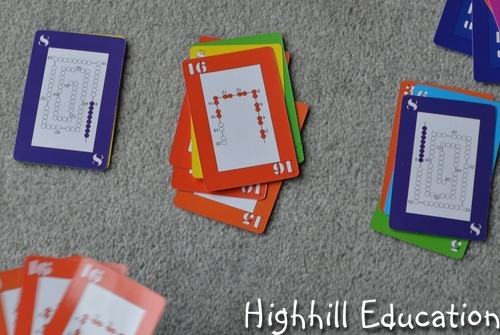
The card game Speed! comes with eight decks of playing cards. Each deck is color coded and uniquely numbered to help kids memorize the multiplication tables. For example, the red Two-Speed deck contains the numbers 2, 4, 6, 8, 10, 12, 14, 16, 18 and 20. The blue Seven-Speed deck contains the numbers 7, 14, 21, 28, 35, 42, 49, 56, 63 and 70. The game was designed as a two-person racing game where the winner is the first person to get rid of all of his/her cards. (see video)

However, since the game is comprised of decks of cards, many games that can be played with a standard deck of cards can also be played with Speed! cards. This adds a new twist to many card games. One simple game that works very will with Speed! cards is a game called "Garbage".  The video below shows the game playing played with a standard deck of cards.


The photo below shows the desired finished layout if the game was being played with the Three-Speed deck of cards.


What I like about the game Garbage is that it is a slower placed game that allows players more processing time. When playing this game and drawing a number 24 for example, players can say out loud "24 is 8 times 3", or "24 divided by 3 is 8". This helps kids to better link skip-counting to multiplication and division and provides a fun alternative game to play with the Speed! cards.

How to Slow Down the Game of Speed!

Speed! is a great game for learning to skip-count, which leads directly into learning multiplication and helps kids to develop an excellent mathematical foundation. But, what do you do if the child gets intimidated by the "speed" of the game?


While most kids love the game Speed! because if its intense pace, this can have the opposite effect on some children. (Click here to see a video of the game Speed! being played.) One thing that can be done is to institute turns into the standard Speed! game. This can be done in one of two ways. The simplest way is for each player to play one card and then let the other person have a turn to play one card passing only when the player does not have a playable card. The second way to institute turns into the game of Speed is to allow one player to play cards until he/she runs out of moves, and then let the other player play all cards until running out of moves. Taking turns will greatly slow the pace of the game allowing more processing time and calming the nerves of children who need it.

Geography Game

This is a very straight forward way to study countries of the world. All of the kids enjoyed playing the game when they were about six years old.

Materials:
Internet and printer or Blank outline country map
Crayons or colored pencils
Letter dice
Object counters such as dried beans


Set up
  • The first step is to decide on a continent to study and then print out a Blank Outline Map.
  • Next color each country a different color.
  • When you are ready to play, each player chooses two dice.
  • Then decide on a winning number. This is the number of beans a play must collect to win the game. 30 would be a good place to start.
Play
  •  The first player rolls the two letter dice and then finds all the countries that begin with the letters rolled. A bean is placed on each country.
  • When the player is finished placing beans, other players have a chance to place beans on any missed countries.
  • The player removes and keeps the beans and play proceeds to the next player. 
  • When a player collects 30 beans, or then number agreed upon at the start, the game is over.


Unexploded Cow

We played the game Unexploded Cow at a gaming convention a few weeks ago.


Unexploded Cow just sounds wrong, but that is the actual title of the game. Many games today have a story built into the play. The game Unexploded Cow is set in 1997 when Mad Cow Disease was headline news. The story behind the game is that infected British Cows are being sent off to France to locate unexploded bombs left over from World War II. When a bomb is located, it takes care of two problems at once; destroying a diseased cow and an unexploded bomb at the same time. Hence that act is good, earning the player money.

I have to admit that after reading the story behind the game I was a little bit disturbed, but laughing hysterically. So what does the story have to do with the play of the game? During a turn, players place diseased cows face up in their herd after paying a fee for each cow. Cows are named and some cost more than others. In addition, when they are destroyed, some bring in more money than others. To destroy a cow, players roll the dice at the end of their turn and count from right to left to find the cow to be exploded. In addition to regular cows, there are spy cows which can be placed in other players herds, cards which instruct players to exchange herds with each other and cows that can explode adjacent cows.

In spite of the raunchy theme, players develop critical thinking skills while trying to earn the most money destroying bombs and cows. The game lasts 20-30 minutes and is very entertaining. My 13 year old son loved the game so we purchased it on Amazon after the conference as it wasn't being sold there. It is a quirky game to add to your home game library.

Please visit again next week to learn about another game played at the convention.

For more great educational activities check out these blog hops. 

Claim It

My husband and son won the game Claim It at a gaming convention.


Claim It is a board game based on the days of the gold rush. Participants try to claim the largest cluster of land by rolling dice and claiming squares on a grid.


Each turn the player rolls three dice. They must select a number tile shown on one of the dice. The other dice numbers must match the numbers shown on a grid. Players mark that square and then roll the dice again to claim another square. They may roll as many times as they wish, but if they have used all of the claim numbers, their turn ends in a bust and they cannot claim any of the squares which they had marked.

Kids playing this game develop skills in statistical reasoning quite quickly by learning that if they roll the dice more than four times they are likely to loose their claim. Younger kids will learn to read a grid and all players will learn to recognize number patterns. Games are a fun way to increase number sense and develop critical thinking and strategy skills.

Luck, greed and strategy all play roles in this game. It is simple to play and fun for kids as young as 8 years old. If you have a chance this game is a fun one to try or to add to your home game library.

For more great educational activities check out these blog hops. 

Love Letter

Love Letter was voted the game of the year in 2012.


Last week I wrote about how games can help develop critical thinking skills. Over the next few weeks I plan to introduce some games you have probably never heard of.

In the game Love Letter, the players are competing to have their letter read by the princess. The player with the highest ranking official card in their hand at the end of the play is the lucky letter writer. During the game players must choose cards to play which can cause other players to be removed from the round. For example, if they are able to name the official held in another player's hand that player is finished for the round. Other cards enable them to peak at another player's hand or trade hands with another player.


My daughter and I actually discovered this game back in 2012 after attending a game night at our local library. The librarian running the session was a hobby gamer who had just attended a gaming convention. He eagerly taught us Love Letter as well as a few other games he purchased at the convention.

Like all games, winning this game involves discovering a strategy that will enable the player to hold the highest ranking card at the end of play. At a cost of around $10 it makes a fun stocking stuffer and addition to your home game library.

For more great educational activities check out these blog hops. 

Gaming and Critical Thinking

Playing games is one of the best ways to develop critical thinking skills.

Last week I wrote about attending our first gaming convention. If you've never heard of or been to a gaming convention, I highly recommend it.

At the convention, I was busy playing my skip-counting card game Speed! in the vendor room while my husband and son tried out a variety of new games. Because a gaming convention is filled with people who like to play games, through demonstrating my game, I had the opportunity to see how playing games has enhanced the logic and critical thinking skills of the participants.

Most people have a hobby. For some, their hobby is a musical instrument, for others it's sewing, woodworking, politics, reading, running or camping. There are an unlimited number of hobbies, but I had never thought of playing games as a hobby until I attended a gaming convention.

Hobbies are interesting, because they are a pleasurable pastime for the participant. People tend to fill their free time exploring their hobby as much as possible, and over time become unofficial experts in their field as they continue to increase their knowledge.


Speed! is a relatively easy game to learn, but I was stunned by how much quicker veteran gamers learned to play. Most picked up on all the rules after only about 2 minutes of instruction and were onto strategizing how to win. At one time during the convention a five year old boy and his seven year old sister walked up to my table. They only played one round of Speed!, but before the round was done they were racing at top speed while predicting two to three moves ahead. I could see the five year old boy thinking 'if I play my 9, then my sister will play her 12, but if I play my 3 instead, then she won't have a card to play. Picking up on strategy during the first round of play was unbelievable, but it happened over and over throughout the weekend.


The question was why did the gamers pick it up so fast? Well the obvious answer was that they play games often. By continuously strategizing in different circumstances they have learned to recognize patterns at a rapid rate. In addition, they don't just follow the rules, but predict possible outcomes of various acceptable moves and select their best option. Based on the information available, they try to think several moves ahead when planning their moves.


My husband and son witnessed this same skill while playing games with other gamers. At the conference many game tables were set-up with a person available to teach others the game. Attendees could show up at scheduled times to try out new games. My husband and son tried games with others three times at the convention and lost every time. They said that the other gamers were strategizing at the very beginning of the game while it took them half way through the game to understand the rules. The game hobbiests were just that much quicker.

The skills being developed by playing games; critical thinking, logic, and decision making not to mention math, are applicable in many aspects of life from most careers, jobs and daily routines. There are many games on the market, so start thinking about games like books. Try one and see how it goes. If you like it teach friends and play again. Then try a new game. There are so many to choose from. Have fun!

Please visit Highhill Education again next week as I will begin writing about some of the games my husband and son played.

For more great educational activities check out these blog hops. 

Home Game Library

Do you collect and play games?

Many homeschoolers naturally collect books. They visit the library, thrift stores, book stores and somehow end up with an endless supply of books. Well now is a great time to start a new collection. Games!


The paradigm for how I view games has just gone through a transformation. In the 80's, when I grew up we all had the same games. Many of us have memories of playing Monopoly, Clue, Candy Land, Chutes and Ladders, Sorry and Life. Today, there are as many games to choose from as books. Ok, well maybe not quite as many, but the number is rapidly increasing.

Have you recently visited a unique Toy and Game store and wondered why you have only heard of a few of the games? I have, and have felt very overwhelmed by the variety of choices. Fortunately, many stores now offer the opportunity to try out the games during their game days, but an even better way to try out a variety of new games is to attend a gaming conference.

Over the weekend, we (my husband, son and I) attended our first gaming conference to promote my skip-counting card game Speed! While there I was stunned to find there are gaming conferences all over the state giving gamers the opportunity to participate in conferences many weekends of the year.

It turns out there are five primary interests of gamers; board and card games, role playing games, minitures, collectables, and comics. Many of the gamers have interests in more than one area, but others stick to a focus. Because my game and interests fall into the board and card game category, that is the area we explored.


At gaming conferences, attendees have the chance to try out a variety of games. Very reasonably priced tickets can be purchased for one day or the entire weekend. The tickets grant access to the convention's library of games as well as game tables set up with a "game master" that instructs first-time players in the rules of a game. In addition, game designers attend the conventions with their prototype games seeking advice for tweaks before production.

It didn't take long for my husband and son to decide I would be taking care of our "Speed!" table, while they would roam the conference exploring as many new games as possible. Since this was our first experience at a gaming convention, they decided that their favorite table was actually a promotion table. There were over 30 unopened games on the table. Anyone attending the convention could play those games. If they played an entire game from start to finish, they could put their name into a raffle for that game. Well the boys ended up playing five games from the table and winning two of the games they played. The $70 win value, more than covered the $30/person ticket price for the entire weekend. They were all smiles.


Before attending the conference I knew there was a bigger variety of games available than when I was a child, but had no idea of the extent. I was blown away by the choices and a little overwhelmed at first. But approaching a new game like a new book was key. You will not read everything in the library in one day and you won't play all the games either. That's the fun of it. Playing or reading something new and then sharing your experience with friends discussing a book at a book club, or playing a game during game night.

If you have an opportunity to attend a gaming convention, I highly recommend the experience.

Check out these great blog hops for more educational activity ideas.

Settlers of Catan - Strategy Game

Each game of The Settlers of Catan is unique and full of strategy sure to make competitive kids and adults think.


The idea is to be the first player to earn 10 points. The most common way to gain points is by building structures (small ports or large ports). Structures are purchased with resources such as sheep, wood, bricks, rocks, and wheat.


Resources are earned each time the dice are rolled. If a structure has been built on a rock quarry with a number 8 sitting atop the quarry, each time an 8 is rolled, the player owning the structures gets a rock resource. Since dice are incorporated into the game, a fair amount of statistical analysis as well as luck goes into winning the game.


There are many rules to the game and it's best to learn them by having no idea what's happening but being guided by an experienced player the first time through. My kids learned the game from a friend and insisted I play. I hated it the first time, but now am hooked. I want to play every night and am determined to beat my 14 year old daughter who can't seem to lose.

This game makes a great gift and is perfect for family time. Remember, Christmas is coming.

Rummy with Speed! Cards

Playing Rummy with Speed! cards is a fun way to work on number sense and multiplication skills.

A variety of combinations of Speed! cards can be selected to provide primary focus on different numbers in the multiplication tables. Since the above deck contains a majority of Four-Speed! cards, it focuses on the fours.

The above photo shows the cards included in the deck. To create a deck which focuses on a certain number, begin with the focus deck. Select at least two cards of each number in the deck and four cards of the lower multiples. Next select four cards from other decks of each of the lower numbers. For example, if focusing on the fours, get all four threes, sixes and nines from the Three Speed! deck. Get all four five cards from the Five-Speed deck, and get all four sevens from the Seven-Speed! deck.

Next deal ten cards to each player.

For the first few rounds, play with the cards visible.

The goal is to get all the cards into groups with less than 10 left over. The first person to achieve this is the winner.

Groups are made of multiplication fact families. For example, in the above photo the first group works because 3x4=12 and the second group works because 4x6=24.

This group also works because 3x3x4=36.

It does take some effort to put the decks together and make sense of the rules, but once that is accomplished, the fun starts. In general, kids don't enjoy multiplication drills, but they do enjoy games. The challenge of this activity provides both!


Tic-Tac-Toe Handwriting Practice

Playing Tic-Tac-Toe to practice handwriting is so motivating to children.

They gladly write their letters over and over again in hopes of winning the Tic-Tac-Toe game.
Instead of playing with X's and O's, parents can select any letter kids need to work on. Another variation is to play with shapes. Stars, triangles or even numbers.

Learning through play is the best way.

To see our other educational math and writing activities please visit our Math Page and Reading and Arts Page.


This post is linked to:
Share-It Saturday
Hip Homeschool Hop
Trivium Tuesdays
Tuesday Tots 
Capri +3
Tots and Me

Farkel - Math Game for Kids

Classic Farkel Game is a fun dice game that is very good for practicing math skills. All that's needed to play are six dice. Players take turns trying to be the first to reach 10,000 points. Since Farkel is an old game there are different ways to keep score. Here are the rules we follow.
 
Ones - 100 points
Fives - 50 points
Three ones - 300 points
Three twos - 200 points
Three threes - 300 points
Three fours - 400 points
Three fives - 500 points
Three sixes - 600 points
Four of a kind - 1000 points
Three pairs - 1500 points
Five of a kind - 2000 points
Six of a kind - 3000 points
Six dice straight - 1500 points
Two triplets - 2500 points

Players must roll a minimum of 500 points to begin tracking their points. Each time the dice are rolled at least one die worth points must be set aside. The remaining dice may be rolled again to earn a greater amount of points. The process repeats until the dice rolled are not worth any points. If all the dice are worth points the player may score the points and roll all the dice again to earn more points.

After one player reaches 10,000 points the other players have one more turn to try to beat the score. The player with the highest score wins.

We play this game for math as it involves several math skills. Adding the score for each turn is great mental math practice. Since the lowest possible point value earned is 100 points, playing is good for adding bigger numbers and helps kids better understand place value. Each time the child wants to check the score they are comparing numbers, putting them in order and working on greater than, less than skills.

Once children have mastered those skills they are ready to be the score keeper. Keeping score involves adding and carrying numbers.

We have two versions of this game but prefer the Pocket Farkel version shown below. The box is smaller than a deck of cards and fits comfortably into my purse. The case is handy and it contains the point scoring values so I would recommend it. We often play while waiting to see doctors at the hospital.


Sign-up to follow Highhill Education by email below.
Enter your email address:


Delivered by FeedBurner


This post is linked to:
123 Homeschool4Me
Sun Scholars

* I did not receive any compensation for this recommendation. I'm just a homeschooling mom who has found many products that I like. If you're interested in the products I recommend on this blog I want to make it easy for you to find them. 
** I am an Amazon associate and receive a small portion of the sales on orders made after clicking in from this site, which I promptly spend on homeschooling books and supplies for my children.

Sumoku - Addition and Division Game

Sumoku is one of the games we play for math.

Sumoku is a Scrabble like game played with numbers where goal is to be the player with the highest number of total points. At the beginning of each game the dice is rolled once to determine a multiple. In Scrabble a word is played, and in Sumoku a number is played. When the digits in a number are added together, they must be divisible by the multiple shown on the dice. Only one of each color tile may be used in a single number.

Games take around 30 minutes to play and serve as an excellent mental math workout. Players are constantly adding to find the best moves and dividing to make sure the moves are legal. By playing regularly the kids begin to recognize multiples of numbers more readily.

To see the other games and activities we do for math visit our Math Page.


Sign-up to follow Highhill Education by email below.
Enter your email address:


Delivered by FeedBurner


* I did not receive any compensation for this recommendation. I'm just a homeschooling mom who has found many products that I like. If you're interested in the products I recommend on this blog I want to make it easy for you to find them. 
** I am an Amazon associate and receive a small portion of the sales on orders made after clicking in from this site, which I promptly spend on homeschooling books and supplies for my children.

Lost Cities - Mental Math Game

Lost Cities is a card game we play often for math. Single and double digit addition, subtraction, multiplication, and negative numbers are involved in every game.

Two players take turns playing cards in number order on their side of the board. Multiplier cards must be played before any number cards. There are five different colors each corresponding to a "mission". Players may begin as many or few missions as they like, but when the draw pile runs out the game is over.

Throughout the game mental math is constant as players calculate how many additional points are needed to have a positive scoring mission. Before the game begins, players agree on the number of rounds to be played. When each round is finished the scores are totaled.

Here's an example of how the game is scored.
Add the point value for the mission (color).
Subtract 20 points for having begun a mission.
Count the number of multiplier cards played for the mission, add 1, and multiply the mission total by the multiplier.

White: -20
2+3+5=10
10-20=-10
1 multiplier + 1 = 2
2 x -10 = -20

Green: 51
3+7+8+9+10=37
37-20=17
2 multipliers + 1 = 3
3 x 17 = 51

Red: -15
5+10=15
15-20=-5
2 multipliers + 1 = 3
3 x -5 = -15

Grand Total: 16
-20+51-15=16

Both my six year old and eleven year old girls really like this game. My six year old can't do all the math on her own yet, but she can add up to 20 and play cards in the proper order. The more she plays the more she practices her math skills.


This Post is Linked To:
Mrs. H's Resource RoomRelentlessly Fun
Fourth Grade Flipper 
Hip Homeschool Hop 
Mom's Library
Real Family Fun
TGIF Linky
Family Fun Friday
Sun Scholars
Pin Me Linky

* I did not receive any compensation for this recommendation. I'm just a homeschooling mom who has found many products that I like. If you're interested in the products I recommend on this blog I want to make it easy for you to find them. 
 ** I am an Amazon associate and receive a small portion of the sales on orders made after clicking in from this site, which I promptly spend on homeschooling books and supplies for my children.

Game of Life - Math

We played The Game of Life for math.

There's nothing new about The Game of Life. It's was created in 1860 and has been sold publicly since the 1960's. I liked it as a kid and my kids like it now.

I am a huge fan of playing games to learn and practice math skills. What I like about The Game of Life is that the lowest denomination of money is $5,000. When the kids play they are constantly practicing adding, subtracting, multiplying and dividing in the thousands which helps them to understand place value.

Now that summer is here we are on a school break we actually aren't doing any school. We're just playing games and following our interests which can be just as educational.

To see other math games and activities please visit our Math Page.


* I did not receive any compensation for this recommendation. I'm just a homeschooling mom who has found many products that I like. If you're interested in the products I recommend on this blog I want to make it easy for you to find them. 
** I am an Amazon associate and receive a small portion of the sales on orders made after clicking in from this site, which I promptly spend on homeschooling books and supplies for my children.

Thirteen - Adding Game

Children practice adding playing the game Thirteen and don't even realize they are learning. Thirteen is played using Speed! cards and can be played with two to six players. The games last less than five minutes and are easy to sneak in at the end of a lesson.

Thirteen is similar to Speed! because it is also a race game. Players try to end with as few cards as possible in their hands. In addition, those who correctly add two cards which total thirteen and are the first to shout thirteen have a great advantage. In that case the other players must divide the played cards between them and add them to their hands.  


Instructions

Required Cards
First create two stacks of cards from Speed!
  1. Addend Cards - Gather the four lowest cards from each deck of Speed! cards. In other words, get the 2's from Two Speed, 3's from Three Speed and so on. Thirty-two cards in all.

  2. Answer Cards - Gather the following cards; 
  • From the Two Speed Deck - two 4's, two 18's, all the 4's, 6's, 8's, 10's, 12's, 14's and 16's
  • From the Three Speed Deck - all the 9's, 12's and 15's
  • From the Four Speed Deck - all the 8's
  • From the Five Speed Deck - all the 10's
  • From the Seven Speed Deck - All the 14's
Set-Up
  • Divide the Addend Cards into two piles and place them face down in the middle of the play area.
  • Deal 10 Answer Cards to each player. If six people are playing deal only 8 cards. Set the remaining cards aside.
  • The players hold all ten cards in their hands.


Play
Object - To be the player with the least number of cards in hand at the end of play.
Decide how many times to go through the Addend Cards. One time is a good number when learning the game.
  • Two players simultaneously flip the center decks completely over to start the game.
  • Players look at the cards in their hands and see if one of them is the sum of the two middle cards.
  • If it is they play it as fast as they can. Only one card can be played per flip.
  • If not they shout the sum of the cards.
  • Two players simultaneously remove one card from the top of each center deck and repeat the previous three steps.

  • If the sum is thirteen, the player who said thirteen first does not have to take any played cards. The other players must divide the played cards and add them to their hands.
  • When all the Addend Cards are removed the game is over unless players agreed to go through the Addend Cards more than one time.
  • The player with the least number of cards in his/her hand is the winner.


Note: There are no 5's, 7's, 11's, 13's or 17's in the 52 Answer Cards.


Hip Homeschool Hop Button parents as teachers
Related Posts Plugin for WordPress, Blogger...