Showing posts with label Education. Show all posts

Learning Styles

Parents who have more than one child quickly realize that what works for one child does not necessarily work for another. Among other things learning style tends to vary between children. While some learn well by listening (verbal), others do better by watching someone else (visual) and still others must figure things out for themselves (logic). There are seven dominate learning styles and most children lean towards one method. Knowing and understanding the learning style of the child can make educating that child much easier and more effective. Just as the child favors different learning styles, educational materials and curriculum tend to be more suited for educating specific learning styles.


Visual - Learn with the eyes - reading, watching videos, observing the world
Aural - Learn with music; rhythm and pitch - songs, rhyme, poetry, lyrical language
Verbal - Learn with words - understands word meaning - reading, writing, mnemonics, audio stories
Physical - Learn by moving and doing - crafts, dancing, sports, building models, repair
Logical - Learns by thinking, reasoning, recognizing patterns, categorizing
Social - Thinks out loud, works well in groups and by sharing ideas with others
Solitary - Thinks before speaking, analyzes situations and problems

Learning styles have to do with how information is absorbed and processed. Because we absorb information through the senses, the more senses involved in learning, the better information is remembered; Seeing (Visual), Hearing (Verbal and Aural), Touching (Physical). Some people process information through reflection in a quiet environment (Solitary), while others bounce their ideas off people to gauge their reaction (Social). Although one learning style may be dominant, most children are readily able to learn using a variety of learning styles.

The best way to determine the child's dominant learning style is through observation. Think back to when the child was learning to walk, potty training and playing as a young toddler. My son used to get on his hands and knees in the kitchen while he opened and closed the drawers for hours on end. He was observing the slide mechanism of the drawer trying to figure out how it worked. He displays traits of logical, visual, and physical learners.

On the other hand, my oldest daughter almost always did as she was told. If we were leaving the house and both children received the same instructions - "Go brush your teeth, grab a snack, get a warm jacket because it's getting cold outside, and bring something to do in the car," my daughter would have done everything and be waiting in the car, while my son would be in the living room fiddling with something, or if I was lucky, he would be in the car, but without a jacket of course. He is not a verbal learner. Everyone has a preferred learning style.

Traditional education methods tend to favor verbal and visual learners. To educate a class the teacher gives a lecture (the verbal learners are learning), and then gives a homework assignment which involves reading (the visual learners are learning). Often times the logical learners never get the chance they need to figure the information out for themselves and the physical learners don't get enough opportunity for hands-on activities.

If a child is struggling with academics, it doesn't mean the child is not smart. It may mean the child has a learning disability, but it may also mean that the child's dominate learning style is not being well stimulated.

I learned this the hard way. As I mentioned, my older daughter is a strong verbal learner. She also learns well visually. Hence, when I began educating her using many of Charlotte Mason's principles, which relay heavily on reading, she thrived. We read loads of books together and she remembered everything. When I began the same curriculum with my son, it seemed he could not learn. After reading the same books he had no idea what the story was even about. After struggling together for quite some time, we changed our educational materials and methods.

Here's an overview of how curriculum relates to learning style.

Traditional Approach - Verbal, Visual
Verbal and visual learners tend to thrive with the traditional approach to education because lectures are easily absorbed as are reading assignments.

Classical - Verbal, Visual, Musical/Aural, Solitary
The Classical philosophy of education does an excellent job stimulating musical/aural learners. During the elementary years children learn many different songs designed to help them remember information. There are songs for presidents, states, skip-counting numbers and more. Since the Classical method relies heavily on literature, visual learns also tend to thrive. However, since many novels are now available in audio format, the method can work well for verbal learners as well.

Montessori - Physical/Kinaesthetic, Logical/Mathematical, Solitary
The Montessori approach to education provides great stimulation for physical and solitary learners. Children choose their own activities. Most are hands-on and they often consist of manipulatives constructed from natural materials. While using the manipulatives, children learn to recognize patterns with letters and numbers thereby developing reading, mathematical, scientific and other skills.

Waldorf - Musical/Aural, Physical/Kinasthetic, Logical/Mathematical, Social
One principle of Waldorf education is to educate the head, heart and hands. In other words, knowledge for the brain, exercise for the heart and handicrafts for the hands. Waldorf students regularly participate in group circle time activities involving music. Children explore nature and natural playthings. Kids learn to knit, crochet and draw geometrical/mathematical works of art. Due to the diverse nature and methods of topics, musical, physical, logical and social learning styles are all well stimulated.

Charlotte Mason - Verbal, Visual, Solitary
This literature based philosophy of education involves reading lots of fictional books that teach. Children primarily work alone and are encouraged to reflect on the books they have read. Visits to natural environments are taken regularly and observations are recorded in dedicated nature notebooks. Through listening and observation, children learn about great composers and works of art. Thus the Charlotte Mason philosophy well stimulates visual and verbal learners.

Unit Study, Interest Based, Eclectic - All Learning Styles
Because unit study, interest based and eclectic educational philosophies are flexible and adaptable, they work well with all learning styles. Using these methods, materials and topics enable educators to create a tailor-made education for the child thus stimulating the learning style of the child.


As curriculum can be evaluated on how children with varying learning styles will respond, knowing the learning style can aid in the selection of educational materials and influence the choice of experiences in which to partake.


Verbal - Traditional, Classical, Charlotte Mason
Verbal learners enjoy tours, audio books, audio language learning programs.

Aural - Classical, Waldorf
Aural learners remember anything set to music and the internet is packed with this type of information (especially youtube). Poetry tends to stimulate aural learners and today there are many CD's which introduce foreign language, math, history and other topics which are set to music. Playing music in the background can help aural learners think and replaying the music at a later time can actually help them remember.

Visual - Most Curriculum
Since most curriculum tends to have a strong visual component, visual learners are very adaptable. However, they thrive in a visual environment. Museums and video documentaries are great additions to curriculum designed for visual learners.


Physical - Montessori, Waldorf
Montessori and Waldorf are two very different approaches to hands-on education. Both tend to work well for physical learners. While Montessori students work in a solitary environments, Waldorf education is more group oriented. Physical learners thrive at hands-on museums and tend to love crafts, and activities. Handicrafts are great for physical learners; sewing, building bridges, origami, blocks and models. Physical learners also thrive in laboratory environments; Chemistry lab, metal shop, wood shop, cooking in the kitchen, etc.


Logical - Montessori, Waldorf
By recognizing patterns and through internal reflection logical learners make sense of their world. The Montessori philosophy encourages this by presenting a variety of manipulatives to children. They are taught to explore the materials until they fully understand concepts. Waldorf incorporates an extensive amount of pattern within artwork and handicrafts. Through continued increasingly difficult exposure children learn to recognize patterns and create new patterns on their own. Logical learners also tend to do well with computer-based educational materials as they are pre-programmed with patterns designed to provoke a desired response.


Social - Waldorf
Children learning using the Waldorf philosophy of education spend a lot of time learning together. They participate in circle time and learn to discuss their ideas. Book clubs, team build activities, and group projects allow social learners to thrive as they receive much feedback on their ideas in these environments.


Solitary- Traditional, Charlotte Mason, Montessori
In traditional education settings, children are taught to primarily work alone. Charlotte Mason involves lots of reading which is easily done alone. Using the Montessori philosophy children discover through play with manipulatives. Solitary learners need down time to explore their ideas in their own way. Books, documentaries, computer-based learning, and tinkering space is good stimulation for solitary learners.


Whatever the child's dominant learning style, they are bound to encounter situations which stimulate both their dominant and non-dominant styles. Exposure to input from a variety of styles improves non-dominant tendencies, but exposure to information through dominant learning styles will allow children to thrive.


How to do well on the SAT

Did you know that doing well on the SAT is one way of saving lots of money on college?

Not only are good grades and high SAT/ACT scores required for acceptance into college, but they are used to determine the amount of money you will pay to be there. Usually called Merit Scholarships, many colleges and universities actually determine the tuition you will pay based on grades and SAT/ACT scores. The chart shown below from Michigan State University is only one of numerous examples found on university websites. In most cases the tuition reductions are automatically applied to your account without even having to apply. So the obvious question becomes "How can I do well on the SAT/ACT?"

Matrix depicting non-resident scholarship award levels. This information can also be found using our net price calculator.

While attending a homeschooling convention this spring I saw several booths selling SAT/ACT test preparation programs, but one stood out above all the others. College Prep Genius - After attending a lecture by the owner and looking over the program we purchased it. I have been working through the material at home with my kids and am very happy with this purchase. Let me tell you why.

What we purchased is a one-year, on-line subscription to a series of lectures designed to be covered over a 12 week period. In addition, there is an electronic textbook and supplementary material such as a workbook which is to be printed at home. What I really like about this program is that it explains how standardized tests are written and strategies for doing well. She explains how logic can be used to answer most questions even if the material has not been thoroughly covered. Answering all the questions in the limited amount of time is the biggest issue when it comes to taking standardized tests. Therefore, she discusses the optimal order for answering questions in order to save time and do better on the test.

I was really skeptical at first, but have been completely turned around. One of the biggest selling points for me was that by understanding the principles of standardized testing, people who have completed this course not only do better on the SAT/ACT, but a wide variety of standardized tests as well. Since my daughter wants to become an orthodontist, the dental exam test is in her near future. My husband is also working through the program as he has a standardized test for security in his computer programming job coming up.

With many sites on-line it is often difficult to determine who is making money from what and this bothers me. Therefore, I want to be perfectly clear and let you know that with this blog I don't make any money for recommending this product or most of the products I recommend. I do make an extremely small amount of money (about $10/month) if you click and place an order for something I recommend on amazon through this blog. The only exception is the card game Speed! that I developed and the book Johnny's Jelly Bean Tacos written by my husband. I hope you enjoy this recommendation and the others I have made as they have worked well for me and my family throughout our homeschooling adventure.

Speed! and Special Needs - Strengthens Working Memory and Processing Speed

How does your skip-counting card game Speed! work for children with special needs? This is a question I occasionally receive and up until now have not had a good answer. Special needs is not my area of expertise. What I do know is that children love to play this game because it is fun. They play to win and want to play more not realizing that by playing they are memorizing the answers to the multiplication tables.


During the course of demonstrating the game to a multitude of people at homeschooling conventions I have met two different special needs experts that absolutely love the game. Dr. Carol Brown at Equipping Minds holds a doctorate in education and has more than 35 years of experience working with students. She has a program that works to strengthen cognitive abilities of both children and adults. Faith Berens, MEd is a reading specialist and special needs consultant for HSLDA.

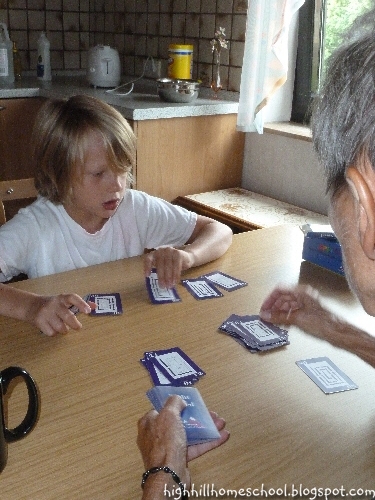
Both of these special needs experts explained how Speed! helps to strengthen working memory, and processing speed. (Here is a video of the game being played.) When kids first learn to play the Three Speed! deck for example, they may not know how to skip-count by three. That doesn't matter because the numbers are written on each card. In the image below, the bubble chain is colored into the number 18, because the card is an 18. Kids can look at the card and see that the next number in the sequence is 21 and the previous number in the sequence is 15. These are the two acceptable plays on an 18. Because the winner is the first player to get rid of all his/her cards, kids work to improve their memory. After all, it's much faster eliminate the step of checking the card to see what's next and play a card based on memory. The more often kids play the game, the less often they will need to refer to the number chain to determine what comes next or previous. It's the repetition of play that helps improve memory.


It's the desire to win that helps improve processing speed. Processing speed is the time it takes a person to react to a visual, auditory or movement input. In Speed! there are no turns. As soon as a player realizes one of his/her cards can be played, he/she may play it. Players may react to the visual number on the card. If someone is counting out loud, they may react to the auditory stimuli. They may also react to the movement of the other player placing a card on the center pile. Regardless, they quickly learn that to win, they should go fast.

With that being said at least one of the education experts pointed out that if the stress of the race is too much for a participant, the game can be altered to institute turns and slow the pace. Processing speed will still be improved and when the child is ready, the rules can be changed to eliminate turns.

Both Dr. Carol Brown and Faith Berens MEd compared Speed! to games like Set, Blink and Spot It which they commonly play during therapy sessions to improve visual processing, auditory processing and working memory skills.


I am so excited to relay this message to you and hope that whether you work with special needs children or not you will give Speed! a try. Playing this game is a fun mental workout for both children and adults. The Three-Speed! deck may seem easy, but the Seven-Speed! deck is a challenge for most adults. We can all benefit from some brain exercise.

Personal Education Plan Conference

After working through about six weeks of the school year it was important to have a conference with each of my students (children) to discuss their accomplishments, what they are currently working on and their ideas of future study for the year. Because my kids have lots of control over their education and primarily work independently throughout the day conferences are important to ensure we have a solid education plan.

First, I asked them to list activities they spend their time on during a typical day and to estimate how much time is spent on each activity.

My son's list:
Engineering Class at High School 1 hr
Band Class at High School 1 hr
DuoLingo 30 minutes
Programming 30 minutes
Reading different books 1 hr
Geometry 1 hr
Walking 30 minutes

My daughter's list:
Reading 1-2 hrs
Algebra II 1 hr
Sewing 30 minutes

We discussed each of their activities and whether it was a short, medium or long term activity. Short term activities take one week or less to complete. They include easy research topics such as what is the Maginot line, but can lead into research of additional tangent topics. Medium term activities take 6-10 weeks. A few examples include unit studies such as Greek History, or the solar system. Long term activities can last the entire year. Completing an algebra book or continued study of a foreign language are good examples.

Therefore, if the school day lasts six hours, six long term activities are the most that can be fit in one school year. If one hour per day is dedicated to medium term activities, approximately 3-6 can be covered in a year and 36 or more short term activities can be covered in a one hour period over the course of a school year. 


For my son, his day is pretty full and most of his activities are long term. I suggested that he add short term research topics into his day especially if he feels he has finished something. That will give him the opportunity to briefly touch on many different topics.

My daughter has some time available in her day. In addition to what she listed, she had been visiting a doctor three days per week, cooking at least one meal per day and attending rehearsals for theater four days per week. Therefore her schedule is a bit busier than it first appears.

Next I listed standard school subjects: reading, writing, math, history, geography, science, foreign language, art, music, p.e., and technical classes. Then I asked them to determine which subjects were being covered and which subjects were lacking.

With an idea of time available in the schedule and subjects that could be covered better I asked them both to list a few things they would like to study in the near future. My son wants to learn about Henry Ford, Steve Jobs and Hitler. My daughter didn't have any strong desires.

So for the next six to eight weeks or so, my son will continue down the same path until we sit down and reevaluate again together. I felt my daughter needed some more guidance. So I added several activities to her schedule including: reading the Story of the Greeks, finishing the book In the Hall of the Dragon King, working through Lightning Literature and Composition, finishing a spelling program we began at the end of last year called Uncovering the Logic of English, studying the Human Body with the book The Way We Work, and watching various musicals that are great for kids such as Singing in the Rain. Many of these activities I will be doing with her but she can do some on her own. Just like with my son, I will sit down with my daughter in another two months or so to discuss our plan.

My goal is the make the independent learners so I want to give them lots of freedom, but I also want to make sure they are progressing and learning each day. It is definitely a balancing act of give and take, suggestion and trial to meet those goals, but I we are all satisfied with our current plan.

Advanced Sewing with Middle Schoolers

My sixth grader is learning much about sewing techniques.

This year, the kids have had a lot of say over their education. Though they don't have complete autonomy, they can select from a list of acceptable topics/activities or suggest their own. My goals are for them to become independent learners excited about what they are studying. In addition, I want them to persevere through difficulties and explore a wide variety of material implementing and enhancing their current skills as well as reading, writing and math skills. I've written several posts describing my son's exploits with Xcode, and now I have to tell you about my daughter.

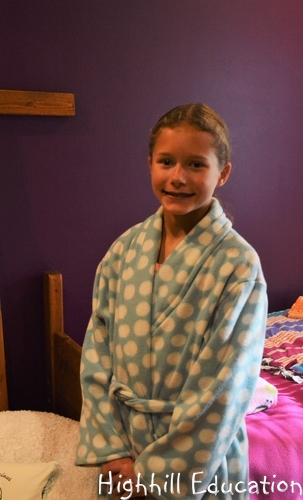
She loves SEWING and DESIGN and HANDS-ON projects, so it was no surprise to me when she decided to sew a robe, learn about color theory and then implement what she learned by creating a table runner, and refinish a small cabinet. Reading a book on Greek Mythology was not a complete surprise, but a welcome addition to her crafty endeavors.


Last year we spent one day per week sewing a very elaborate quilt. My mom, I and my daughter each created a similar quilt. The project involved a multitude of new sewing and machine embroidery techniques. We all learned a ton.

This year we want to continue learning to sew, but one goal of mine is to make sure my daughter is continually learning when in school. Therefore, if she wants to sew, I would like her to sew something new or incorporate a new technique. Since sewing day last year was all about the quilt, it makes sense that this year should be all about clothes.


Her first project of the year was making a robe. Although she has created a few clothes items from patterns, reading patterns is a skill that she can definitely improve. To make the robe she selected the fabric, and worked with my mom to read the pattern. Most of the skills required to sew the robe were familiar to her, but she learned to match dots and marks within the pattern, put in sleeves and sew a square of stitching at the end of the belt rather than a straight line to hold the stitching in better.

Proud is my word for the year. I am proud of her and she is proud of herself. This was one great project for starting the year.

Homeschooling to High School and back to Homeschool

My oldest daughter is a senior and considered a homeschooled student. She was a full time student in Kindergarten, and 11th grade. This year she is taking AP psychology at the local high school and Organic Chemistry and Anatomy and Physiology at the community college. The rest of her day she is homeschooled. Next year she will be going to a technical college and has already been accepted.

Her schedule is strange I know, and she knows. Sometimes it bothers her a little, but she mostly just jokes about it. After being a full-time student last year, she was hoping to graduate from the local high school. Unfortunately that didn't work out.

First day shadowing at dental office

The main issue was the Anatomy and Physiology class. You see, my daughter wants to be an orthodontist. Who knows if that will happen, but that is the path we are working towards now. She completed AP chemistry during homeschool as well as most general education requirements such as government, history, English, foreign language, etc. Last year she completed AP Physics and AP Biology at the local high school.

Therefore, the next classes required for most biology degrees is Anatomy and Physiology and Organic Chemistry. We thought she would be able to be dual enrolled at the high school and community college there by letting the local district pay a portion of her educational expenses. While this was possible, the high school said they would not pay for the Anatomy and Physiology class at the community college since the high school offers Anatomy and Physiology and she had not taken it there. They said this despite the fact that she has met all of the requirements to graduate from the high school and that the high school A&P is not a prerequisite for the college A&P.

While this could work, we felt it would be a huge waste of time. Although by all accounts the high school A&P course is excellent and college-level, there is no way to obtain college credit for taking the course. She would have to take the college A&P course the following year thereby delaying any courses for which A&P was a prerequisite. In other words, she would delay herself a year and take a very similar course two times.

Since the high school said they wouldn't pay for it, they also would not offer credit for it. She could still take the course but to graduate from the high school, she would have to take four classes. (They would pay for and give her credit for two classes for the organic chemistry course, and two additional class credits would have been given for A&P if it was approved.) Unfortunately, there isn't time in the day to take four high school classes plus two college classes especially when driving time and course schedules are considered. That made the decision easy for us. Homeschool again.

As I said earlier, she is taking one class at the high school. This will enable her to stay in contact with the friends she has made at the high school as well as participate in the school play. (Homeschooled students in Michigan are allowed to take any elective courses and participate in any clubs the school offers. No competitive sports.)

Her exposure to the public school system has been good. I think it was important for her to take a few classes and see how the more traditional education systems works. She learned a lot! Not only did she learn the course material, but she saw how structured the system can be. She now understands how much freedom and say she had over her own education which allowed her to progress at her own pace. She sees the difference between learning to seek knowledge verses learning to get good grades. She sees inappropriate behavior and also found kids who can challenge her academically. Although she is quite independent and thinks for herself, she now cares about her appearance and has learned a little about fashion.

Although I'm mildly sad she will not be able to graduate from the local high school, it's probably more appropriate for her to graduate from homeschool. After all, she spent 11 years as a homeschooled student and 2 as a public schooled student. We're just glad we have a good plan for this year and that she has been accepted to the technical college she wanted to go to.

One Way Homeschooling and High School can be used Together

Last week I described how we are using a Montessori inspired approach to middle school and my son's progress in learning to program in Xcode. In addition to programming in Xcode, he is working on a math patterns book and taking two courses at our local high school.


At the end of the last school year we were studying a book together entitled Pattern Explorer. He liked this book enough to decide to complete it on his own. I really like the Pattern Explorer book because it teaches students to think about math in a non-traditional way. The book he is completing is perfect for kids who are at the pre-algebra and algebra level of math. It is a level 2 book, so there is also a level 1. For more information on this book click here.

At the high school my son is taking an engineering class and band.  In Michigan homeschooled students are allowed to take any non-core classes. That means they may take anything that is not specifically required for graduation. Parents must provide transportation, but for us the school is close enough for him to walk. My older daughter has taken many art classes as well as AP biology, AP physics, AP composition and a dentistry class at the tech center.

So far he is really excited to go to the public school for a portion of the day and I'm happy this opportunity exists. He will get to see some of his friends from scouts and see what public school is all about. Taking two morning classes will require him to wake up with an alarm clock on a very regular basis with no slack for sleeping in. Although we have had a regular schedule for school, the school system will be much more rigid and structured. It will be good for him to see this system. He will get to learn from people new to him and he will be expected to meet their expectations. Overall, I hope he has some fun, learns new skills and finishes knowing that he is smart and capable.

Although it is still too soon to tell, the first few weeks were good. I'm optimistic that the two hours he spends in public school each day will be beneficial.

Montessori in Middle Homeschool - Xcode

Last week I mentioned we are implementing a Montessori inspired approach to middle school. After giving the kids a long list of research topics mixed with hands-on activities and small projects to choose from, my son exclaimed that he wanted to learn to program in Xcode, an Apple programming tool used to create Apps. Well that wasn't on the list, but an acceptable topic none-the-less.

After completing three days of school he unfortunately hadn't gotten too far with Xcode, but had been very persistent and learned a lot. His main issue was getting access to Xcode which was a real challenge since he has a Windows computer. In what must be an effort to increase sales of hardware, Apple makes it quite difficult to run Xcode on a non-Apple machine.


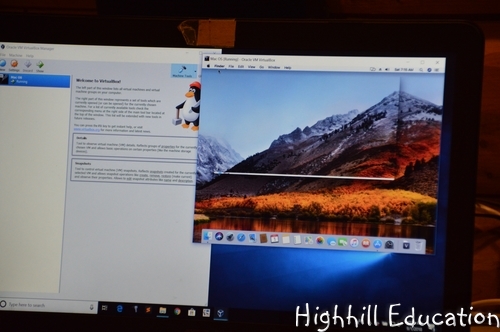
He actually did get Xcode running but it runs slow on his Windows machine. To get it going, he figured out how to create a virtual Apple desktop on his PC. This was quite a process which involved lots of trial and error, and an unwanted bit-coin mining virus. In the end, Xcode will run on the virtual desktop, but runs too slow to be an effective solution. Next he investigated remote logging-into my husband's Apple machine to see if he could run Xcode that way. Well it tuned out that the best way to access Xcode was directly through an Apple computer. Now he is in the research and tutorial phase of learning Xcode. I can't wait to see where this leads him.

Most Montessori programs are designed for pre-school through elementary. What I like about the Montessori philosophy is that students are motivated by selecting their own activities. However, un-like an unschooling approach where the student has complete control over what they study, I like the way the Montessori approach sets-up the classroom and effectively gives students acceptable choices. I see our approach to education as Montessori inspired because the choices are given by the adult but selected by the student. It tends to be quite hands-on and often involves learning life skills. Since middle and high school students are capable of reading, a list of acceptable topics and activities for this age works well. Also, unlike the elementary years where students are learning the basics and have necessary manipulatives readily available, for this age, resources are gathered and research completed based on what the student selects to pursue.

So far this approach to education is accomplishing a few of my educational goals for the year including teaching the kids to persevere, making them more independent learners and getting them excited about school. They have been motivated to read and research because they have selected what they want to study. Both my husband and I assist them and try to offer suggestions when we see them getting stuck or progress slowing.

Although this project has taken the majority of his time, he has a few other smaller projects he is working on. I will explain more next week.

Homeschooling Middle Schoolers with Montessori

Welcome back to another school year! My kids will be in 6th, 9th and 12th grades this year. Last year I didn't do too much blogging because we focused a lot on the basics (reading, writing, and math). We actually followed a writing curriculum and it worked well. Since we followed lots of curriculum, we weren't doing many unique things for school, so I didn't have much to say.


This year, with the new school year approaching, I felt the need to change things up a bit and am moving more towards a Montessori approach to education. We've already finished week one and it is working great! We will probably keep working with this approach until Thanksgiving at least, and then I will re-evaluate.

If you are familiar with Montessori, then you know it's a philosophy that is typically used for elementary aged students. If you are familiar with this blog, then you know I admire certain aspects of many education philosophies (Montessori, Charlotte Mason, Waldorf, Unschooling), but stick with an eclectic approach I call Highhill Education.

My initial goals for this year are to make my 6th and 9th graders much more independent and excited about learning. We have always done a variety of book and hands-on activities for school. Some of which have worked great and others which needed to be rethought. Anyway, anytime I mention school, my younger two kids roll their eyes and get ready to fight anything I have planned. The bottom line is that school just cramps their style by taking a large chunk of time out of whatever it is they would have been doing. In other words, they start complaining. Since they haven't spent much time in traditional school, they have nothing to compare homeschooling to and just don't realize how good they have it.

My youngest would spend all of her time sewing, painting her nails, designing clothes, reading and doing crafts. My son would spend all of his time riding his bike to his friend's house to hang-out, swimming and playing video games. I don't have an issue with their activities, what I have an issue with is what they aren't doing. That's why this approach is currently working well. Let me explain.

To start the year, I gave the kids a long list of items they could choose to study. Some things on the list include:

If Hitler was so bad, how did he get a whole country of people to follow him?
What did Steve Jobs do before starting Apple?
Learn to program in Python
How are math and origami related?
Study the Life of Fred Geometry book
Why is poetry so difficult to understand?
How do producers create special effects for movies?
How did jazz music evolve?
What is the Picot-Sykes Line?
Install a water bottle holder on a bike
Repair the sprinkler system
Refinish the kitchen chairs
How are rising oceans effecting coastal cities?
Plan a weekend family vacation within a three hour driving distance

Hopefully you get the idea? My husband and I told them they need to pick a minimum of one thing and maximum of three things to investigate. Each of these topics are meant to keep them going for a few days to months. We also said they should be prepared to discuss their projects and findings and shouldn't look into something for an hour or so and give us a quick answer. These questions/topics are meant to inspire, so we asked them to select something that interests them. I'm hoping that the lines between when school starts and stops will become blurry and that they will be so interested in what they select, that they will work on it during much of their non-school time as well.

I already mentioned that we finished week one, but I didn't mention that they have been constantly working on the projects they selected. I will describe them in the next few posts. What I'm worried about and haven't figured out yet is how to get them to do a variety of activities without much prompting. If you have any suggestions, I would love to hear them. Anyways, I'm happy with their progress thus far, but the lack of variety is what is likely to cause us to shift gears again in November. I will keep you updated.

Welcome back. I hope your school year is off to a great start.

How does homeschooling work over the long-term?

Now that my kids are in 5th, 8th and 11th grades, we are seeing the results of homeschooling long-term.


We began this journey 10 years ago when my oldest was in 1st grade. As with any education plan there have been both high points and challenging moments. Now that my oldest is in 11th grade, we have come full circle as this year she is thriving in public school; back for the first time since Kindergarden.

Last year my oldest studied AP Chemistry, AP Calculus, AP Statistics, AP Music Theory, AP Government, and AP American History at home.  It sounds challenging and it was, but she didn't spend any more time studying than a typical high school student. In fact, I believe she studied less. Now she is a smart child, but by no means a genius of any sort. Homeschooling has simply enabled her to always be challenged at her level. These classes just happened to be the next in line.

Her 2016/17 course load was a challenge for me too. My main role as homeschool mom has always been to find the best resources for each child based on their learning style, interests and ability. With resources in hand, I put together a schedule/plan for each child to keep them challenged, thinking, and learning new material. Some subjects the kids study on their own, where as others I am very involved. There is always a balance.

Although my oldest studied AP Government, AP American History and AP Music Theory completely on her own. I was an integral part of AP Chemistry, Calculus and Statistics. Those being difficult classes, and I being her main person for questions resulted in a challenging year. When she had questions, I first had to understand the material and often, this was time-consuming. But we made it through and I am very happy with where she is now.

This year she is in the public school system. She is taking AP Physics, AP Biology, AP Composition and dentistry. Yes! She is studying lots of science and doing great! Her teachers say she thinks differently, often has different views and ideas on topics, but is mixing well with the other kids and doing a great job. I'm overjoyed to have more time to spend with the other two kids and a little extra free time during the day to complete the things I need to get done.

Next year when she is a senior, she will likely take two sophomore/junior level courses at a local university as she mostly beyond community college.

It's been a while since I've written on this blog. I suppose I haven't had much to say lately, but I am planning to write a post a week starting in January to discuss some of the curriculum and educational activities I have been doing at home with my 5th and 8th grader.

Happy Holidays.

Our Summer Flow

Last summer, the kids got lots of exercise, had some fun, worked a little and got to sew.


We are a homeschooling family that looks forward to a relaxing summer off from school. Over the summer our priorities switched from schoolwork to exercise, reading, yard work, sewing and free time. Although exercise is something we do year round, we tend to spend even more time exercising during the summer months. The kids like to run races, we take family bike rides and we live in a beach town where there are lots of opportunities for swimming. We take full advantage of those opportunities.


In addition to exercise we tried to create a balance of other activities. Before the summer began, my nine year old was a very resistant reader. She could read, but didn't like it. Therefore, I wanted to emphasize reading in a positive way that would hopefully result in a willing reader.

Just under a year ago we moved into a new house with a lot of yard and yard work. Since there were many things I wanted to improve the yard work was the perfect opportunity for the kids to help out and earn some extra money. Each day I planned to work outdoors, but that was a lot for children. Therefore, I made yard work an option.

Our new house is very close to my parents house and my mom has a love of sewing. The girls and I, being quite crafty ourselves, wanted to learn from grandma. Thankfully she was willing to sew with us one morning a week.


With these goals in mind we put together a daily routine.

Wake-up-9:30 am - Eat breakfast and exercise
9:30 am - Listen to mom read (30 minutes) - Younger kids only
10:00-12:00 - Yard work for mom - kids can help and get paid (optional)
12:00-1:00 - Lunch
1:00-1:30 - Silent Reading
1:30-3:00 - Errands (Optional if dad is home)
3:00-5:00 - Swimming
5:00-6:00 - Dinner
7:30-8:00 - Reading Together
Bedtime

Wednesday Mornings Only 9:00-12:00 - Sew with grandma

This schedule was followed quite loosely which is why we called it a flow. Obviously rain changed many plans, as did orthodontist appointments, play dates and special events. Overall, it was successful as it helped us to make time for reading, sewing and yard work which would have been easily skipped without the plan.

Because the reading was spread throughout the day, we almost always fit in one reading session and usually completed two or three each day. At the end of the summer I was surprised at how many books were read. Sometime during the summer, my reluctant reader found the Magic Tree House series. From that time on, I found her reading at times not on the flow. I can't express how excited I am about this change.

 The yard still has a long way to go, but the kids pockets are full of money. They didn't help every day, but helped enough to make an impact. Once school started, they continued to help with yard work many times throughout the fall.

Sewing with grandma was a hit. I loved it! We continued to sew one morning per week throughout the school year, completed numerous projects, and learned a vast array of sewing techniques including applique, piping, putting in zippers, basic crazy quilting, and so much more.

Preparing for the CLEP or AP Government Exam

I am reading the book Collins College Outlines: Introduction to American Government.


My daughter has passed several CLEP exams which grant college credit. Soon she will be taking the American Government CLEP exam.  This year has been a very different school year in that it is the first time I feel like I am teaching to the test.

Over the past six years my daughter has learned a lot about many history, art, government and economics topics through reading engaging books and hands-on activities. This year, she is documenting her knowledge by passing CLEP exams. In preparation for each for each exam she has spent approximately six weeks reviewing material and filling in gaps.

After she decides to take an exam she first takes a practice exam from the CLEP Study Guide. Next, we work together to identify any weak areas. Then she reviews previously read materials and we work to find new materials that help with the review.


In helping her find resources to study for the Government exam I came across the book Collins College Outlines: Introduction to American Government and I am really enjoying reading it. The book is part of a series that is marketed as helping students to prepare for AP exams. In general, AP exams and CLEP exams cover the same material, but the university decides which one, if any, or both, to accept. CLEP exams can be taken at any time of year, by anyone, but AP exams are only open to high school students. My daughter is in the unique position to be eligible for both exams.

Getting back to the book, since it is written for the general audience as a review for exam preparation it is mostly unbiased, a little dry, but very informative. It covers the creation of American government, federalism, mass media, interest groups, elections, congress, bureaucracy, civil liberties among other topics. My daughter and I are both familiar with many of the topics in the book but like they way it defines basic terms and explains the roles and interactions between groups. The book is meant for reviewing. It doesn't go too in depth into any topic, but gives enough information that can lead to further research by an interested reader.

Before reading this book we read the Uncle Eric Series by Richard J Maybury, The Five Thousand Year Leap, The Freedom Answer Book and others that can be found on the History Page. This book expands on that knowledge and we are drawing many connections between the book and current events.

I'm confident that after reading this book she will be prepared for yet another CLEP exam. Although this year has been a little less mind expanding than years past, it is really exciting to see how much she has learned by reading interesting books and hands-on activities. Homeschooling really does work!

For more great educational activities check out these blog hops.

Unexploded Cow

We played the game Unexploded Cow at a gaming convention a few weeks ago.


Unexploded Cow just sounds wrong, but that is the actual title of the game. Many games today have a story built into the play. The game Unexploded Cow is set in 1997 when Mad Cow Disease was headline news. The story behind the game is that infected British Cows are being sent off to France to locate unexploded bombs left over from World War II. When a bomb is located, it takes care of two problems at once; destroying a diseased cow and an unexploded bomb at the same time. Hence that act is good, earning the player money.

I have to admit that after reading the story behind the game I was a little bit disturbed, but laughing hysterically. So what does the story have to do with the play of the game? During a turn, players place diseased cows face up in their herd after paying a fee for each cow. Cows are named and some cost more than others. In addition, when they are destroyed, some bring in more money than others. To destroy a cow, players roll the dice at the end of their turn and count from right to left to find the cow to be exploded. In addition to regular cows, there are spy cows which can be placed in other players herds, cards which instruct players to exchange herds with each other and cows that can explode adjacent cows.

In spite of the raunchy theme, players develop critical thinking skills while trying to earn the most money destroying bombs and cows. The game lasts 20-30 minutes and is very entertaining. My 13 year old son loved the game so we purchased it on Amazon after the conference as it wasn't being sold there. It is a quirky game to add to your home game library.

Please visit again next week to learn about another game played at the convention.

For more great educational activities check out these blog hops

Gaming and Critical Thinking

Playing games is one of the best ways to develop critical thinking skills.

Last week I wrote about attending our first gaming convention. If you've never heard of or been to a gaming convention, I highly recommend it.

At the convention, I was busy playing my skip-counting card game Speed! in the vendor room while my husband and son tried out a variety of new games. Because a gaming convention is filled with people who like to play games, through demonstrating my game, I had the opportunity to see how playing games has enhanced the logic and critical thinking skills of the participants.

Most people have a hobby. For some, their hobby is a musical instrument, for others it's sewing, woodworking, politics, reading, running or camping. There are an unlimited number of hobbies, but I had never thought of playing games as a hobby until I attended a gaming convention.

Hobbies are interesting, because they are a pleasurable pastime for the participant. People tend to fill their free time exploring their hobby as much as possible, and over time become unofficial experts in their field as they continue to increase their knowledge.


Speed! is a relatively easy game to learn, but I was stunned by how much quicker veteran gamers learned to play. Most picked up on all the rules after only about 2 minutes of instruction and were onto strategizing how to win. At one time during the convention a five year old boy and his seven year old sister walked up to my table. They only played one round of Speed!, but before the round was done they were racing at top speed while predicting two to three moves ahead. I could see the five year old boy thinking 'if I play my 9, then my sister will play her 12, but if I play my 3 instead, then she won't have a card to play. Picking up on strategy during the first round of play was unbelievable, but it happened over and over throughout the weekend.


The question was why did the gamers pick it up so fast? Well the obvious answer was that they play games often. By continuously strategizing in different circumstances they have learned to recognize patterns at a rapid rate. In addition, they don't just follow the rules, but predict possible outcomes of various acceptable moves and select their best option. Based on the information available, they try to think several moves ahead when planning their moves.


My husband and son witnessed this same skill while playing games with other gamers. At the conference many game tables were set-up with a person available to teach others the game. Attendees could show up at scheduled times to try out new games. My husband and son tried games with others three times at the convention and lost every time. They said that the other gamers were strategizing at the very beginning of the game while it took them half way through the game to understand the rules. The game hobbiests were just that much quicker.

The skills being developed by playing games; critical thinking, logic, and decision making not to mention math, are applicable in many aspects of life from most careers, jobs and daily routines. There are many games on the market, so start thinking about games like books. Try one and see how it goes. If you like it teach friends and play again. Then try a new game. There are so many to choose from. Have fun!

Please visit Highhill Education again next week as I will begin writing about some of the games my husband and son played.

For more great educational activities check out these blog hops

Home Game Library

Do you collect and play games?

Many homeschoolers naturally collect books. They visit the library, thrift stores, book stores and somehow end up with an endless supply of books. Well now is a great time to start a new collection. Games!


The paradigm for how I view games has just gone through a transformation. In the 80's, when I grew up we all had the same games. Many of us have memories of playing Monopoly, Clue, Candy Land, Chutes and Ladders, Sorry and Life. Today, there are as many games to choose from as books. Ok, well maybe not quite as many, but the number is rapidly increasing.

Have you recently visited a unique Toy and Game store and wondered why you have only heard of a few of the games? I have, and have felt very overwhelmed by the variety of choices. Fortunately, many stores now offer the opportunity to try out the games during their game days, but an even better way to try out a variety of new games is to attend a gaming conference.

Over the weekend, we (my husband, son and I) attended our first gaming conference to promote my skip-counting card game Speed! While there I was stunned to find there are gaming conferences all over the state giving gamers the opportunity to participate in conferences many weekends of the year.

It turns out there are five primary interests of gamers; board and card games, role playing games, minitures, collectables, and comics. Many of the gamers have interests in more than one area, but others stick to a focus. Because my game and interests fall into the board and card game category, that is the area we explored.


At gaming conferences, attendees have the chance to try out a variety of games. Very reasonably priced tickets can be purchased for one day or the entire weekend. The tickets grant access to the convention's library of games as well as game tables set up with a "game master" that instructs first-time players in the rules of a game. In addition, game designers attend the conventions with their prototype games seeking advice for tweaks before production.

It didn't take long for my husband and son to decide I would be taking care of our "Speed!" table, while they would roam the conference exploring as many new games as possible. Since this was our first experience at a gaming convention, they decided that their favorite table was actually a promotion table. There were over 30 unopened games on the table. Anyone attending the convention could play those games. If they played an entire game from start to finish, they could put their name into a raffle for that game. Well the boys ended up playing five games from the table and winning two of the games they played. The $70 win value, more than covered the $30/person ticket price for the entire weekend. They were all smiles.


Before attending the conference I knew there was a bigger variety of games available than when I was a child, but had no idea of the extent. I was blown away by the choices and a little overwhelmed at first. But approaching a new game like a new book was key. You will not read everything in the library in one day and you won't play all the games either. That's the fun of it. Playing or reading something new and then sharing your experience with friends discussing a book at a book club, or playing a game during game night.

If you have an opportunity to attend a gaming convention, I highly recommend the experience.

Check out these great blog hops for more educational activity ideas.

Studying for the Western Civilizations CLEP Exam

My 15 year old daughter just took her second CLEP exam - Western Civilizations I: Ancient Near East to 1648.


Returning to the United States in 2015 after living in Germany for six years she took her first CLEP exam German. Although she was homeschooled in Germany she attended dance classes with German kids and spent lots of time immersed in German culture. Therefore, this exam was relatively easy for her. The Western Civilizations exam was very different.

The exam covers western civilization from the Greeks and Persians, through the middle ages and Renaissance. Coincidentally, this lines up very well with the history topics we studied while she was in elementary school.

As part of our homeschool curriculum, we studied one topic in history for between 6-15 weeks with a weekly project. Details of the lessons and projects can be found on our History Page.

Therefore, in studying for the Western Civilization CLEP exam step one was to review the spine books we read in the past.

Mesopotamia Books
Ancient Greece Books
Ancient Rome Books

Viking Books


Middle Ages Books

Renaissance Books


Next, she took a practice exam to find weak areas. Because we felt church history and the Middle Ages were the weakest areas, she spent approximately six weeks studying primarily those topics. We found the following resources helpful.

Ryan Reeves Church History Videos on Youtube
Librivox/Baldwin Project –
Saints and Heroes to the End of the Middle Ages
Saints and Heroes Since the Middle Ages

SHE PASSED!

Now she just needs to decide what to take next.

Check out these great blog hops for more educational activity ideas. 

Preparing to Take CLEP Exams

My 10th grade daughter is concentrating on The Three C’s: Calculus, Chemistry and CLEP tests.


One huge advantage of homeschooling is the ability to challenge students at their level. Because my 15 year old daughter has progressed at her own speed since 1st grade, she is far ahead of public school students of the same age. 

Throughout her elementary school years we studied various topics in history and science and made sure to read, write and do math every day. Fortunately, new math concepts were relatively easy for her to master. This gift enabled her to move through math at a rapid pace. Like wise, reading was a hobby for her. She voraciously read every child’s chapter book within her grasp. Coupled with our history and science unit studies, this approach gave her a vast knowledge of many topics.

Therefore, when lesson planning this year we began talking about her future goals. At this stage she thinks she wants to be an orthodontist. Perhaps this goal will change in the future, but it is a great place to start our future planning. With the goal of dentistry and college in mind we began researching what to study this year and in the near future.

After learning about some near term options the plan for how to proceed this year became glaringly obviously. As an 11th and/or 12th grader she could gain experience, knowledge and college credit taking technical courses, which include dentistry through the local district. In the half-day, one year long program, kids get hands-on experience in a dentist office, and study anatomy and other topics relative to dentistry. This however, isn’t the only option. By taking 1 course at the high school she is eligible to take courses at a local community college. So we looked at the course list.

Based on the descriptions of many of the first and second year community college courses much of the material seems to have already been covered. The only way at this stage to begin taking credit for current knowledge is to take exams. CLEP is the best option.

Most colleges and universities award some amount of credit from CLEP exams, but very few award credit for all exams taken. Because we aren’t sure which institution(s) will be in her future path, we are  planning to take exams for which she has learned the majority of the material.

That being said, my 15 year old’s curriculum plan for the year is to complete chapters 21-24 of Life of Fred Calculus, complete her chemistry labs and book and take approximately 1 CLEP exam every six weeks. In addition, she will take ceramics and drawing at the local high school.

As a 13 year old she passed the German CLEP test with flying colors. The results of her testing this year will shape the path for next year and future lesson plans. Although her CLEP list has not been fully determined, she will likely take Western Civilization I and II, History of the United States Early Colonization to 1877, History of the United States 1865 to Present, Humanities, Calculus, Chemistry, and Natural Sciences.

Can homeschoolers take public school classes?

My daughter took art and drama classes at our local high school.

After moving back to the United States I wanted to continue to homeschool my children, but taking a few classes at the local public school seemed like a good idea. In our district homeschoolers can take  any non-core classes. In other words, they can take classes not required for graduation including PE, art, music, computer and drama classes, but not math, history and science courses. Each district has its own policies on homeschoolers taking classes, but most do offer some options.

Last year my daughter signed up for drama, art and design, and painting. This year she will be taking ceramics and drawing. The art program in the district is phenomenal and she is taking full advantage of it.

Here is a small sample of her creations at the public school.


In addition to taking non-core classes, homeschoolers are eligible to participate in any clubs the school offers such as yearbook, debate, photography, etc... Since my daughter took the drama class, she began participating in the school plays and the drama club.

Unfortunately participation in sports is not nearly as easy. The district told us that homeschoolers are eligible to participate in sports. They only need to take five classes at the high school. (Full time students take six.) Our local school added a one course requirement above the requirement of the Michigan High School Athletic Association which requires four classes. Then they said another option would be for her to practice with the team and just not compete. Personally I think that would be a huge blow to a child. Although my daughter is athletic and would enjoy the comradery of public school sports, it seems the system is designed to discourage homeschoolers from participation.

Perhaps one day policies on the sports issue will change to be more in line with the policies on classes and clubs. In the mean time, my daughter is greatly enjoying her art classes and the school plays. They have excellent programs.

Check out these great blog hops for more educational activity ideas. 

Easy Peasy at Highhill Homeschool

My son followed Easy Peasy All-In-One Homeschool.

Last year putting together my son's education plan was extremely easy and worked better than any year before. He completed Easy Peasy Fifth reading, writing, computer and thinking along with Year 4 science, history, art and music. In addition, he did Life of Fred Math, Duolingo German and piano lessons each week.


Easy Peasy is a free on-line curriculum put together by a homeschool mom. She wanted her children to be able to work independently and therefore communicated their work load with them via the computer. Eventually she polished it and made it available for other homeschoolers. She did an excellent job!

The program consists of eight years of study 1-8 each containing language arts (reading, writing, spelling and grammar), computer, and math. In addition, there are four courses of study covering different topics in history, science, art, music and bible.

Year 1 - Biology, Ancient History
Year 2 - Animals, Early American History
Year 3 - Earth Science, Geography and Cultures
Year 4 - Physics and Chemistry, 20th Century History

The reason I think it worked so well for my son is that he has always been an independent learner and Easy Peasy enabled him to work that way. In addition, the way in which the science and history portions of the study were put together really peaked his interest. The reading was interesting to him and the combination of videos, small projects, printing out timelines, and completing small bits really appealed to him. 

Although he had done a lot of writing and reading in the past, I felt he needed some work in Language Arts. His writing was very creative, but he had difficulty with structure. He knew about punctuation and capitalization, but didn't feel it was important, and therefore often neglected it. Over the course of the year I saw great improvement in his finished papers. I'm so happy we tried Easy Peasy with him.

Below are a few pictures I snapped of him completing work assigned by Easy Peasy.


Check out these great blog hops for more educational activity ideas.

End of College?

I recently read the book End of College by Kevin Carey.

After graduating from college and beginning my career as a mechanical engineer I quickly realized that very little of what I learned in college was necessary for me to do my job. Instead, my co-workers taught me the new skills I needed to meet the company's expectations. In college I learned many concepts regarding motion (physics, and dynamics), heat transfer, chemistry and more. On the job I needed to design parts using 3D modeling software, call vendors, and analyze parts to ensure they could handle extreme vibrations. In addition, I needed to interact with adults. Although there was some cross over of information, it was very limited.


At work, before I began designing parts I attended a 2-3 week class which met 8 hours/day to learn to use special software for 3D modeling. In college, I had never even heard of ProEngineer. While learning to determine if parts could handle shock loads, I worked alongside a senior engineer and read reports on previous similar analyses. Calling vendors was completely new to me. We often needed information on parts we purchased but didn't have available to look at. I learned the best questions to ask and how to navigate through organizations. Calling vendors taught me my most valuable lesson: if you need a business service (manufacturing, design, samples, odd parts created...) just start making phone calls and searching the internet. In a nutshell, it taught me how to research and accomplish goals. Anything is possible.

So what was the purpose of those four years spent obtaining a mechanical engineering degree? That degree was my ticket to a job. It was a required document that employers knew meant I could set a goal and follow through. It meant I was reliable and capable of working, and smart enough to do the job. Four years seems like a long time that could have been better spent learning skills more applicable to my job. Apparently I'm not alone in my thoughts on this subject. The book End of College makes this point along with many others that leads to the conclusion that we have been and are continuing to pass through a revolution in education.

From high costs, to professors being more concerned with research than teaching, to lots of student free time spent partying; this book address many inefficiencies with our current university education system. Learning about the history of education and how it reached its current state was fascinating, but learning where we are headed was even better.

Have you heard of Mozilla Open Badges? It is a non-profit organization that tracks educational achievements. For example, if you take a free online course through a university, this site could be used to note your completion. It could track passing scores on examinations such as CLEP or track classes taken at stores or businesses. For example, my mother loves to take sewing and embroidery classes and sometimes brings my girls. Their achievements in these classes could be tracked on this site.

At the current time, this site and other similar sites are gaining momentum but in the very early design stages. Professionals, educators and businessmen throughout the world are beginning to explore them and determine how they could be used in their companies. In my mind, these sites could replace some degrees by replacing the degree with a different set of educational accomplishments. Although it isn't crystal clear what the future holds for college education, there is no question that it is changing.

My 14 year old daughter is a typical homeschool student in a lot of ways. Because she has had the opportunity to constantly learn at her level she is more advanced that a typical high school student. This efficiency is the reason many parents choose to home educate. Although I still feel qualified to educate her further, I question how she will receive credit for her knowledge since it will be at the college level.

Most universities accept some CLEP credits, but limit them so that students will be forced to take classes at the school. This increases revenues to the college, but ignores whether or not the student already knows the material. There are however, a small number of programs available where students receive degrees based on knowledge as opposed to time spent studying at the institution. I'm still researching and searching for the best solution for my children on this matter.

In the mean time, I would like to highly recommend the book End of College as I hope our future generations will be able to learn in a more efficient manner for everyone.

Check out these great blog hops for more educational activity ideas. Simplify Life
Related Posts Plugin for WordPress, Blogger...