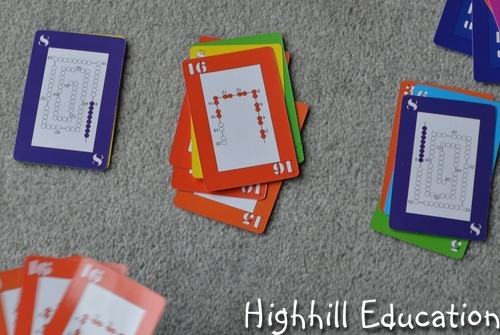
The card game Speed! comes with eight decks of playing cards. Each deck is color coded and uniquely numbered to help kids memorize the multiplication tables. For example, the red Two-Speed deck contains the numbers 2, 4, 6, 8, 10, 12, 14, 16, 18 and 20. The blue Seven-Speed deck contains the numbers 7, 14, 21, 28, 35, 42, 49, 56, 63 and 70. The game was designed as a two-person racing game where the winner is the first person to get rid of all of his/her cards. (see video)
However, since the game is comprised of decks of cards, many games that can be played with a standard deck of cards can also be played with Speed! cards. This adds a new twist to many card games. One simple game that works very will with Speed! cards is a game called "Garbage". The video below shows the game
playing played with a standard deck of cards.
The photo below shows the desired finished layout if the game was being played with the Three-Speed deck of cards.
What I like about the game Garbage is that it is a slower placed game that allows players more processing time. When playing this game and drawing a number 24 for example, players can say out loud "24 is 8 times 3", or "24 divided by 3 is 8". This helps kids to better link skip-counting to multiplication and division and provides a fun alternative game to play with the Speed! cards.
Speed! is a great game for learning to skip-count, which leads directly into learning multiplication and helps kids to develop an excellent mathematical foundation. But, what do you do if the child gets intimidated by the "speed" of the game?
While most kids love the game Speed! because if its intense pace, this can have the opposite effect on some children. (Click here to see a video of the game Speed! being played.) One thing that can be done is to institute turns into the standard Speed! game. This can be done in one of two ways. The simplest way is for each player to play one card and then let the other person have a turn to play one card passing only when the player does not have a playable card. The second way to institute turns into the game of Speed is to allow one player to play cards until he/she runs out of moves, and then let the other player play all cards until running out of moves. Taking turns will greatly slow the pace of the game allowing more processing time and calming the nerves of children who need it.
How does your skip-counting card game Speed! work for children with special needs? This is a question I occasionally receive and up until now have not had a good answer. Special needs is not my area of expertise. What I do know is that children love to play this game because it is fun. They play to win and want to play more not realizing that by playing they are memorizing the answers to the multiplication tables.
During the course of demonstrating the game to a multitude of people at homeschooling conventions I have met two different special needs experts that absolutely love the game. Dr. Carol Brown at Equipping Minds holds a doctorate in education and has more than 35 years of experience working with students. She has a program that works to strengthen cognitive abilities of both children and adults. Faith Berens, MEd is a reading specialist and special needs consultant for HSLDA.
Both of these special needs experts explained how Speed! helps to strengthen working memory, and processing speed. (Here is a video of the game being played.) When kids first learn to play the Three Speed! deck for example, they may not know how to skip-count by three. That doesn't matter because the numbers are written on each card. In the image below, the bubble chain is colored into the number 18, because the card is an 18. Kids can look at the card and see that the next number in the sequence is 21 and the previous number in the sequence is 15. These are the two acceptable plays on an 18. Because the winner is the first player to get rid of all his/her cards,
kids work to improve their memory. After all, it's much faster eliminate
the step of checking the card to see what's next and play a card based
on memory. The more often kids play the game, the less often they will need to refer to the number chain to determine what comes next or previous. It's the repetition of play that helps improve memory.
It's the desire to win that helps improve processing speed. Processing speed is the time it takes a person to react to a visual, auditory or
movement input. In Speed! there are no turns. As soon as a player
realizes one of his/her cards can be played, he/she may play it. Players may
react to the visual number on the card. If someone is counting out loud,
they may react to the auditory stimuli. They may also react to the
movement of the other player placing a card on the center pile. Regardless, they quickly learn that to win, they should go fast.
With that being said at
least one of the education experts pointed out that if the stress of
the race is too much for a participant, the game can be altered to
institute turns and slow the pace. Processing speed will still be
improved and when the child is ready, the rules can be changed to
eliminate turns.
Both Dr. Carol Brown and Faith Berens MEd compared Speed! to games like Set, Blink and Spot It which they commonly play during therapy sessions to improve visual processing, auditory processing and working memory skills.
I am so excited to relay this message to you and hope that whether you work with special needs children or not you will give Speed! a try. Playing this game is a fun mental workout for both children and adults. The Three-Speed! deck may seem easy, but the Seven-Speed! deck is a challenge for most adults. We can all benefit from some brain exercise.
Skip-counting is a key ingredient in teaching upper level elementary math concepts. Once kids have a good handle on the numbers 1-100 and can count backwards from 20 to 0 they are ready to learn skip-counting. This usually happens between the ages of 4 and 8 years old and around the same time as kids are learning addition. Numerous math skills are based on skip-counting such as multiplication, division, adding and reducing fractions. With a good understanding of skip-counting, children are able to progress much more rapidly through these upper elementary math concepts.
Songs, the card game Speed! and hands-on practice work well together to cement the fundamentals of skip-counting. When playing Speed! kids learn to skip-count beginning on any number. For example, if they are skip-counting by 3's, they may begin at 18 and progress to 21. They also learn to skip-count backwards. The rhythm and rhyme of song helps engage memory and the colored decks of cards in the game Speed! help kids create a visual association with numbers.
The card game Speed! has just been given a facelift. The exterior of the container was lightened from a dark blue to a light blue and the numbers on the cards are now a more common font which is easier to rapidly read. The original version is shown above on the left, and the updated version is on the right.
If you haven't purchased this game yet, now's the time. After all, it's fun and a great way to keep kids learning over the summer! Kids play because they want to win, not to learn to skip-count. The beauty of the game is that in order to win, they have to have the skip-counting numbers memorized and they do so enthusiastically. The big secret, is that the numbers are all the answers to the times tables. After playing Speed!, kids can quickly apply what they've learned to multiplication, division, factoring, and fractions. How can you beat an educational game kids actually want to play.
This video explains how the card game Speed! works to help kids boost their math skills.
From skip-counting to multiplication, division and fractions, this game is excellent for kids ages 4-12, or anyone learning addition through multiplication.
Speed! is a fast-paced card game that helps kids learn how to multiply. What it does is teaches skip-counting which is a fundamental skill that leads right into multiplication. Continuing to build on math skills, Speed! helps kids with division, factoring, reducing fractions, and the many math skills that build upon skip-counting. I want to show you how this works.
The game contains eight decks of cards, 2-9’s. Each deck is color coded and based on a different number. For example, the three—speed deck contains the numbers 3, 6, 9, 12, 15, all the way up to 30. So playing 3-speed, kids learn to count by 3’s. Each deck is played the same way, only the numbers change. After kids master one deck, such as 3’s, they can move onto another deck, counting by 4’s or any number 2-9. Throughout this video, I will give examples referring to the 3-speed deck, but please keep in mind that the same principles apply to all decks. There is a video showing the game being played and I highly recommend viewing it if you haven’t yet.
A unique aspect of this game is that in order to win, kids not only need to know how to count higher by 3’s beginning with 3, but they need to be able to count higher by three starting with any multiple. That means they may start on 18 and count to 21, then 24. They also need to be able to count backwards by 3’s starting on any multiple of three. In other words, they may start on 15, and count to 12, then 9. Kids play to win, not to memorize, but regardless of their reason, they are learning a critical skill.
After kids have played 3-Speed for a week or a month, or however long it takes them to get really fast they have memorized the answers to the 3 multiplication tables, but don’t necessarily understand the link between skip-counting and multiplication.
At this point, it’s a good idea to lay the cards out in order like this, and explain this is 3x1, 3x2, 3x3, 3x4, 3x5, all the way up to 30. Then after asking the child “what’s 3x6?”, they can point and say 18. “What is 3x8?” Well it’s 24.
Now the kids will begin to understand the link between skip-counting and multiplication, and it’s a good time to go back to playing the game. After all, the game is the drill work of multiplication and it’s the fun part. Kids are playing to win, and not to learn, but they are learning and that’s why it works.
Some kids will understand immediately and not need any flash card work to make the transition into multiplication. Others will still need some time with flash cards, but since they are already familiar with the answers to the multiplication tables, the time spent with flash cards should be greatly reduced. Sticking with one deck and mastering the corresponding set of multiplication tables before moving on to another deck will result in a greater reduction of time spent with flash cards since there are less numbers in their head from which to select an answer.
Learning division works the same way. Again, with the cards laid out in order, if the child is asked “what’s 24 divided by 3?”, they can count, 1,2,3,… it’s 8. What’s 12 divided by 3, It’s 4.
It’s best to begin with the 2’s or the 5’s because they are easiest, and concentrate on one deck of cards until it is mastered. Concentrating on one deck of cards reduces the number of options for answers and helps kids to create number associations.
In addition to building recognition within number families, kids that play a lot of Speed begin to recognize patterns between the decks. When playing 3-Speed, they might say, well wait a minute, a lot of these numbers are in 6-Speed!, Six-Speed has a 6, 12, 18, 24, and 30. Those numbers are in both 3 and 6 Speed…. and wow! A bunch of these numbers are in 9-speed too. Nine-Speed has a 9, 18, 27. It’s unconsciously making number associations between different decks that can really help kids to boost their math skills.
Now when they get into higher level math such as reducing fractions, they might have to reduce the fraction 6/21. So then they think, wait a minute, both of those numbers were in 3-speed. There is a relationship between those numbers, and the common number is 3. The fraction 6/21 can be reduced to 1,2…..7ths.
When my own kids were around the age of 7 or 8, we played Speed! every day for about 4-6 months straight. It was our math curriculum. Each day, I would lay the cards out in order and quiz them orally on multiplication for about 1 minute. Then we would play Speed! for about 15 minutes concentrating on one deck until it was mastered. This emphasis on skip-counting and number association allowed all three of my very different children to fly through many math concepts.
I recommend this game for kids ages 4 through 12 or for anyone learning addition up through multiplication. As soon as kids have an attention span, a desire to play games, and can count they are ready. The 2’s and 5’s are easiest, so they are the best decks to start with. When kids are learning addition, they are ready to begin counting by 2’s.
We used this game as our primary method for teaching multiplication. Other families have used Speed! on family game night, to improve or review multiplication, to gain a good number sense, or as a fun way to work on math over the summer. Since there are 8 decks of cards in the set, 16 kids can play at one time making the game a great option for co-ops and schools.
Remember, kids play because it’s fun and they want to win. Not because they want to boost their math skills, not to learn multiplication, but they do. So have fun with it. Thanks for watching.
Speed! teaches skip-counting by 2's up to 9's using eight decks of cards. The game is based on the traditional card game called Spit or Speed where two players race to be the first one to get rid of their cards. Skip-counting (by threes for example: 3, 6, 9, 12, 15, 18, 21, 24, 27, etc) leads directly into multiplication as the numbers in the deck are the answers to the multiplication problems.
By playing the game kids not only learn to skip-count, but begin to unconsciously form number associations in their head. Therefore, when they are introduced to higher level math concepts, they tend to catch on quicker. For example, if they are asked to reduce the fraction 12/27 they will recognize that both of those numbers were in the Three Speed game. It is that association that is the key to reducing the fraction to 4/9.
For kids just getting started with multiplication (ages 4-6) I recommend beginning with the Two Speed or Five Speed decks as they are the easiest. From there, it's best to move on one deck at a time focusing on each one until the child is very fast at getting rid of his/her cards.
For kids who have already begun multiplication or are reviewing, they really enjoy trying out all the decks. It's still best to begin with Two-Speed or Five-Speed until the rules are understood, but then begin to move on to explore the other numbers. They will enjoy challenging friends, siblings and parents.
Parent Tip: If you have a young child that is motivated by winning, this game is perfect. During a game, when the cards in the center are the same the first person to shout "SPEED" gets to give the center stacks of cards to his/her opponent. Since the winner is the first to get rid of his/her cards, the first person to shout "SPEED" has a tremendous advantage. When my kids were young, I never noticed the matching numbers. Therefore, my kids always won.
Speed Price Drop from $19.99 to $17.99 until July 31, 2016
The price of the skip-counting card game Speed! will be reduced to $17.99 until February 14, 2014. In addition, for quantities of 10 the price is just $15.99 per box when purchased directly through me. There are no coupons necessary. Just visit my Speed! page or go to Amazon.
The Business Story of Speed!
Speed! has been available just over two years and I have learned so
much. With the way sales/expenses are going, I'm on track to break even
financially, but come out way ahead in knowledge gained. Since the main
focus of this blog is hands-on learning, I wanted to share my
experience.
In September 2011, 1000 units of Speed! were received at the Amazon warehouse and went up for sale on-line. Sales were steady and the feedback was excellent (4.9 out of 5 stars). Since then 5000 additional units were produced and also sent to Amazon for sale. Today, sales are continuing on a steady path and feedback is still excellent. However, business is not as rosy as it sometimes seems........
Locating a Manufacturer
Before Speed! was available at Amazon, it was necessary to find a manufacturer. After three estimates of around $120 per box of Speed! from American producers, I used the internet to look elsewhere and was surprised by how simple it was. After several exchanges via email, I sent the graphics I produced to a manufacturer who in turn produced a prototype (for a fee of course). After some modifications, a second prototype, and about four months time, Speed! was set to be produced.
Importing
Importing the shipment to the United States was the next major hurdle, which again turned out to be simpler than I anticipated. After locating an importer and filling out several forms, they did the remainder of the work (for a big fee of course). Before long, Speed! was at Amazon and ready to sell.
Marketing
Having a great product is
excellent, but effective marketing is even more important. This was one
of the first pieces of advice I received when embarking on this journey
and I have since found it to be very true. Living in Germany, selling in America makes marketing extra difficult. Personally I have found that demonstrations of Speed! result in high sales. Events like family math night and homeschool conventions are my favorites. In total, this amounts to approximately three days of face-to-face interaction with my customers per year (in Germany). The rest of my marketing is done on the computer which I also enjoy.
Specifically I have given away countless boxes of Speed! to internet bloggers for reviews, schools for use in classrooms and during family math nights, and to homeschool groups for door prizes at not back to school parties. Posts have been linked to numerous blog-hops. Advertisements have been placed on blogs, in homeschool magazines, and on educational websites. Finally, I've researched placing ads in big name magazines like Parenting, but found costs beginning in the tens of thousands of dollars way out of my league.
I often wonder how sales of Speed! would be different if the game was marketed by a big company like Milton Bradley, but instead it's being promoted by me. One busy mom of three active kids who values education. Marketing is the key to business success and becoming familiar with how important policies work has been an eye-opening experience.
Business Mistakes
Being new to the business world led to some major mistakes on my part. My first mistake was ordering 5000 units prematurely. The initial 1000 units produced have all been sold, but the rate of sales doesn't require an inventory of 5000. In hindsight this is easy to see. At the time, it was impossible to predict how fast sales would increase.
My second mistake was having my inventory shipped directly to Amazon. Again being an American living in Germany complicated this issue. Not wanting to burden friends or family members in the states with games to store and ship, it was determined that storage at Amazon would be the best route for Speed! After all, the storage fees were expensive, but affordable.
Next, the unexpected happened. An email was received explaining that long-term storage fees would be charged by Amazon for inventory remaining in the warehouse over one year. No fees were charged on the first 1000, so I was taken aback by the email. Perhaps I missed this one when reading the multitude of on-line policies or perhaps the policy was changed? Either way, the fees of 75 cents per unit, charged every six months, are steep.
Now I can choose to have the inventory shipped to friends or family in the States and re-ship it to Amazon as sales demand, pay to have it destroyed, or pay the fees and work on marketing to increase sales. I'm still thinking this one over and hope you will help. (MARKETING, Facebook, Pinterest).
My preferred route would be to sell all units in stock at Amazon to families who value education and fun. I would like the savings to be passed on to the consumer instead of being sucked up by Amazon under the name of long-term storage. Actually, I think Amazon would prefer it that way as well. I don't have any hard feelings toward Amazon. My feelings are quite the contrary in fact. Amazon and its huge marketing base has enabled the Speed! sales to be where they are today.
No Regrets
I have no regrets and would create Speed! over again in a heartbeat. If I hadn't developed Speed! I would still be talking about doing it and wondering about what might have been. Whether this business succeeds or fails like so many new ventures remains to be seen. I've learned much and have so enjoyed the emails I've received from parents explaining how Speed! has worked for their children.
Please Help
I'm just a mom and not a huge corporation, so I really need your help in telling friends and family about Speed! Please Like
this post on Facebook and spread my story. Write about Speed! on your blog. Share your personal experience with Speed! on your homeschool group's website. Bring Speed! to your child's school. Bring it to a homeschool event. Log into Amazon and write a Speed! review. Give Speed! as a gift, stock-up for future gifts and give Speed! to every teacher you know:) Anything you can do to spread my story is greatly appreciated. Thank you and I hope you have fun playing Speed! with the kids (both big and small) in your life.
Kids as young as four are learning to skip-count by playing Speed!.
The ability to skip-count makes learning multiplication much easier. Susan, a homeschooling mom who purchased Speed! less than two weeks ago made my week by emailing me this sweet story and video of her son skip-counting by twos.
"I just wanted to thank you for creating Speed! Here is a video of our
son, aged 4 years, from tonight. He is counting by
twos in sequence for the second time--the first time being just before
I grabbed the Ipad. This is a direct result of your game! He insists
on playing Speed! every night, and he loves beating his daddy.
He's starting in on Three Speed. It's really amazing!"
Susan uses the Montessori approach of discovery in learning. Activities such as learning numeric symbols
with the sandpaper numerals, "making ten" with the red and blue rods,
learning to add and subtract with the red and blue rods, working with
the golden bead material and manipulating numbers in the decimal
system are just a few elements.
The set of Speed! cards contains decks for skip-counting by numbers two through nine. With young children it is often helpful to play Speed! using a regular deck of cards, with the
kings, queens and jacks removed, where aces are one. This teaches the
basic idea of the game. Susan did this and it was a great way of setting her son
up for success with Two Speed. Now, after only two weeks, he's playing Three Speed.
"He's always enjoyed numbers, so that was a plus. Your game, however,
has taken him to another level."
Thank you Susan and all the other parents, aunts, uncles, grandparents, friends and teachers who have purchased Speed!
The simplicity of the card game War makes it a great first math game for kids. After they have mastered the basics of greater than less than through play, using a deck of Speed! cards instead of a normal deck, adds a perfect amount of challenge.
Speed! cards were designed to teach skip-counting. A box of Speed!
comes with eight decks of cards each focused on a different number. For
example, the Two-Speed! deck contains the numbers 2, 4, 6, 8, 10, 12,
14, 16, 18 and 20. There are four cards of each number for a total of 40
cards in the deck.
Playing War with the deck of Two-Speed cards introduces children to
place value through a greater set of numbers. Moving onto Three-Speed,
which includes the numbers 3-30 counted by 3's increases the difficulty
even more. Mixing two or more decks of Speed! cards together creates a
game of War like none ever played before. Kids love this new twist to a
favorite game.
In the above example War is being played with a deck of Six-Speed cards. The 2 in 24 is larger than the 1 in 18, but the 8 in 18 is greater than the 4 in 24. By playing this game the child learns that the 2 in 24 is the most important digit when determining which is the greatest.
Adding War
Many educators play Adding war with their
students because it teaches addition in a fun way. Instead of flipping
one card as in War, players flip two cards and the player with the
greater total takes both.
In case of a tie each player flips two
additional face down cards and two additional face up cards. The player
with the higher total of face-up cards takes all the played cards. The
first player to gain all the cards is the winner.
Like playing War with a deck Speed!
cards, Adding War with Speed! adds a whole new dimension to the game.
It's a great way to get a mental math workout. Instead of adding mostly
single digit numbers, the difficulty increases significantly because
players frequently add two digit numbers to determine the winner of the
round.
After playing several rounds of adding war with the same deck of cards number sense begins to develop naturally. In the above example 18+54 < 42+36 or 72 < 78. Another way many players begin to think about the above example is 3 sixes + 9 sixes < 6 sixes + 7 sixes, in other words, 12 sixes < 13 sixes or 12*6 < 13*6.
The point is that through play the kids begin to think and develop a deeper understand of numbers and what's actually happening.
Math through play is the best way! To see more ways to use Speed! cards please visit my Speed! Page.
Get $4 off on the 4th of July when you purchase a box of Speed! on Amazon. Playing Speed! is an exciting way to review the multiplication tables through a fun, fast-paced skip-counting game.
Offer Good July 4, 2013 - July 6, 2013
Claim Code: QJ4L89EY
Now there are three ways to enjoy this awesome skip-counting game. It's fun for both kids and adults, and a little bit addictive. We
think that's good because the more it's played the easier multiplication
becomes.
Here's some of the feedback we received in January when Speed! went live on the iPad.
My wife wants it on her iPhone NOW!
I watched my husband play for an hour after he downloaded it while I waited for a turn.
My son has been playing for an hour. He doesn't want to give his brother and sister a turn.
Your
brother and his two brother-in-laws haven't left the couch for two hours.
They are all playing Speed! on their own iPads and having a great time. (from mom)
It's only 99 cents so download it and enjoy. If you like it (and we know you will) be sure to let your friends know about Speed! and leave us some feedback in the iTunes store:)
Celebrate March Madness with a Speed! tournament. If you are a teacher
that would like to host a tournament let me know and I will send you a
free box.
Speed! makes skip-counting loads of fun, and mastery of
skip-counting makes multiplication easy. Two players compete against each other to be the first to get rid of
their cards, but they must watch-out...... if the number in the middle
is the same the first player to shout "Speed" has a big advantage. Then
the played cards are added to the opponent's stack.
Speed! is available as physical cards and as an iPad app. The physical version of Speed! is available on Amazon.com. The package includes eight decks of cards;
Two Speed through Nine Speed. Since two students can play with one deck
of cards 16 kids can be busy memorizing their multiplication tables with
one box of Speed!
On the iPad the Lite version is free and contains the Two Speed deck of cards at
all levels while the Full version costs only 99 cents and contains card decks Two Speed through
Nine Speed.
The games are
fast paced and last less than five minutes, so it's a great activity to
sneak in at the end of a lesson and will be easy for kids to find a few minutes to practice for the upcoming tournament.
If you would like to host a tournament here's how it works.
Leave me a comment here or on Facebook that includes your email address and school name.
Then I
will send you a free box of Speed! cards for your tournament.
When the event is over send me an email or write something on your blog to let me know how it went.
Offer open to the first ten qualifying teachers until March 31, 2013. Only one teacher per school. Tournament must take place with elementary aged school children before May 31, 2013. US addresses only
Children practice adding playing the game Thirteen and don't even realize they are learning. Thirteen is played using Speed! cards and can be played with two to six players. The games last less than five minutes and are easy to sneak in at the end of a lesson.
Thirteen is similar to Speed! because it is also a race game. Players
try to end with as few cards as possible in their hands. In addition,
those who correctly add two cards which total thirteen and are the first
to shout thirteen have a great advantage. In that case the other
players must divide the played cards between them and add them to their hands.
Instructions
Required Cards
First create two stacks of cards from Speed!
Addend Cards - Gather the four lowest cards from each deck of Speed! cards. In other words, get the 2's from Two Speed, 3's from Three Speed and so on. Thirty-two cards in all.
Answer Cards - Gather the following cards;
From the Two Speed Deck - two 4's, two 18's, all the 4's, 6's, 8's, 10's, 12's, 14's and 16's
From the Three Speed Deck - all the 9's, 12's and 15's
From the Four Speed Deck - all the 8's
From the Five Speed Deck - all the 10's
From the Seven Speed Deck - All the 14's
Set-Up
Divide the Addend Cards into two piles and place them face down in the middle of the play area.
Deal 10 Answer Cards to each player. If six people are playing deal only 8 cards. Set the remaining cards aside.
The players hold all ten cards in their hands.
Play
Object - To be the player with the least number of cards in hand at the end of play.
Decide how many times to go through the Addend Cards. One time is a good number when learning the game.
Two players simultaneously flip the center decks completely over to start the game.
Players look at the cards in their hands and see if one of them is the sum of the two middle cards.
If it is they play it as fast as they can. Only one card can be played per flip.
If not they shout the sum of the cards.
Two players simultaneously remove one card from the top of each center deck and repeat the previous three steps.
If the sum is thirteen, the player who said thirteen first does not have to take any played cards. The other players must divide the played cards and add them to their hands.
When all the Addend Cards are removed the game is over unless players agreed to go through the Addend Cards more than one time.
The player with the least number of cards in his/her hand is the winner.
Note: There are no 5's, 7's, 11's, 13's or 17's in the 52 Answer Cards.
Speed! makes skip-counting loads of fun, and mastery of skip-counting makes multiplication easy. Today I'm announcing a special offer for teachers.
Speed! has been a hit at Family Math Night. Are you a teacher who would you like to try playing Speed! with kids and their parents during Family Math Night? If you would I would love to send you a free box.
Leave me a comment that includes your email address, school name and date of Family Math Night.
Then I
will send you a box of Speed! cards so you can try it out.
When the event is over send me a quick email or write something on your blog to let me know how it went.
Speed! is also fun in the classroom. Here's a post from Mrs. McCumbee who organized a Speed! competition.
Offer open to the first ten qualifying teachers until Feb 14. Only one teacher per school. Events must take place with elementary aged school children before May 31, 2013. US addresses only
To find Speed! in the App Store switch the category to education and then search on
Speed, math
Speed, highhill
Speed, multiplication
Then download it and have fun playing!
Speed! makes skip-counting loads of fun, and mastery of
skip-counting makes multiplication easy. Compete against the computer to
be the first to get rid of your cards, but watch-out...... if the
number in the middle is the same you must be fast to tap the Speed!
button, otherwise you will get all the played cards added to your stack.
Skip-count by 2's, 3's, 4's, 5's, 6's, 7's, 8's and 9's.
Begin as a Trainee and advance to Legend. With five levels to pick from
and eight numbers to skip-count this game will keep you entertained for
hours.
The Lite version is free and contains the Two Speed deck of cards at
all levels while the Full version costs only 99 cents and contains card decks Two Speed through
Nine Speed.
Speed! is an educational app for all ages that is a lot of fun to play.
The physical version Speed! is available at Amazon.




 on Amazon. Playing Speed! is an exciting way to review the multiplication tables through a fun, fast-paced skip-counting game.