Showing posts with label Books. Show all posts

Johnny's Jelly Bean Tacos

With sales down at his taco restaurant, Johnny Van Socken invents a new delicacy that becomes an instant success: jelly bean tacos! Unfortunately for Johnny, his success poses a threat to some of the local business owners. When the other business owners convince the local government to pass rules to control the sale of jelly bean tacos, Johnny stands up to protect his rights as a businessman, as well as the rights of his customers.


Here's an excerpt from the text.

"The competition was frazzled. What should they do?
Mixing tacos and jelly beans just made them say "Ew!"
That people would eat this hardly makes sense.
This affront to good cooking is a terrible offense!"


Johnny's Jelly Bean Tacos is written in verse and perfect for kids ages 4-10. The story introduces kids to the concept of government protectionism without ever mentioning the phrase. Johnny's Jelly Bean Tacos is truly an entertaining book. Although kids will come away with an understanding of protectionism, this is not a lesson in disguise. It is a great story!

Bridge to Terabithia

My oldest daughter, a voracious reader, has volunteered to review some of her favorite books on Highhill Education. Here is her first review.


     In a heartwarming and heartbreaking story, Bridge to Terabithia follows the friendship of two fifth grade students, Jess Aaron and Leslie Burke. It was published in 1977 by Katherine Paterson, and won the Newbery Medal in 1978. In 2007, Bridge to Terabithia was adapted into a film. A moving story of friendship and loss, Bridge to Terabithia is a story for children aged around 12 and up.
     Using deceptively simplistic language, Paterson eloquently weaves an incredibly complex story.     Though it primarily follows Jess and Leslie, several other characters (including May Belle, Mrs. Meyers and Janice Avery) are carefully developed. Most, if not all of the characters experience loneliness; which is a key theme throughout the novel.
     In the beginning, Jess’s greatest dream is to be the fastest runner in fifth grade. However, though he has trained all summer, his dream evaporates when he and other boys are easily beaten by the strange new kid: his neighbor, Leslie. Initially, Jess’s disappointment appears as anger, and he and his classmates shuns Leslie. However, Jess eventually realizes Leslie is quite an interesting person, which leads to their becoming friends. Together, they create the world of Terabithia, a magical kingdom of which they are the rulers, where they can escape from their worldly problems. However, one day, in a failed attempt to reach Terabithia, Leslie is terminated, leaving Jess anguished and full of despair.
     Overall, Bridge to Terabithia tells a compelling story which examines the essence of human nature. As reviewed by The Horn Book, “the story is one of remarkable richness and depth.” It is a book which the reader will continue to think about, and may even reread. Bridge to Terabithia is a wonderful story for children aged around 12 and up.

Pattern Explorer Review

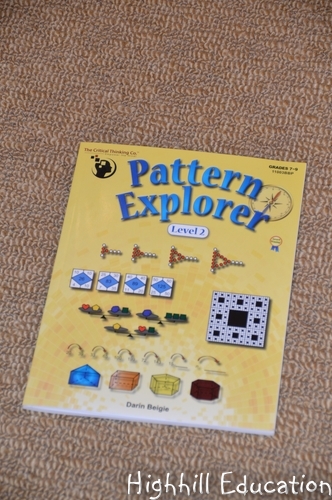
Pattern Explorer is one workbook, from The Critical Thinking Company While their other workbooks were equally engaging, I felt this one was the most appropriate level for my kids. Their workbooks are unique because they are designed to teach kids how to think. This one really works! I would recommend it as well as trying others.

Pattern Explorer comes in Levels 1 and 2. The Level 2 book pictured here is geared towards students studying pre-algebra or algebra. Each page contains several picture problems such as the one shown below. The top problem on the left shows a series of figures containing solid and transparent circles. The student is asked how many shaded and total circles appear in later stages of the series.

This may seem like quite a difficult question, but the table below the figures assists the students in finding the answer by helping to recognize patterns. Once the table is completed it becomes much easier to see how the number of circles in later figures is determined.


The page on the right above shows a different type of problem in the book. The balance problem works a little like solving a algebraic problem in which you can divide both sides by the same number, or subtract the same number from both sides. For example, the top problem asks how many diamonds will balance a pentagon. One pentagon sits on the top left scale balancing four triangles. Two triangles balance three diamonds on the other scale. To solve the problem, students must figure out how the different shapes relate to each other. Students can arrive at the same answer thinking about the problem in different ways.

In addition to these two types of problems, the book contains sequence problems, function problems and number problems all designed to teach kids to think. As a child I was always good at math, and now I have kids who are good at math. These books are excellent for kids excelling in math, but would also be good for those struggling as they approach problems in a pictorial way that appeals to the brain in a different way.

Life of Fred English and Grammar

Did you know there are Life of Fred English books?


The creator of Life of Fred is a retired high school math teacher who entertains students while doing an excellent job teaching the application of math. Unlike a typical math textbook, the books require little "kill and drill" problem work.

In the language art series, five year old math professor Fred, travels to Australia and ends up teaching language arts. In the same way the math books teach application of concepts, the language arts series aims to teach the application of grammar.

I worked through the series of four books over a period of about six months with my fifth and eighth grader who have a good background in creative writing and some knowledge of the parts of speech. We found the books entertaining and a good overview of English and grammar.

Because language arts does not naturally build upon itself like math, we found it difficult to retain all of the concepts presented in the books. Therefore, I would recommend working through these books as a review or as a tangent to other language arts lessons. They are worth while, but I would not rely on them as the sole method for learning literature and grammar concepts.

Firekeeper's Son

Set in Korea, The Firekeeper's Son is a fictional story based in history.


Long before telephone communication and the internet, the Koreans used signal fires to warn the king of a pending attack. In case of attack, enemies were most likely to arrive by sea. Therefore, the firekeeper living closest to the sea would light a fire every night to signal he did not see enemy soldiers. There were a series of firekeepers between the sea and the palace, and it was each firekeeper's job to light a fire after ensuring the fire in his line of sight was burning. If ever a fire was not lit, it was a sign of trouble.

Firekeepers tended to come from the same family. In The Firekeeper's Son, one night the fire didn't burn as usual. When the son went to investigate, he found the fire should have been lit and made sure the job was completed proving himself to be a qualified firekeeper.

This tale of courage not only teaches children about a small part of Korean history, but inspires. When kids hear tales of children taking responsibility it empowers them to do the same. I recommend this picture book for kids K-4th grade.

Johnny's Jelly Bean Tacos - Book Release

My husband wrote a book and my daughters and I illustrated it! Johnny's Jelly Bean Tacos


I'm so excited to tell you about our second product from Highhill Educational Supplies, but first let me tell you about the author.


Jeff Norkoli is an informed citizen who has learned to gather information from a wide variety of news sources and thereby think for himself. Being aware of issues in the country is a passion of his, and living overseas in Europe for six years has given him a unique perspective. As a homeschooling father since 2007, he has learned to appreciate the value of a great story.

He holds degrees in both civil engineering and computer science. Throughout his career he has continuously been given tasks which include writing because his co-workers..... (didn’t want to do it)…. discovered his gift of word smithing. 

Long before becoming a homeschooling father, his own father shared with Jeff his talent for creativity with words often writing poems for birthdays and other special occasions. Jeff enjoyed listening to his father’s ballads and inherited his ability to naturally create them. His talent for writing coupled with his interest for educating children in an entertaining way inspired him to write this children’s book.


With sales down at his taco restaurant, Johnny Van Socken invents a new delicacy that becomes an instant success: jelly bean tacos! Unfortunately for Johnny, his success poses a threat to some of the local business owners. When the other business owners convince the local government to pass rules to control the sale of jelly bean tacos, Johnny stands up to protect his rights as a businessman, as well as the rights of his customers.

Johnny's Jelly Bean Tacos is written in verse and perfect for kids ages 4-10. The story introduces kids to the concept of government protectionism without ever mentioning the phrase. Like the card game Speed! which is truly a game, Johnny's Jelly Bean Tacos is truly an entertaining book. Although kids will come away with an understanding of protectionism, this is not a lesson in disguise. It is a great story!

The Giver

 What does a perfect world look like to you? Would you like to live in a place with no pain or fighting? Would you like to live in a place where each person works in their ideal job and where nobody suffers from hunger?

 The Giver by Lois Lowry tells a strange story of a utopian world. All the people are happy and just go about their lives questioning nothing. What they don't understand is what they have given up to live in this ideal world.... Free choice and so much more.... After all, their ideal world was created by their ancestors many generations ago.


This book is an excellent read for children 11 years old and up as reading it will invoke questions of personal beliefs and philosophy.

Bridge Unit Study - Lesson 7: Bridge Design

My son designed several bridges.


What type of bridge would you build across a busy shipping waterway? How about over a deep ravine?


The book Bridges: Amazing Structures to Design Build and Test discussed advantages and disadvantages of many types of bridges including beam, arch, suspension, cantilever, draw, and hanging. It also addressed how the loads are carried, options for materials and brief changes throughout history.


What I really liked was the challenges the author posed to readers. Several times, kids were given a set of requirements and asked to design a bridge to meet those requirements. Each time my son was eager to design a bridge. Well he is far from an expert bridge designer, these questions enabled him to think about what he would do.


Programming for Kids

My son is learning to program using Javascript.

After many years learning the basics of computer programming with Scratch, my son is learning his first programming language. Javascript. His last project on Scratch was a Mrs. PacMan game. After working many weeks on his design, which included downloading and reading the code of a similar game, he was ready to move on. Well, actually he wasn't. He wanted to make his game perfect which is a common trait of a computer programmer and engineer, but we told he he was ready to level up, or graduate if you will, to bigger and better things.

We found the key in the book Javascript for Kids. After reading the first chapter I was hooked. The author explained that in reality, computers were actually very dumb. They can after all, do only what humans have told them to do. It made perfect sense and made me laugh.


Then we moved on. This book is perfect because it starts with the very basics and builds from there.  In discussing variables, the first main topic, the difference between numbers, strings and booleans is explained. Short program examples are given and the kids can type them right into the browser to see how it works. Chapters also contain challenge questions designed to get kids creating their own programs using the tools they learned.

We covered about a chapter per week and by the end my son was on a roll.


The Tuttle Twins

The Tuttle Twins is a new series of books to help children learn about complex political and economic concepts.

There are currently five books in the series targeted at children ages 6-13. Each 50 page book focuses on a government policy or concept that has real life consequences for all citizens.

The Tuttle Twins and the Creature from Jekyll Island
The Tuttle Twins Learn about the Law
The Tuttle Twins and the Miraculous Pencil
The Tuttle Twins and the Food Truck Fiasco
The Tuttle Twins and the Road to Surfdom

For example, the Food Truck Fiasco explores protectionist laws designed to prevent competition when the owner of a restaurant convinces the city to pass laws that make it difficult for food truck vendors to continue to compete. Eminent Domain, Free Market, and concepts of liberty are among those introduced.

Because these books are targeted at young children, they are brief and the language is simple. The story line does a good job of introducing complex topics but doesn't go into a lot of detail, and does little to address opposing view points. Overall, they are a descent introduction especially if the parents encourage further discussion.

An unrelated follow on series that continues to explore similar complex topics is Richard Maybury Uncle Eric Books. The Uncle Eric books are better for children a little older. (Ages 12-18)

* I did not receive any compensation for this recommendation. I'm just a homeschooling mom who has found many products that I like. If you're interested in the products I recommend on this blog I want to make it easy for you to find them. 
 ** I am an Amazon associate and receive a small portion of the sales on orders made after clicking in from this site, which I promptly spend on homeschooling books and supplies for my children.

Best International Historical Fiction

By reading my daughter and I have studied many historical topics. Although we often read historical fiction in connection with our history studies, it happens to be a favorite genre of both my daughter and myself. These books are great reads for upper elementary and middle school students, and are excellent for sparking interest in historical topics.


Snow Treasure tells the story of school children in the north who save the town's treasure from Nazi's during World War II occupation.


The Well of Sacrifice
Red Sand Blue Sky (Girls First!)

The Endless Steppe: Growing Up in Siberia
During World War II a family is set to Siberia. This is the story of how they adjust to this harsh land during hostile times.

Viking Adventure
The Vikings discovered America long before Columbus. In this story, a young Viking boy leaves home seeking adventure. Trained for a life of exploration, he is part of a voyage to Vineland.

The Apprentice

The Children of the New Forest
During the time the British kicked out the king, a family of soldier's children are orphaned and go into hiding. Their lives change dramatically as they learn to hunt, cook and care for themselves.

Trapped by the Ice!: Shackleton's Amazing Antarctic Adventure - Shackleton, an explorer, lead an expedition to the South Pole. During his journey the crew suffered many hardships but were able to overcome due to the outstanding leadership of Shackleton.


* I did not receive any compensation for this recommendation. I'm just a homeschooling mom who has found many products that I like. If you're interested in the products I recommend on this blog I want to make it easy for you to find them. 
** I am an Amazon associate and receive a small portion of the sales on orders made after clicking in from this site, which I promptly spend on homeschooling books and supplies for my children.

Revolutionary War Books for Kids

The Revolutionary period of American history is filled with stories of heroes who fought in vastly different ways for the freedom of the coming nation. Reading children's picture books made up a significant portion of our lesson plan for learning about this period. In addition to picture books we incorporated longer chapter books. Our favorites were the type that taught through story. LIVING BOOKS! Here's a list of books and videos we used to study American Revolutionary War History.


Benjamin Franklin

Grade 1st - 4th
Benjamin Franklin by D'Aulaire
What's the Big Idea Ben Franklin by Jean Fritz

Grade 5th - 8th
Ben and Me: An Astonishing Life of Benjamin Franklin by His Good Mouse Amos
Poor Richard by James Daughterty

High School
Autobiography of Benjamin Franklin

George Washington

Grade 1st - 4th
George Washington by D'Aulaire 
George Washington's Breakfast by Jean Fritz
George Washington's Mother by Jean Fritz


American Revolution

Grade 1st - 4th
Liberty's Kids Video Series Episodes 1-40
USKids History: Book of the American Revolution
The American Revolution for Kids: A History with 21 Activities
Sam the Minuteman (I Can Read Book 3)
18 Penny Goose
And Then What Happened Paul Revere? by Jean Fritz
Why Don't You Get a Horse, Sam Adams? by Jean Fritz

Grade 5th - 8th
Sarah Bishop

Constitution

Grade 1st - 4th
Where was Patrick Henry on the 29th of May? by Jean Fritz
The Great Little Madison by Jean Fritz
Will You Sign Here John Hancock? by Jean Fritz
 
Grade 5th - 8th
A More Perfect Union: The Story of Our Constitution

High School
The Freedom Answer Book: How the Government Is Taking Away Your Constitutional Freedoms
The Five Thousand Year Leap: 28 Great Ideas That Changed the World (Revised 30 Year Anniversary Edition)

Check out these great blog hops for more educational activity ideas. 

Liberty's Kids - American History Videos for Kids

Liberty's Kids is an animated series for kids which covers the American Revolution.


It begins with the Boston Tea Party and ends with We the People. Each episode in the 40 episode series covers a major event of the Revolutionary time period such as The Battle of Bunker Hill, Paul Revere's Ride and The Intolerable Acts. The 20 minute long episodes are perfect for short attention spans and an easy introduction to American History.

William J. Bennett's Children's Book of America and Jean Fritz's American History Short Narrative Stories are nice companions for the videos.


Check out these great blog hops for more educational activity ideas. 

American Revolution for Kids: Soldiers

We read a few books about soldiers and made a tri-cornered hat.

The British soldiers wore red because it disguised the color of blood. To Americans they were known as Lobsterbacks or Red Coats. As professional soldiers, they were sent to America to keep law and order and enforce British rules. On top of being soldiers, they often accepted work in America to supplement their income. Therefore, they were liked by some and loathed by others. After all the country was at war and Americans were not all on the same side.

As tensions rose, they were sometimes taunted and teased in public. These incidents led to some of the most well known scuffles of the war including the Boston Massacre. As the war continued, more and more soldiers were sent to America. There were too many to house in British facilities, therefore many were boarded with families in private homes. To Americans rebelling against British rule, this was a gross injustice.

When the founders wrote the Declaration of Independence they wrote up a list of complaints against the British Government. One complaint on the list was the required quartering of British Soldiers at the expense of the Colonists. The book, The 18 Penny Goose, illustrates this complaint through the eyes of a child. When British soldiers came through Letty's village, she was worried about her ducks and wrote the soldiers a note. This easy reader is perfect for kids ages 5-11.

Contrary to the British, the American soldiers were not professional fighters. Instead, they were farmers, merchants and craftsmen. They worked their day jobs and then grabbed their muskets, scythes or other weapons and went off to defend themselves against tyranny. Since they could be ready to fight at a moments notice they were known as minutemen.

The book Sam the Minuteman tells the story of how one minuteman and his son were involved in the first battle of the Revolutionary War.

After reading a little about American and British soldiers my daughter made a tri-corner hat. The basic idea was to cover a piece of cardboard in the shape of a triangle with a circle in the middle for the head with fabric.

 First she made a band of white fabric to fit her head. Next she cut out a piece of cardboard with a circle hole in the center for her head.

 Then she cut a large circle of fabric. She draped the fabric over her head and then placed the cardboard overtop.

 The loose fabric was brought over the cardboard and stitched into place. Then she added a few feathers.


For more American History book/project ideas, please see our History Page.
Check out these great blog hops for more educational activity ideas. 

George Washington and John Hancock

We read about John Hancock, George Washington and made Liberty Punch.

John Hancock

Everyone knows who George Washington was, but what do you know about John Hancock? He was the first person to sign the Declaration of Independence, but what was his role in the American Revolution?

John Hancock inherited a shipping company and was therefore one of the wealthiest residents of Massachusetts. He used much of his personal wealth in the fight for American independence. Because the British were placing taxes on imports to America, he became a smuggler during the days of the American Revolution.

Reading the book Will You Sign Here John Hancock? by Jean Fritz we learned that John Hancock wanted everyone to like him. He was a great host to both influential Americans and foreign dignitaries. He served as a member of the Continental Congress and was governor of Massachusetts.

George Washington

There are many biographies about George Washington, but sifting through them all we were able to narrow them down to three picture book biographies perfect for elementary age children.


We especially enjoyed the two Jean Fritz biographies. In George Washington's Breakfast, a young boy goes on a search to determine what George Washington may have eaten. After searching libraries, museums and his own attic he does arrive at an answer. Then he begins to wonder about lunch. George Washington's Mother was equally entertaining. How would you feel if your son wanted to join the Navy or the Army? What would you do if he decided to run off to fight a war? This book makes George Washington's Mother into a human we can relate to while enabling children to learn about several other reasons George Washington is a hero of America's past.

Liberty Punch

Along with reading biographies of famous Americans, we referenced some of the activities from The American Revolution for Kids. My daughter made Liberty Punch to celebrate American freedom.

The simple recipe mixed raspberry tea, ginger ale and mint leaves. She liked it so much she made it twice.

Check out these great blog hops for more educational activity ideas.

James Madison and Patrick Henry - Kids Rights

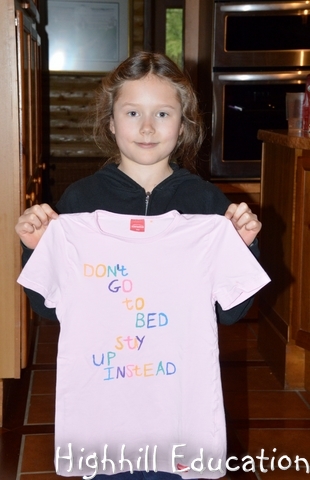
James Madison and Patrick Henry were two great Americans who stood up for American rights, but they were extreme opposites. We read about these two leaders then my daughter made a t-shirt to help fight for a kid right.

James Madison was a quiet, small man with a history of illness. Reading and learning were great passions of his. He was extremely intelligent and a great thinker. Perhaps a little shy, he did not enjoy speaking to a audience, but did so when he felt it was absolutely necessary. He was a framer of the Constitution and became president of the United States.


Patrick Henry, on the other hand, was a tall, out-spoken man who liked being the center of attention. He began his oratory career arguing in a courthouse and continued making long speeches as a member of the Virginia House of Burgess. By some peers he was seen as a great speaker who sometimes lacked the intelligence or thought behind his words.

Both Patrick and James were opposed to taxes levied on the colonies by the British, but that is the major extent of their agreement. James Madison believed in the Constitution and worked to convince other colonial leaders of its necessity. Conversely, Patrick Henry thought each state should be independent and any document linking the colonies needed, at minimum, a bill of rights.

As it turned out, Madison and those in favor of a constitution won out. After many long months of discussion, the Constitution was ratified without a bill of rights.

Kids Rights

Propaganda, protests and public demonstrations are major ways people fight for change. I asked my daughter to think about the rights she felt she deserved. When discussing rights it is important to note that a "right" should not indirectly enslave another person. Therefore, if my daughter said it was her right to be served dinner every night I would have argued with her because being served would have required me or another individual to do the serving. In contrast, it would have been alright if she declared it her right to choose whether or not she ate dinner each night. Granted, this example could lead to discussions of charity, mother's duty, and people facing starvation, but the point was to discuss the difference between a right and a desire. 

Rights are tricky to understand and this is one area in which we as a nation have currently lost our way. Studying American history gives us a great opportunity to discuss the difference between a right and a privilege.

Therefore, after reading about how these early American patriots fought for rights they felt they deserved, my daughter made a t-shirt to help her fight for a right she felt she deserved.

She used fabric markers to write "Don't go to bed. Stay up instead!" - I guess she feels she is old enough to determine her own bedtime.......... another topic for discussion.

Check out these great blog hops for more educational activity ideas. 

Related Posts Plugin for WordPress, Blogger...