The Tuttle Twins is a new series of books to help children learn about complex political and economic concepts.
There are currently five books in the series targeted at children ages 6-13. Each 50 page book focuses on a government policy or concept that has real life consequences for all citizens.
For example, the Food Truck Fiasco explores protectionist laws designed to prevent competition when the owner of a restaurant convinces the city to pass laws that make it difficult for food truck vendors to continue to compete. Eminent Domain, Free Market, and concepts of liberty are among those introduced.
Because these books are targeted at young children, they are brief and the language is simple. The story line does a good job of introducing complex topics but doesn't go into a lot of detail, and does little to address opposing view points. Overall, they are a descent introduction especially if the parents encourage further discussion.
An unrelated follow on series that continues to explore similar complex topics is Richard Maybury Uncle Eric Books. The Uncle Eric books are better for children a little older. (Ages 12-18)
* I did not receive any compensation
for this recommendation. I'm just a homeschooling mom who has found many
products that I like. If you're interested in the products I recommend
on this blog I want to make it easy for you to find them. ** I am an Amazon associate and
receive a small portion of the sales on orders made after clicking in
from this site, which I promptly spend on homeschooling books and
supplies for my children.
We all want our children to grow up to be financially independent adults. Therefore reading elementary aged kids a few books showing examples of financial responsibility is a fun place to start.
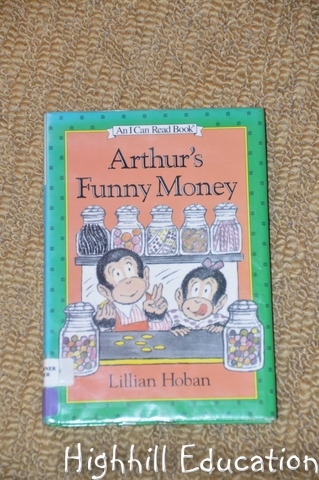
Arthur's Funny Money - When children work hard to get something they want they learn lessons that will last a lifetime. This book is a fun place to start teaching kids about the importance of money.
Arthur's Pet Business - Responsibility is a big step in teaching kids to be financially stable. Even very young children will be able to relate to Arthur when he puts together a pet business to earn money.
As Right As Right Can Be - How perfect is your appearance? When you purchase a new dress do you also need new shoes? This book shows how that type of thinking can get out of control.
Check out these great blog hops for more educational activity ideas.
The more I learn about wars in history, the more I see a repeated story.
I'm not a fan of children's story books that have a bully. The bullied child fights back and eventually the situation is resolved. In the end, the bullied child is happy. There are numerous books with this storyline and conflict. They only differ by the way the conflict is varied. Sometimes the bully steals lunch money, sometimes the bully pokes fun at clothing. Regardless, the story is the same. It's predictable.
Just like this storybook plot, war stories are repetitive. In each case, the leaders present an issue to the public that evokes
lots of emotion. The more the public hears the emotional story, the more
they support the war effort. However, in most cases, the public is
completely unaware of the true motive behind the war. MONEY! In almost every case the story is the same. The true reason for war is money.
I'm not a history expert by any means. In fact, I didn't do that great in history class in either high school or college. However, for the past seven years I have been homeschooling my children. Each year we study history. For the past five years we have selected one cultural and time period of history and learned all about it. We have covered Mesopotamia, Greece, Rome, Persia, Celts, Vikings, China, Scythians, Middle Ages, Renaissance and now we're into American History. I'm amazed how frequently the war story repeats itself. Here are a few examples:
War - Public Support Gained of Issue - True reason
Roman Empire
The Romans fought many wars to expand their empire. The public supported the wars because they believed their enemies were barbarians and uncivilized people which they could teach and reform. However, the true reason for the wars was money. Each time the empire conquered new territory, slaves were taken. In ancient Rome slaves meant money.
Middle Ages (Crusades)
During the Middle Ages the Crusades were supposedly about religion, but in actuality they were all about money. The public felt they had a right to the holy land and that it was their duty to take the land from the non-believers. If they fought for the holy land they believed their sins would be forgiven and they would be rewarded in heaven. However, throughout the conquest, religious leaders with public support not only plundered wealthy cities, they also began services which resulted in huge economic gains. Groups of knights formed which became wealthy by offering protection to travelers. The knights enjoyed a tax exempt status which greatly contributed to their wealth. In addition, they offered travelers high-interest rate loans. This series of wars fought in the name of religion, was really about money.
Mexican-American War
In the early days of America President Polk hoped to achieve greater economic wealth by acquiring all of the land between the two oceans. However, Polk gained public support for the war by telling the people that Mexico fired on American soldiers on American soil. In actuality, the American soldiers who were fired upon were on land Mexico rightly believed belonged to them. Once again, public support was created for the war under the guise of righteousness when the true reason for the war was all about money.
Civil War
In recent weeks I've been reading about the Civil War. This most deadly of all past American Wars was fought in the name of slavery, when again the true motivation was money. The Lincoln administration wanted a big central government in which favors could be given to friends and big businessmen. Most of the favors were being received by people in the north. In the south, taxes were being raised on imports in order to force the people to purchase goods from the north. Because the south was opposed to these taxes, the north ended up closing ports in the south. This economic dispute lead to states in the south wanting to leave the union and ultimately war. The war fought in the name of slavery, was actually all about money.
Present
So now fast forward to present times. Why are we fighting in the middle east? I've heard women in those countries are treated poorly. I've heard we're scared those countries have weapons of mass destruction. Well I know they have oil. Oil represents money. I ask you........ do you think the war story has changed?
If you have any good books to recommend on this topic please leave me a comment.
Stories involving economics put the topic into context and make concepts easy to understand and remember.
Supply and demand are related. When one goes up the other goes down. In college, I remember being confused by the countless number of similar graphs illustrating this concept. Despite the fact that the concept is simple, when put into word problems in exam format I was more confused than ever. Like history, I'm finding economics much simpler and enjoyable the second time around.
One excellent source of economics concepts are the books written in story format by Russell Roberts.
The Choice by Russell Roberts tells the story of a business owner who travels through time to see how his company and America change after government officials pass laws limiting trade. Most people think we as Americans are better off when we purchase products "Made in America". While the people who work for the companies producing those products definitely benefit, the rest of America may or may not. The book clearly explains this concept by exploring a series of questions asked by Ed Johnson, the owner of a television set company and David Ricardo, his time traveling tour guide.
The Price of Everything by Russell Roberts begins when a large store raises their prices following a natural disaster. Again, the general thought is the store is price gauging and hurting the public. This book pokes holes in that argument by explaining how high prices make people think twice about what they really need. In addition, it further explores concepts such as supply and demand, and specialization, all in story format.
These books make economics an exciting topic for discussion by putting the topic into context. I much prefer them to the dry textbooks I attempted to learn from in my younger days. :)
Check out these great blog hops for more educational activity ideas.
The single best resource I have found which combines the subjects of history, economics and government are the Uncle Eric books written for children by Richard Maybury.
Reading this series teaches kids how to make decisions that will affect their lives in a positive way. I loved sections of Personal, Career and Financial Security which discussed the benefits of exposure to a variety of experiences such as, school plays and clubs, sports teams and work experience. Teens have the opportunities to learn different skills from all of these activities. Whether training a new employee, to working with another student to memorize lines, to speaking in front of a large audience, to learning to be responsible and show up on-time each day, kids will benefit.
The book Liberal? Conservative? or Confused? explained how different parties try to control different aspects of our lives which they believe will benefit society. What is a liberal and why is the term so confusing? This book explains.
Since I noticed many parallels between Ancient Rome and America a few years ago when we studied the Roman Empire, I was excited to read Ancient Rome: How It Affects You Today. There were three distinct eras of Roman history. There was the Roman Monarchy, The Roman Republic and then the Roman Empire. The book explains how the government changed during each era and how it effected the people. These changes are evident today in American history, but on a much accelerated basis.
Overall, I would highly recommend this series of books as part of a connected study of history, government and economics.
Check out these great blog hops for more educational activity ideas.
As a high school student, my daughter has been studying history, government and economics.
Did you know it was illegal for Americans to own gold following the great depression?
If a friend borrowing your house, told you that when you wanted it back they would give you one room instead of the entire house because they had traded the rest of the house for vacations and other things they wanted, you would probably be pretty upset. Your friend didn't keep up his end of the contract and defaulted on the debt to you. There could be multiple reasons for your friend's actions, but the bottom line is that you are out most of a house. Fortunately you were lucky enough to get a room out of the deal.
This may sound quite far fetched, but it is almost exactly what happened in 1971 when the United States was taken off the gold standard. The formal word for being taken off the gold standard is a devaluation of currency. In code, the 1971 devaluation meant the government defaulted on its debts, and instead of owing gold, Americans owned paper. America being taken off the gold standard was a lot like the friend borrowing the house.
Concepts of inflation, deflation, devaluation, depression and recession are difficult to understand when watching and reading about current events in the media. The media has us so confused that we think there is no way we could ever understand these concepts. The reason is they are not pure economic concepts we are trying to understand. They are economic concepts mixed with government policy. The government regulation of currency makes it behave in an unpredictable manner which even financial analysts have difficulty understanding.
This correlation of government, economics and history is a subject my husband and I have been working to understand and find resources to teach the concepts to our children. Fortunately, there are resources available that can help untangle the confusion.
The book How to Profit from the Coming Devaluation is an economics book first published in 1970. The author, Harry Browne, predicted the devaluation of 1971 and the following recession. Not being an economics scholar, I loved this book because it explained how the government's involvement effects conditions we see and feel in our everyday lives. In addition, it teaches how to prepare for a recession before it happens.
My husband, daughter and myself enjoyed reading this book and now feel we have a much better understanding of how governments use inflation, deflation and devaluation to control the money supply. We all know that money doesn't grow on trees, but sometimes it seems like the government believes it does. With skyrocketing national debt we wonder how and when this will all end. How to Profit from the Coming Devaluation is a simple book to read that really helped me to gain valuable knowledge and prepare for the future.
This year my high-school aged daughter studied government, economics and history.
Because there is so much correlation between the
three subjects it's difficult not to study them together. Over the next several weeks, I will discuss the
resources we used covering these subjects at the
high school level.
Before beginning this in-depth government, economic, history study we spent a lot of time studying history. In fact, history has been covered in some form each year for at least six years. In addition, the basics of government were well understood before beginning this unit. This government course is not a course to learn about the three branches of government and how many representatives there are, but rather a course to understand how the government works and has operated throughout history. Different administrations have enacted policies which continue to affect us today. Many political decisions are based upon power and economics. To truly understand government and it's impact upon us, it is important to understand how we got to where we are. Hence, history, government and economics can and should be studied in conjunction.
There is no better place to start than the beginning of American Government as we know it today - The Constitution. The book Five Thousand Year Leap does just that. It explains the reasoning behind the Constitution in a set of principles used to define the Constitution such as Principle 7: The proper role of government is to protect equal rights, not provide equal things., Principle 1: The only reliable basis for sound government and just human relations is Natural Law, and Principle 27: The burden of debt is as destructive to freedom as subjugation by conquest. I highly recommend this book as a great place to study government once the basics are understood.
Please join me each week as we dig deeper into these three intertwined complicated subjects to shed light on them and make them easy enough so that a high school student can understand.
Check out these great blog hops for more educational activity ideas.
I began reading Life of Fred: Pre-Algebra 2 With Economics with my daughter as part of her math curriculum, but quickly discovered the book is even better for teaching kids the basics of economics.
When the main character Fred discovered he could purchase a case of hot dogs to sell at his hot dog stand for $90 from "Freedonia, a floating island nation in the middle of the Atlantic," he was excited to bring down his prices and increase his profits. His former supplier, Whole Dog, who sold hot dogs for $100/case was less thrilled. The author explained that Whole Dog had three choices for dealing with the problem - lower their prices, use violence, or send lobbyists to the senator. Their strategy of sending lobbyists worked. They provided the senator lots of votes and tuition for his daughter's education, and he passed a law which a tariff of $40/case was levied on hot dogs. The story didn't end there. It continued with discussing who won and lost from the tariff and how decisions affect society as a whole.
Other topics such as how competition, using technology to replace people, and price fixing effects prices and society are discussed.Tulip mania, what materials work well for money, and the rule of 72 (used for predicting how long it will take for sales to double) are covered as well.
This book is filled with examples to explain how economics really works. America was formed around the principals in the constitution and grew to be a great and powerful nation because of capitalism. It's sometimes difficult to understand how decisions made which seem to protect the interests of citizens can actually end up having the opposite effects. This book does a wonderful job of explaining the long term effects of these decisions and I recommend it for middle and high school students studying government, economics or pre-algebra.
* I did not receive any compensation
for this recommendation. I'm just a homeschooling mom who has found
many products that I like. If you're interested in the products I
recommend on this blog I want to make it easy for you to find them. ** I am an Amazon associate and
receive a small portion of the sales on orders made after clicking in
from this site, which I promptly spend on homeschooling books and
supplies for my children.
Middle Ages Unit Study
Week 17: We held a middle ages market.
Many family names came from crafts practiced during the middle ages; bakers, brewers, millers, shoemakers and thatchers. Sometimes the names were passed down through a female, but they were slightly altered; female brewers were known as brewsters, female bakers were known as baxters, and female weavers were known as spinsters or websters.
Due to conflicts between craftsmen and city officials over money, guilds were formed. The city officials charged fees for selling wares and naturally wanted the largest amount possible. By banding together in guilds, craftsmen could make demands of their own resulting in lower fees. These traditions live on today in labor unions and vendor permits.
If a large enough group of merchants and craftsmen joined together, they could purchase a Free Borough. In other words, they could form their own city and create their own regulations free from the rules of a king. The Republic of Venice is a very successful example of a free Borough.
During the middle ages, markets were often held as special events. Grand markets held once per year share a likeness with state fairs celebrated annually in the United States. Goods from around the known world and entertainment filled the day.
For our medieval market, the kids were divided into seven groups.
Candlemakers
Brewers who sold pretzels and beer (root beer of course)
Silk Traders (Foreign Merchants)
Shoemakers
Smiths
Spice Vendors (Foreign Merchants)
Entertainers
After setting up their booths each group was given a few coins to begin with. Next the lady of the house visited each booth to collect a two pence fee for selling (foreign merchants had to pay three pence). Since most booths had more than one child, they took turns selling and shopping. Coins were used and items were bartered in trade. Entertainers were paid when they were entertaining and obnoxious cries by those selling wares were fined. At one point a thief (mom) was caught steeling from some of the vendors. She was sent to the Tower of London where she remains today awaiting her punishment.
This activity was awesome! The kids loved it and begged for more. By participating they gained a better understanding of the types of products available at medieval markets, practiced counting money, and worked on their social skills and powers of persuasion. Thank you April for putting it together:)
Middle Ages Unit Study Week 14: We learned about the Venetian Republic and played an economics game since the Venetians were mostly merchants.
While the people of modern day France and Germany lived in villages
ruled by kings and lords during the middle ages, the Republic of Venice
prospered. Built on a lagoon because it was a safe haven away from the
Huns, the Venetians lived for trade. Many of the residents were
merchants who traveled to Constantinople and other ports on the
Mediterranean Sea.
Venetian Republic
During the 12th century, the people of
Constantinople grew fearful of the growing power of the Venetian
Republic and imprisoned Venetians living in their city. This act lead to
the retaliation of Venice during the 4th Crusade. Constantinople was so
badly destroyed by the crusaders that it was a factor in the eventual
downfall of the city.
As for Venice, new trade routes discovered by Vasco de Gama which bypassed Venice had serious consequences. Later, wars with the Turks and and the plague weakened the empire until it was finally crushed by Napoleon. Although much of the documentary Francesco's Venice is appropriate for children, there are some parts that are definitely not. Please preview this before watching with children.
Marco Polo came from Venice, and the Republic of Venice was a great empire which is easy to cover with children in conjunction with a Marco Polo study. In addition to the video, we read two stories to learn more about Venice.
My 12 year old daughter read the book Daughter of Venice which told the story of a girl from a large family living in Venice during the middle ages. Based on the customs of the time, it was her fate to be married or join a convent. She wasn't allowed to get sunburned, she played the violin, her younger sister played the harpsichord and three of her sisters died of the plague. By reading this book she learned much about the way families lived in Venice during the 14th century.
The Lion of St. Mark tells the story of the son of a British merchant living in Venice during the 14th century. When he agrees to take a fare and taxi a mysterious passenger in his new gondola, he discovers a conspiracy. He makes connections with an influential merchant as the villain attempts to kidnap the merchant's two young daughters. My daughter enjoyed this book so much I caught her reading ahead. I read this with my 12 year old daughter, and would recommend this book for older children.
Economics Game
Since Venice was built on trade, we played an economics game.
All that's required to play Snakes and Doughnuts
is some dough, stop-watch and pencil and paper. Through a series of
one-minute rounds kids learn about supply and demand, the value of
working together and how trade can increase value.
With the goal of earning as many points as possible, kids are given one minute to create as many snakes and donuts as possible. Snakes are worth 1 point and donuts are worth 2. Both must be as long as a pencil.
At the end of each round points are totaled and the round is repeated until students are satisfied with their productivity. This is evident as the child's point value for the round levels off.
Once kids understand how to gain as many points as possible the rules are changed.
Rounds are altered in the following ways; the point value for donuts increases to 10 points, the kids work together, 1/2 of the dough is removed, different colors are assigned different point values, each child earns a different amount of points for particular colors and trading with other kids is introduced.
Raki's Rad Resources has a link to a file with rules laid out for seven different rounds.
My children, ages 6, 10 and 12 all were able to easily participate in this activity. Incidentally, as the point values for the rounds change, the activity serves as an excellent review of skip-counting.
For more hands-on activities focusing on history, please visit our History page.
* I did not receive any compensation for this recommendation. I'm just a homeschooling mom who has found many products that I like. If you're interested in the products I recommend on this blog I want to make it easy for you to find them. ** I am an Amazon associate and receive a small portion of the sales on orders made after clicking in from this site, which I promptly spend on homeschooling books and supplies for my children.







 is a 30 minute video the kids really enjoyed. Some of our history co-op friends enjoyed
  by Russell Freedman. All of my kids preferred the book
  as it was quite a bit shorter and more interesting to them.
 which told the story of a girl from a large family living in Venice during the middle ages. Based on the customs of the time, it was her fate to be married or join a convent. She wasn't allowed to get sunburned, she played the violin, her younger sister played the harpsichord and three of her sisters died of the plague. By reading this book she learned much about the way families lived in Venice during the 14th century.
 tells the story of the son of a British merchant living in Venice during the 14th century. When he agrees to take a fare and taxi a mysterious passenger in his new gondola, he discovers a conspiracy. He makes connections with an influential merchant as the villain attempts to kidnap the merchant's two young daughters. My daughter enjoyed this book so much I caught her reading ahead. I read this with my 12 year old daughter, and would recommend this book for older children.


