Showing posts with label Day Trip from Ramstein. Show all posts

Geology Unit Study - Gemstones

Week 3: We went mining for rocks and minerals and visited a historic mill where minerals were polished and turned into gemstones.

Gemstones are rocks or minerals which have been cut and polished. Many gemstones are used for jewelry and the rarer the mineral, the more valuable the gem.

Like miners, historic gem polishers had short life-spans. The toxic dust breathed while polishing usually lead to lung disease. Gem polishers worked on their stomachs using their feet to push the stone into the grinding wheel.


As technology improved, gem polishers began to work in an upright position, but continued to breath toxic dust.

Many minerals drastically change their appearance when polished like the fluorite shown in the above photo.

Digging for Gemstones in Idar-Oberstein
After learning about gemstones and polishing techniques at the Idar-Oberstein, Germany Historic Mill, we spent two hours digging for precious stones. The field was fortified with rocks and minerals from around the world, so a successful dig was guaranteed.

Searching for stones in newly turned over ground

Digging with a pick-ax

Just getting started

Sifting dirt for stones

Cleaning stones in the wash basin

Scrubbing off the mud

Two hours of digging is back breaking difficult work whether the field is fortified or not. We were glad this was a field trip and not a regular job. Often stones under the ground all looked alike. They were not obviously good finds until they were cleaned.

Digging in this fortified field was a bit expensive, but was totally worth it. We gained an appreciation of what easy mining is like and began a diversified rock collection. After returning home we spent several afternoons clean rocks and trying to identify them.

Middle Ages Unit Study - Castle Life

Middle Ages Unit Study
Week 18: We made castles from paper and cardboard.

Life in a medieval castle was not all fairy tale, fun and games. Castles were military fortresses that housed the lord and his family, soldiers and servants. During war times they were flooded with townspeople trying to escape danger.


 Although beautiful to look at, they were difficult to reach, cold and dark.

 Glass was expensive, so the tiny windows were closed tight with shutters.

Bathrooms were overhanging rooms inside the castle. A hole in the structure allowed waste to fall on the garden or moat below.

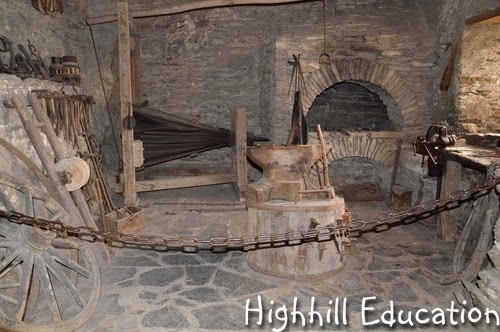
Many castles contained smithies. Although weapons could be created, they were more commonly used for horse shoes and nails.

Many lords were robber barrens who earned their money and status by taxing the local people and stopping river bound ships to collect tolls.

 Despite the rough hard life, there was time for feasts....

 with music,
and games.

After learning about castles, and castle life, we created paper/cardboard castles. The activity came from the Storm the Castle website where the free printouts can be downloaded.

 First the floor plan was glued to a sheet of cardboard.

 Next the buildings were cut from the paper and transferred to cardboard.

 The towers were colored and stood-up on the floor plan.

This activity was simple but excellent. It is good for three dimensional design visualization. Since kids can decorate their castles with paint, crayons or glitter its fun from a craft perspective too.

 Please come back next week for more middle age activities.

All of the castle photos above were taken at the Marksburg Castle near Koblenz, Germany which is a fantastic day trip from Ramstein.


Be sure to check out these blog hops for more great kid educational activities.

Schwarzenacker - Ancient Roman City - Homburg, Germany

The Roman Museum in Homburg, Germany was once a Celtic settlement and later a Roman settlement. During the early 1900's the settlement was rediscovered when construction uncovered many buried silver Roman coins. The coins were most likely buried when the Germans kicked the Romans out of the area, only to be left in the ground for over 1000 years.

Schwarzenacker was on two major cross routes between Trier, Strassbourg, Metz and the Rhine River. At one time the city was home to craftsmen, weavers, and doctors.

 
Today the museum is an active archaeological site.

Many of the underground structures contain oval shaped cutouts which were once used to display statues of the Roman Gods.

Much of the site lies buried beneath the ground.


Several structures have been reconstructed like this home.

Wall murals have been reconstructed in full color.

The basement area of homes usually contained a heat source and the floor was supported with pillars.

The windows contained bars to keep out unwanted guests.

This is the reconstruction of a temple.

This furniture is representative of furniture in a Roman home.

Many frescoes of Gods were brightly painted.

Notches in a stone structure were once used to support wooden beams on which upper floors were built.

The floor would be built on the wooden beams.

This stone hole in the ground is the remnant of a Roman refrigerator.

Waste water was directed out of the city through stone ditches narrow enough to step or leap over.


Astronomy Unit Study - Comets and Meteors

Week 4: We learned about comets and meteors and visited the Planetarium.

A comet is basically a dirty snowball that sometimes contains gas. A meteor is a rock in space that is less than a meter in diameter. A meteorite is a meteor that has passed through our atmosphere and is right here with us. An asteroid is the same as a meteor, but bigger. These words have baffled me as I never knew the differences between them.

We couldn't resist a trip to the Mannheim Planetarium to go with our astronomy studies. The show covered the birth of a universe, constellations, and how the sun travels across the sky. I highly recommend it for anyone living in the area.


Roman Forts - Saalburg

When the Roman Empire ruled forts were built all around the boarders. The Rhine and Danube Rivers were natural boundaries which required less monitoring, but the area between the rivers was known as the Limes and was marked with many forts. Although travel was open across the boundary soldiers monitored traffic much the same as a boarder crossing is monitored today.


Remains of many of the forts still exist today and they all are constructed using the same basic model with similar features. The Saalburg Fort in Bad Homburg, Germany has been rebuilt and is open to visitors.

Four nearly identical gates are located on the sides of the Fort.

Double ditches surrounded the fort for defensive purposes. Although they don't look difficult to penetrate, in former times they were constantly maintained by soldiers. The walls of the ditches were nearly vertical and they were filled with spiky logs and water. The trees surrounding the fort were cleared to allow soldiers to spot people approaching the fort.

Several wells were built at the fort.

The men slept in long barracks buildings.

Foot baths were created for washing feet and the water flowed in ditches.

The forts had center courtyards with a well in at least one corner.

Ceremonies such as retirements, assemblies and announcements took place in the main building of the fort.

Officers had nice living quarters complete with wall frescoes.

Outside the forts a cities sprang up. The villages supported the forts with hotels and shops. This is the remains of a thermal bath outside the fort boundary.

Roman Fort by Stephen Johnson explains forts and fort life in much more detail. After visiting, we browsed the book to further explain the fort.


* I did not receive any compensation for this recommendation. I'm just a homeschooling mom who has found many products that I like. If you're interested in the products I recommend on this blog I want to make it easy for you to find them. 
** I am an Amazon associate and receive a small portion of the sales on orders made after clicking in from this site, which I promptly spend on homeschooling books and supplies for my children.
Related Posts Plugin for WordPress, Blogger...